


The offshore yuan firmed to around 6.77 per dollar on Wednesday as investors assessed the latest inflation data and their implications for China’s economic outlook. Consumer inflation rose 1.2% annually in May 2026, slightly below expectations of 1.3%, indicating that weak household demand continued to offset inflationary pressures from higher global energy prices linked to the Middle East conflict. Meanwhile, producer prices climbed to 3.9% from 2.8% in April and marking the highest reading since July 2022. The increase extended the recovery from China’s long producer-price deflation period, driven largely by higher commodity and energy costs. While China has cushioned part of the energy shock through its strategic oil reserves and renewable energy capacity, persistent cost pressures could squeeze corporate profit margins. A broader pass-through to consumer prices could also erode household consumption, although weak domestic demand has so far limited such spillovers.

Euro: Safe haven appeal grows with structural boosters – BNP Paribas
BNP Paribas strategists argue that Europe is emerging as an alternative safe haven, with the Euro gaining ground as a global safe asset. They note that the European Central Bank’s (ECB) work highlights stronger demand for Euro assets and a higher convenience yield on German bunds, which supports broader Eurozone financing conditions. They stress Europe’s industrial resilience, services strength, tech momentum and improving policy and geopolitical backdrop.
Euro benefits from haven re-rating
“All this turmoil has already made Europe look more attractive, as a haven of stability.”
“Last week, the ECB’s annual report on The International Role of the Euro revealed that the euro is catching up as the world’s safe asset of choice.”
“On multiple occasions, during recent episodes of market turmoil, the euro behaved more like a safe asset than the US dollar.”
“Financial markets have noticed: the so-called convenience yield[2] on German bunds rose threefold from 30 bps to 90 over 2023-25.”
“To the extent that all other bonds (sovereign and private) in euros are priced off German bunds, this benefits the entire Eurozone economy.”

Chart of The Day – USD/NOK
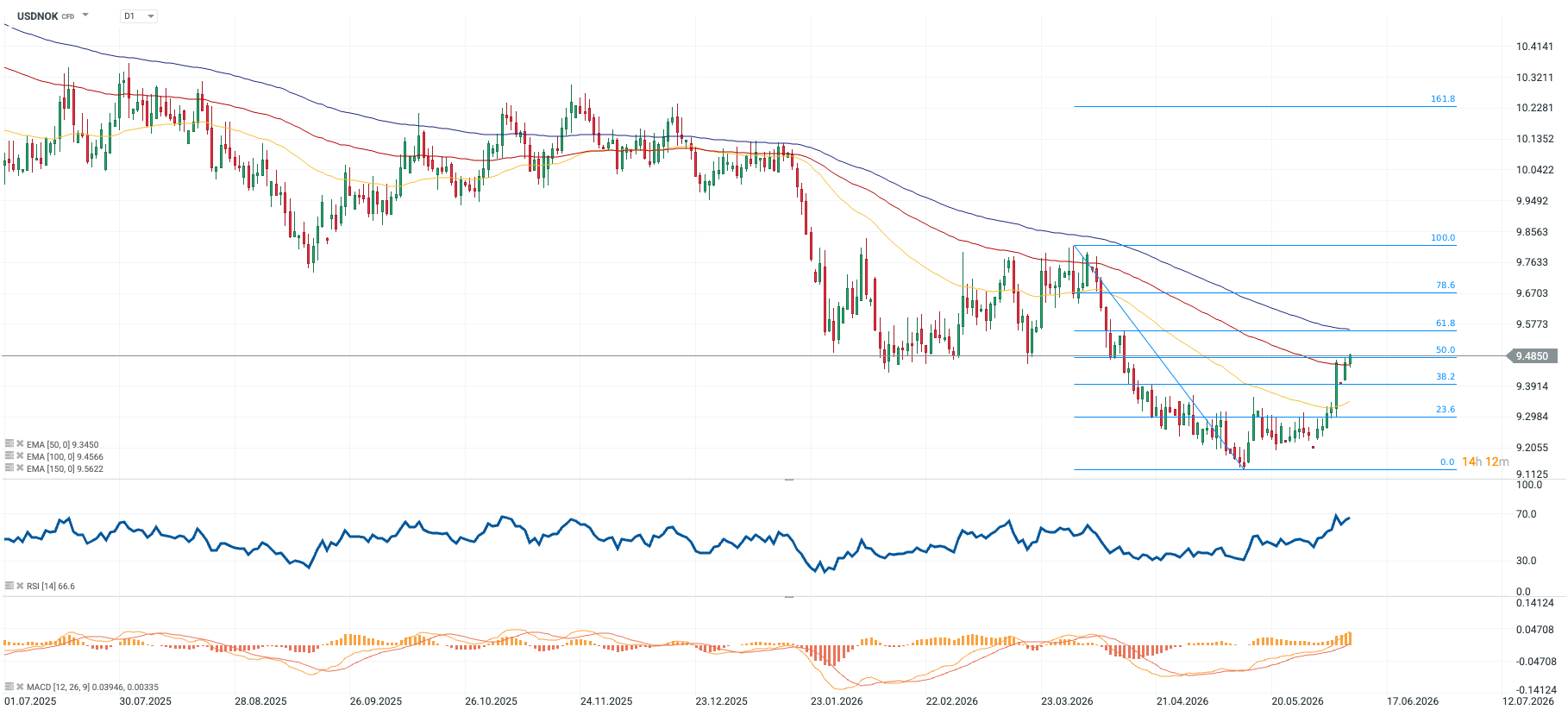
Monday’s rise in energy commodity prices proved short-lived, weighing further on the Norwegian currency. The USDNOK pair is approaching the 9.50 level, which was last seen two months ago. Aside from headlines coming out of the Middle East, tomorrow’s scheduled releases of May inflation data from both Norway and the US should take center stage for the pair.
Geopolitics
The weekend exchange of fire between Israel and Iran has cast doubt on the fragile ceasefire currently in place across the region. Under pressure from Washington, both sides halted further strikes. However, the situation remains highly uncertain, which could sustain high volatility in the prices of key energy commodities.
Macroeconomic Data
Tomorrow’s readings are expected to show core inflation remaining unchanged at 3.2%, alongside a slight decline in the headline figure to 3.1% in Norway. An upside surprise could raise expectations for further monetary policy tightening by Norges Bank. As a reminder, the central bank delivered its first interest rate hike since 2023 back in May, reacting to rapidly rising inflation expectations, persistently elevated wage growth, and the concerning stickiness of core inflation. Meanwhile, the headline CPI figure in the United States is expected to edge upward to 4.2%. The consensus also forecasts a modest increase in the core metric to 2.9%. Investors have already fully priced in a Fed rate hike for 2026. A further build-up of price pressures could increase the likelihood of this hike occurring as early as this autumn.
Technical Analysis
Chart 1: USDNOK (01.07.2025 – 09.06.2026)
Source: xStation, 09.06.2026
After establishing a new local low at the 9.13 level, a strong and aggressive demand-driven rebound ensued. The first two key technical resistance levels have been broken. The price has approached the 50% Fibonacci retracement level, which could serve as a crucial test for the ongoing upward trend. The strong momentum of the move is reflected in technical indicators. The RSI is currently hovering around 67 points, signaling that the market is gradually entering overbought territory, which could trigger a temporary pause in momentum.
Key Levels to Watch:
- To the Upside: If buyers manage to sustain the price above the tested 50% Fibo level, the next natural target for the market could be the 9.56 level, where both the 61.8% Fibonacci retracement and the 100 EMA coincide.
- To the Downside: Conversely, a sustained rejection of the current resistance level would mean anticipating a return to the primary trend and a retest of lower support levels.

GBP/USD Price Forecast: Overall trend appears sideways amid Triangle formation
- GBP/USD rises to near 1.3375 as the US Dollar corrects sharply.
- US President Trump sees a total victory over Iran in the next two weeks.
- Investors await the US CPI data for May and the UK GDP data for April.
The GBP/USD pair trades 0.26% higher at around 1.3375 during the European trading session on Tuesday. The Cable gains as the US Dollar (USD) declines amid expectations that the United States (US) could reach a deal with Iran soon.
US Dollar Price Today
The table below shows the percentage change of US Dollar (USD) against listed major currencies today. US Dollar was the weakest against the New Zealand Dollar.
| USD | EUR | GBP | JPY | CAD | AUD | NZD | CHF | |
|---|---|---|---|---|---|---|---|---|
| USD | -0.12% | -0.20% | -0.03% | -0.14% | -0.26% | -0.54% | -0.20% | |
| EUR | 0.12% | -0.06% | 0.09% | -0.02% | -0.11% | -0.40% | -0.06% | |
| GBP | 0.20% | 0.06% | 0.17% | 0.06% | -0.07% | -0.32% | 0.00% | |
| JPY | 0.03% | -0.09% | -0.17% | -0.11% | -0.22% | -0.50% | -0.16% | |
| CAD | 0.14% | 0.02% | -0.06% | 0.11% | -0.11% | -0.37% | -0.05% | |
| AUD | 0.26% | 0.11% | 0.07% | 0.22% | 0.11% | -0.26% | 0.06% | |
| NZD | 0.54% | 0.40% | 0.32% | 0.50% | 0.37% | 0.26% | 0.32% | |
| CHF | 0.20% | 0.06% | -0.01% | 0.16% | 0.05% | -0.06% | -0.32% |
The heat map shows percentage changes of major currencies against each other. The base currency is picked from the left column, while the quote currency is picked from the top row. For example, if you pick the US Dollar from the left column and move along the horizontal line to the Japanese Yen, the percentage change displayed in the box will represent USD (base)/JPY (quote).
As of writing, the US Dollar Index (DXY), which tracks the Greenback’s value against six major currencies, trades 0.17% lower to near 99.83.
On late Monday, US President Donald Trump expressed confidence that a “total victory” on Iran can be announced in two weeks, adding it would lead to a sharp decline in oil prices. The statement from Trump came after Iran agreed to halt attacking the Israeli territory, which led to a sharp decline in oil prices.
The US Dollar has outperformed in the past few months as elevated oil prices due to the energy supply crisis prompted the US inflation and hawkish Federal Reserve (Fed) bets.
The appeal of currencies from economies, such as the United Kingdom (UK), which rely heavily on oil imports to meet their energy needs, improves when oil prices start falling.
Going forward, investors will focus on the US Consumer Price Index (CPI) data for May and the UK Gross Domestic Product (GDP) data for April, which will be released on Wednesday and Friday, respectively.
GBP/USD technical analysis
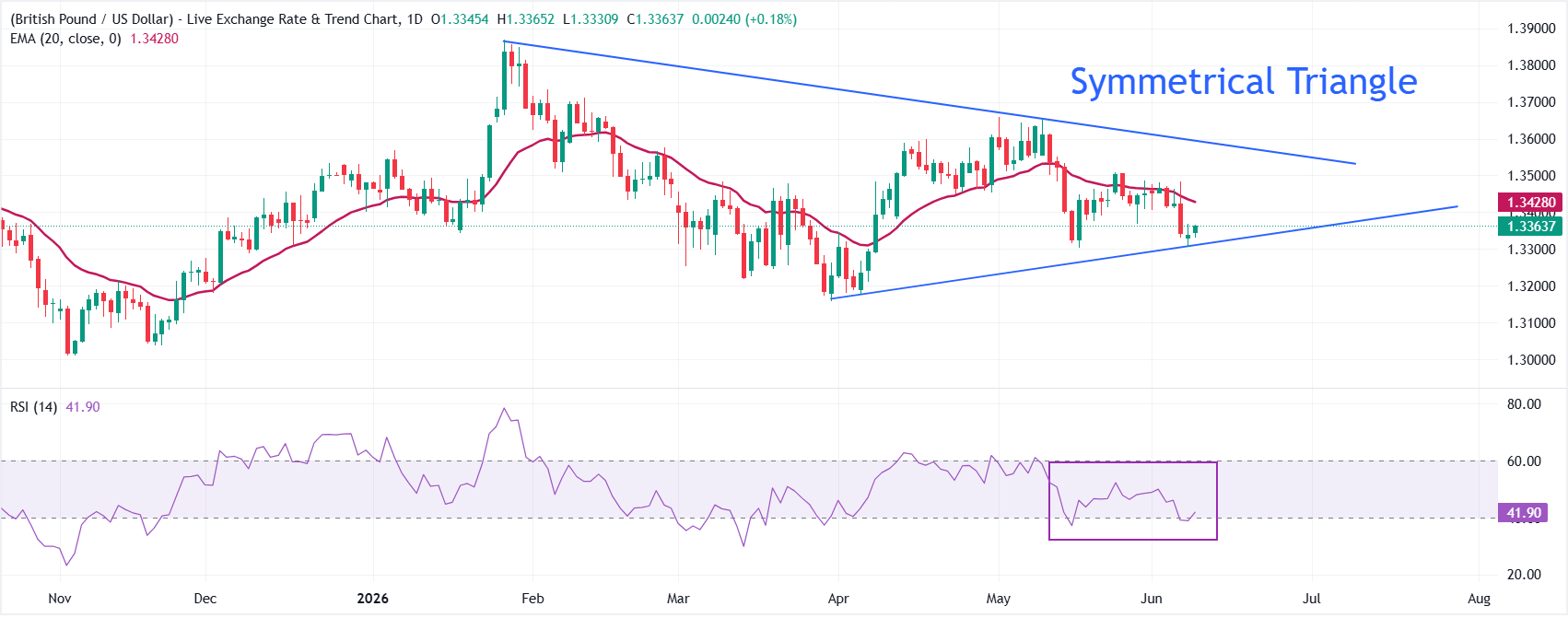
GBP/USD trades higher at around 1.3375 at the press time. However, the near-term tone remains bearish as it holds below the 20-period Exponential Moving Average (EMA), which is at 1.3428. The pair sits between an upward support trend line break around 1.3312 and the reclaimed downward resistance trend line reference at 1.3593, exhibiting a broader sideways trend. The Relative Strength Index (RSI) near 42 leans soft, hinting that downside pressure persists even if not yet overstretched.
On the topside, initial resistance is located at the 20-EMA around 1.3430, and a sustained break above this barrier would open the way toward the former downtrend resistance line reference near 1.3590. On the downside, immediate support emerges at the prior uptrend support break zone around 1.3301, and a drop below there would expose lower levels. The major support area would be the April 7 low at 1.3217, followed by the March 31 low at 1.3159.

Japanese Yen: May weaken toward 160.75 against US Dollar – UOB
UOB’s Quek Ser Leang and Lee Sue Ann describe USD/JPY as range-bound intraday between 159.90 and 160.40 after a brief spike and reversal, but maintain a slightly positive multi-day stance. They see upward momentum building tentatively, with the pair likely to rise gradually toward 160.75 while strong support at 159.60 defines the risk, and longer term highlight scope to test the top of a rising wedge near 161.15.
Dollar Yen bias remains mildly positive
“24-HOUR VIEW: The following are excerpts from our update yesterday: “The slight increase in upward momentum suggests that USD is likely to edge higher to 160.50. The major resistance at 160.75 is unlikely to come under threat. Support is at 160.05; a breach of 159.95 would suggest that the current mild upward pressure has eased.” The subsequent price movements turned out differently than we expected. USD edged to a high of 160.39, dropped to 159.87 before rebounding quickly to close largely unchanged at 160.17 (-0.07%). The price action provides no fresh clues. Today, USD could trade between 159.90 and 160.40.”
“1-3 WEEKS VIEW: We revised our view to slightly positive yesterday (08 Jun, spot at 160.25). We highlighted that “upward momentum is building, albeit tentatively.” We also highlighted that USD “could rise gradually, and the level to watch is 160.75.” There is no change in our view. On the downside, a breach of 159.60 (no change in ‘strong support’ level) would mean that upward momentum has faded.”

Australian Dollar picks up amid easing geopolitical tensions, bright data from China
- AUD/USD hits session highs at 0.7070, although it remains near eight-week lows.
- Bright Trade Balance data from China has provided a moderate impulse to the Aussie.
- Markets show some relief as hostilities in the Middle East stop.
The Australian Dollar (AUD) posts moderate gains against the US Dollar (USD) on Tuesday, regaining some of the ground lost last week, although it remains at its lowest level in nearly two months. News that Israel and Iran halted hostilities has triggered a mild relief rally. At the same time, upbeat Chinese trade data has provided additional support for the Aussie, as China is Australia’s major trading partner.
Data released by the Chinese Government earlier on Tuesday showed that the Asian giant’s trade surplus rose to USD 105.43 billion in May, its highest level since January and well beyond market expectations of USD 92.1 billion. In April, China’s trade surplus amounted to USD 84.82 billion.
China’s exports bloom with the AI rush
In May, exports showed a 19.4% year-over-year (y-o-y) growth, following a 14.1% increase in April, also beating expectations of a 15% increment. Strong demand for chips, amid the sharp increase in AI investment, has been the main driver for May’s surplus, offsetting the negative impact of the energy shock on global demand.
Imports also accelerated, with a 27.4% year-on-year increase in May after 25.3% year-on-year growth in April, suggesting that domestic demand is picking up pace after months of sluggish consumer spending.
Meanwhile, news reporting a pause in the hostilities between Israel and Iran has triggered a moderate pullback in Oil prices, providing a mild risk-appetite. US President Donald Trump affirmed earlier on Tuesday that he might have a proposal for a peace agreement with Iran and showed optimism about an upcoming deal.
In the US, the strong macroeconomic figures released last week, namely Friday’s Nonfarm Payrolls report, have boosted expectations that the Fed will be able to hike interest rates in the second half of the year, if inflationary pressures remain high. In that sense, the US Consumer Price Index (CPI) release, due on Wednesday, will be key to confirm the market’s expectations and is likely to set the US Dollar’s near-term direction.

Euro remains stronger against Japanese Yen following German Industrial Production data
- EUR/JPY holds gains as a stronger Euro is supported by robust Germany’s Industrial Production.
- Germany’s seasonally adjusted industrial output rebounded by 0.4% in April, meeting market expectations and recovering from March’s 0.1% decline.
- The Japanese Yen steadies as lower oil prices temper energy inflation fears, easing market pressure for aggressive rate hikes.
EUR/JPY extends its gains for the second successive day, trading around 184.90 during the Asian hours on Tuesday. The currency cross holds gains as the Euro (EUR) remains stronger following the release of Industrial Production and Trade Balance data.
Industrial Output, in the Eurozone’s economic powerhouse Germany, rose by 0.4% over the month in April, the federal statistics authority Destatis said in figures adjusted for seasonal and calendar effects, compared with the expected 0.4% rise and a decline of 0.1% recorded in March (revised from -0.7%). Annually, the German Industrial Production came in at -0.5% in the same period, following March’s revised 3.4% fall.
Germany’s trade surplus narrowed to €14.5 billion in April 2026 from an upwardly revised €14.7 billion in March, falling short of market expectations of €15.0 billion. It was the smallest trade surplus since November, as imports grew faster than exports. Exports unexpectedly increased by 0.9% month-on-month to a near 3½-year high of €136.6 billion, accelerating from a downwardly revised 0.3% gain in March and easily beating expectations of a 0.3% decline. Meanwhile, imports climbed 1.2% month-on-month to €122.1 billion, the highest level since November 2022, though easing from a downwardly revised 4.5% increase in March.
The upside for the EUR/JPY cross remains limited as a stabilizing Japanese Yen (JPY) acts as a structural headwind. Recent pullbacks in global oil prices have helped temper fears of a severe energy-driven inflation spike, consequently easing immediate market pressure for hyper-aggressive rate hikes.
However, the Bank of Japan (BoJ) is still widely anticipated to tighten monetary policy later this month. Policymakers continue to grapple with underlying inflationary pressures stemming from historically elevated energy costs. In tandem with potential rate hikes, reports indicate that the BoJ will review its bond-tapering framework, with a high likelihood of scaling back its monthly asset purchases. Market participants are now turning their focus to Wednesday’s 30-year Japanese Government Bond (JGB) auction, which will serve as a key barometer to gauge investor demand within this shifting, higher-yield environment.
Why is the British Pound struggling when the BoE is considering rate hikes?
The British Pound (GBP) is struggling as mounting political uncertainty and deteriorating economic indicators complicate the United Kingdom’s outlook. Ahead of the key Gross Domestic Product (GDP) April data to be released on Friday, financial markets are balancing the risk of an economic contraction against the probability of further interest rate hikes by the Bank of England (BoE) to rein in energy-driven inflation.
With internal political friction intensifying due to a high-stakes leadership challenge within the ruling Labour Party, major financial institutions are turning increasingly cautious on the Pound’s near-term trajectory.
Sluggish economic growth and fiscal concerns threaten to drag Pound lower
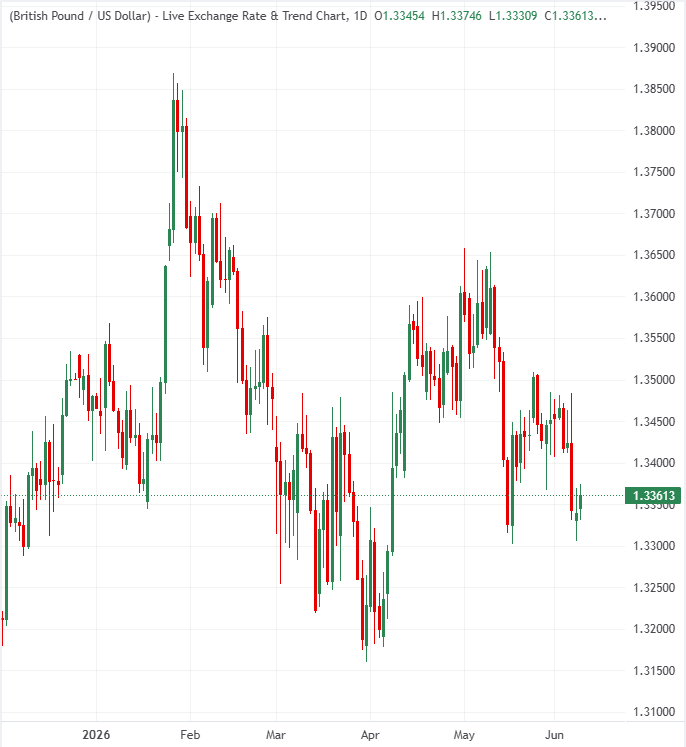
Macro strategists at Brown Brothers Harriman (BBH) warn that the combination of a potentially contracting UK economy and stagflationary pressures leaves the British Pound deeply exposed to a downward correction against the US Dollar. They emphasize that while anticipated central bank interventions may try to curb price pressures, structural damage to the UK’s fiscal credibility from potential political reshuffling could rapidly worsen a currency undershoot.
We expect GBP/USD to fall to 1.3100, reflecting a stronger US growth outlook relative to the UK. BOE rate hikes in a sluggish growth, high inflation environment, is not bullish for GBP but should help cushion the downside.
Uncertainty over the next BoE moves
Economists at Societe Generale suggest that any near-term political noise surrounding Manchester Mayor Andy Burnham’s bid for the Labour leadership will likely yield limited radical change. On the monetary front, they acknowledge that while hawkish voices within the BoE’s Monetary Policy Committee (MPC) are pushing hard for an immediate rate increase, the broader consensus will likely favor a more conservative wait-and-see strategy.
We expect these members [those opting for a rate hike] to remain in the minority and for the BoE to keep rates on hold in June.
Banks anticipate a downward-biased trajectory for the British Pound
The banks anticipate a soft trend for the British Pound. Brown Brothers Harriman maintains an explicitly bearish outlook, forecasting a drop to the 1.3100 mark for the GBP/USD