

Currency Hedger No Comments

GBP recovers against US Dollar; outlook remains weak due to Iran worries

  • The British Pound recovers almost half of its early losses against the US Dollar.
  • Middle East tensions re-escalate due to the exchange of attacks between the US and Iran.
  • 10-year UK gilt yields have remained lower in the past few weeks due to easing hawkish BoE bets.

The British Pound claws back half of its early losses and rebounds to near 1.3400 against the US Dollar (USD) during the European trading session on Thursday from the intraday low of 1.3367. The recovery move in the GBP/USD pair appears to be short-lived as Middle East conflicts have re-escalated.

At press time, S&P 500 futures and Asian stock markets have also recovered significantly. The US Dollar Index (DXY), which tracks the Greenbackโ€™s value against six major currencies, retreats from its intraday high of 99.54, but is still 0.18% higher to near 99.40. A slight correction in the WTI Oil price has also been observed from the dayโ€™s high of $91.17 to near $90.14.

Geopolitical tensions in the Gulf region have been reignited due to the exchange of attacks between the United States (US) and Iran. Earlier in the day, Iranโ€™s Islamic Revolutionary Guard Corps (IRGC) said that it attacked US military bases in retaliation against Washingtonโ€™s strikes near Bandar Abbas airport.

This was the second attack by the US this week after the so-called โ€œdefensive strikesโ€ on Iranian boats deploying mines and their missile launching sites.

Meanwhile, United Kingdom (UK) gilt yields have also recovered strongly after a weak opening due to Middle East concerns. 10-year UK gilt yields have rebounded to near 4.87% from the dayโ€™s low of 4.81%.

UK gilt yields have been declining in the past few weeks due to easing hopes of a near-term Bank of England (BoE) interest rate hike. Traders have pared hawkish BoE bets lately due to weakening job market conditions and lower household spending.


Currency Hedger No Comments

Euro hesitates above 0.8650 against the British Pound as Middle East tensions rise

  • EUR/GBP struggles to extend gains beyond 0.8660 but remains steady above 0.8650.
  • Risk appetite has faltered on Thursday as the US and Iran exchange attacks.
  • ECB-BoE monetry policy divergence keeps the pair buoyed.

The Euro (EUR) is trading flat against the British Pound (GBP) on Thursday. EUR/GBP bulls are struggling to find acceptance above 0.8660 following a 0.4% rally over the previous two days, although downside attempts remain contained above 0.8655 so far.

Speculative demand for the common currency is faltering on Thursday as market sentiment sours and Oil prices jump with tensions between the US and Iran escalating again.

The US military launched fresh strikes on Iranian military sites in the province of Bandar Abbas that, according to the US Central Command (Centcom), “posed a threat around the Strait of Hormuz.โ€ Iranโ€™s Islamic Revolutionary Guard Corps (IRGC) affirmed that they targeted US bases in the Gulf region, and Kuwait authorities reported interceptions of hostile drone and missile attacks.

ECB-BoE monetary policy divergence

The Euro, however, remains fairly steady, favoured by monetary policy divergence between the European Central Bank (ECB) and the Bank of England (BoE). Futures markets are pricing a 91% chance that the ECB will hike interest rates at its June 11 meeting, according to data by the ECB Watch Tool. The BoE, on the contrary, is not expected to tighten its monetary policy anytime soon.

The ECB Chief Economist, Philip Lane, warned on Thursday that inflationary consequences from the US-Iran war will outlast the conflict and that the bank must prevent the general belief that inflation will remain high for a long time to take hold.

Later on Thursday, ECB President Christine Lagarde is expected to take part in a central bankersโ€™ meeting, and her comments on monetary policy will be listened to with particular interest.

Currency Hedger No Comments

EUR/JPY Price Forecast: Loses momentum to near 185.00, but bias stays bullish

  • EUR/JPY weakens to around 185.10 in Thursdayโ€™s early European session. 
  • The cross keeps the bullish vibe, but further consolidation cannot be ruled out in near term with neutral RSI momentum. 
  • The immediate resistance to watch is 185.65; the initial support level is seen at 184.70. 

The EUR/JPY cross loses momentum to near 185.10 during the early European session on Thursday. Escalations in the US-Iran conflict boost the safe-haven currency, such as the Japanese Yen (JPY) and act as a headwind for the cross. 

CNN reported on Thursday that Iranโ€™s Islamic Revolutionary Guard Corps (IRGC) launched an attack targeting an American air base, which they said was the source of US strikes on Iranian targets hours before. The US strikes targeted Iranian drones and a launch site near the Strait of Hormuz. 

Traders will keep an eye on the Tokyo May Consumer Price Index (CPI) inflation report, which is due later on Friday. In case of a softer-than-expected Tokyo CPI print, this could drag the Japanese Yen lower against the Euro (EUR) in the near term. 

Chart Analysis EUR/JPY

Technical Analysis:

In the daily chart, EUR/JPY holds a mild bullish bias as it trades above the 100-day simple moving average and the Bollinger Bands middle line near 184.71, keeping the broader uptrend underpinned. The Relative Strength Index (RSI) hovers around 50, suggesting consolidative but still slightly constructive momentum while price drifts toward the upper Bollinger band.

On the topside, the immediate resistance is the Bollinger upper band around 185.65, and a clear break above this ceiling would open the way for a renewed extension of the advance. On the downside, initial support is seen at the Bollinger middle band near 184.70 and the 100-day SMA at 184.40, with the lower Bollinger band near 183.78 acting as a deeper cushion if a corrective pullback develops.

Currency Hedger No Comments

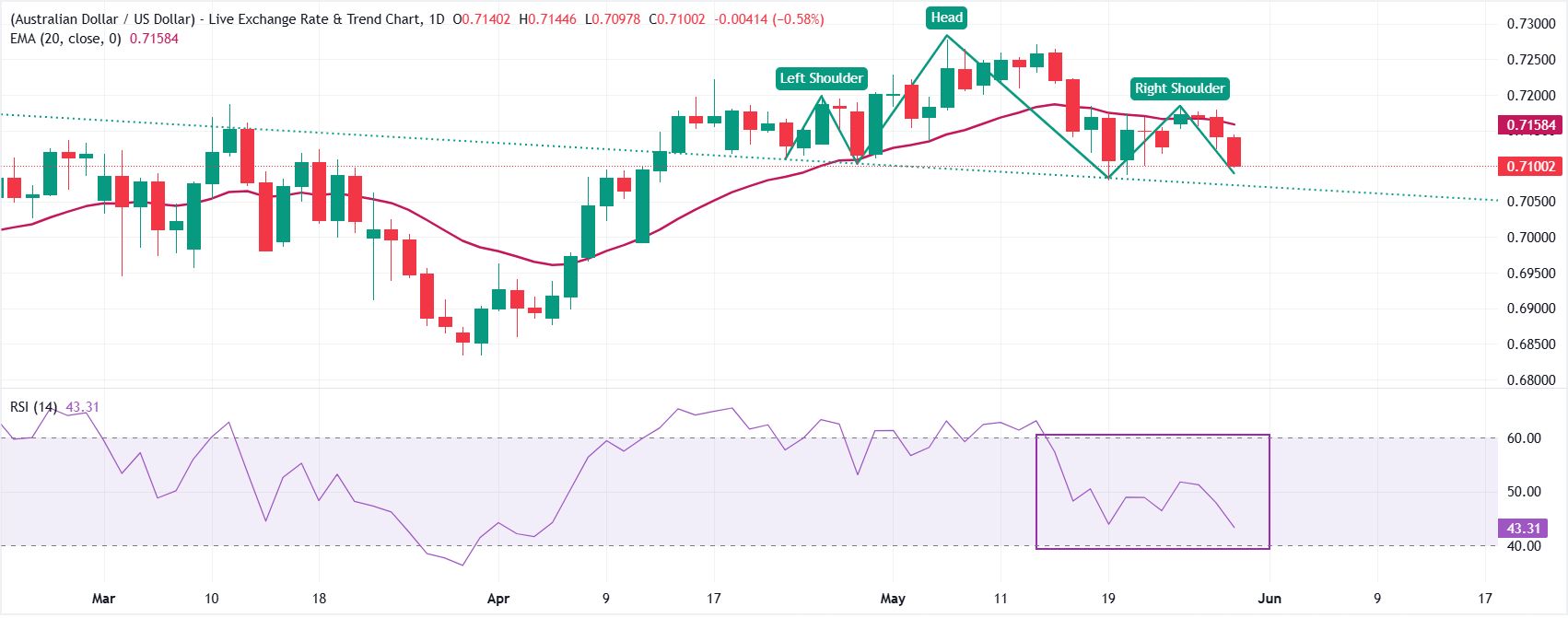
AUD/USD Price Forecast: On verge of Head and Shoulder breakdown

  • AUD/USD tumbles to near 0.7100 as the Australian Dollar underperforms due to multiple headwinds.
  • The exchange of attacks between the US and Iran has dented optimism towards a peace deal.
  • Slower-than-projected Australian CPI growth in April has forced traders to pare hawkish RBA bets.

The Australian Dollar (AUD) slumps over 0.5% to near 0.7100 during the Asian trading session on Thursday. The Aussie par slumps as the antipodean underperforms its peers due to risk-off market sentiment and diminished hawkish Reserve Bank of Australia (RBA) bets.

Australian Dollar Price Today

The table below shows the percentage change of Australian Dollar (AUD) against listed major currencies today. Australian Dollar was the weakest against the US Dollar.

USDEURGBPJPYCADAUDNZDCHF
USD0.30%0.38%0.05%0.16%0.55%0.51%0.32%
EUR-0.30%0.08%-0.28%-0.15%0.25%0.22%0.02%
GBP-0.38%-0.08%-0.34%-0.23%0.17%0.15%-0.07%
JPY-0.05%0.28%0.34%0.11%0.51%0.46%0.28%
CAD-0.16%0.15%0.23%-0.11%0.41%0.36%0.16%
AUD-0.55%-0.25%-0.17%-0.51%-0.41%-0.02%-0.24%
NZD-0.51%-0.22%-0.15%-0.46%-0.36%0.02%-0.21%
CHF-0.32%-0.02%0.07%-0.28%-0.16%0.24%0.21%

The heat map shows percentage changes of major currencies against each other. The base currency is picked from the left column, while the quote currency is picked from the top row. For example, if you pick the Australian Dollar from the left column and move along the horizontal line to the US Dollar, the percentage change displayed in the box will represent AUD (base)/USD (quote).

Market sentiment turns favorable for safe-haven assets as Iran has retaliated against the United States (US) attacks near Bandar Abbas airport by striking its military bases in the Gulf region. At press time, the US Dollar Index (DXY), which tracks the Greenbackโ€™s value against six major currencies, trades 0.3% higher, slightly above 99.50. S&P 500 futures and all major Asian stock markets are bleeding, as of writing, indicating a significant dent in investorsโ€™ risk appetite.

Hawkish RBA prospects have squeezed as the Australian Consumer Price Index (CPI) data for April showed that inflationary pressures cooled down at a faster-than-expected pace. Month-on-month CPI arrived at 0.4%, lower than 0.6% estimates and the previous reading of 1.1%. On an annualized basis, the Australian CPI grew at a moderate pace of 4.2% against expectations of 4.4% and the March reading of 4.6%.

Following the Australian CPI data, markets now imply almost no chance of a June move, while the probability of an August hike has more than halved to 40%, Reuters reports.

AUD/USD technical analysis

AUD/USD trades significantly lower at around 0.7100 as of writing. The near-term tone of the pair is bearish as it holds below the 20-period exponential moving average (EMA), which is at 0.7158. Also, the Head and Shoulder (H&S) formation backs a bearish bias.

The Relative Strength Index (RSI) is near 43, indicating subdued momentum rather than oversold conditions, hinting that sellers still retain the upper hand.

Looking down, the pair could enter a fresh leg of decline if it breaks below the neckline of the H&S formation at around 0.7070. Major support zones will be 0.7050 and the April 13 low around 0.6990. On the topside, the 20-day EMA at 0.7158 is the first resistance to beat for the bulls to ease immediate downside pressure and open the way for a more sustained recovery towards 0.7200.

Currency Hedger No Comments

Euro slumps below 1.1600 against US Dollar amid fears of US-Iran war resumption

  • EUR/USD declines to near 1.1590 as Iranโ€™s retaliation against US attacks near Bandar Abbas has dampened market mood.
  • The IRGC attacks US military bases and threatens a more decisive response if it attacks again.
  • Investors await the US-Germany inflation data.

The Euroย (EUR) slides 0.3% to near 1.1590 against the US Dollar (USD) during the Asian trading session on Thursday. The major currency pair faces intense selling pressure as market sentiment turns risk-averse, followingย Iranโ€™s retaliation against United States (US) attacks near Bandar Abbas airport, Tasnim agency reported.

As of writing, S&P 500 futures are down 0.3% below 7,500, reflecting a sharp dent in investorsโ€™ risk appetite. The US Dollar Index (DXY), which tracks the Greenbackโ€™s value against six major currencies, jumps over 0.3% to near 99.53.

Earlier in the day, the Farsย Newsย Agency reported thatย three explosions were heard east of Bandar Abbas and air defenses were activated for several minutes.

In response, Iranโ€™sย Islamicย Revolutionary Guard Corps (IRGC) has attacked US military bases and has threatened ‘a more decisive’ response if Washington attacks again.

The exchange of attacks between both nations has dented optimism towards a permanent deal. Earlierย this week, US officials, including President Donald Trump, expressed confidence that a deal could be announced soon.

Meanwhile, investors await the US Personal Consumption Expenditure Price Index (PCE) data for April and the preliminary German Harmonized Index of Consumer Prices (HICP) data for May, which will be released on Thursday and Friday, respectively.

Currency Hedger No Comments

New Zealand Dollar drops after NZ budget announcement

  • The New Zealand Dollar faces selling pressure after the NZ budget 2026 announcement.
  • On Wednesday, the RBNZ held its OCR steady at 2.25%, but guided a hawkish monetary policy outlook.
  • Renewed concerns over the US-Iran deal have underpinned the US Dollar.

The New Zealand Dollar (NZD) drops to near 0.5883 against the US Dollar (USD) during the Asian trading session on Thursday, following the New Zealand (NZ) budget 2026 announcement. The Kiwi pair edges down even as the nationsโ€™ Debt Management Office (DMO) has reduced its gross bond issuance plans for four years to June 30, 2030 to NZ$124 billion from NZ$130 billion forecasted in December, which diminishes fears of widening fiscal concerns.

For the current year, DMOโ€™s plans to issue NZ$34 billion worth of bonds remain unchanged with the December forecast.

However, the broader outlook of the antipodean has improved as prospects of the Reserve Bank of New Zealand (RBNZ) raising interest rates in the July meeting have increased after a โ€œhawkish holdโ€ on Wednesday.

Markets quickly nudged up the probability of a quarter-point increase in July to around 75%, and saw rates reaching 3.0% by year’s end, Reuters report.

On Wednesday, the RBNZ left its Official Cash Rate (OCR) steady at 2.25%, as expected, but expressed the need to tighten monetary conditions amid rising inflation. โ€œCommittee sees inflationary pressures going forward, agrees cash rate needs to be higher going forward,โ€ RBNZ Governor Anna Breman said.

Meanwhile, the US Dollar trades sharply higher on renewed concerns regarding the dismissal of the United States (US)-Iran negotiations. As of writing, the US Dollar Index (DXY), which tracks the Greenbackโ€™s value against six major currencies, trades 0.2% higher to near 99.40.

Currency Hedger No Comments

GBP softens to near 1.3400 as US-Iran tensions boost safe-haven US Dollar

  • GBP/USD loses momentum to around 1.3400 in Thursdayโ€™s early Asian session. 
  • US military carried out new strikes in Iran; Trump said he wonโ€™t rush into a deal with Tehran. 
  • Traders reduce their bets on BoE rate hikes due to easing concerns about political developments and softer UK data. 

The GBP/USD pair attracts some sellers near 1.3400 during the Asian trading hours on Thursday. The British Pound (GBP) weakens against the US Dollar (USD) on fresh geopolitical developments. Markets remain cautious ahead of the release of the US April Personal Consumption Expenditures (PCE) Price Index inflation report, which is due later in the day. 

The US military carried out new strikes in Iran, targeting a site that posed a threat to US forces and commercial traffic, according to Reuters. The US described the actions as measured, purely defensive, and intended to maintain the ceasefire. 

On Wednesday, President Donald Trump vowed to reach a favorable deal to end the war with Iran, warning that the regime’s efforts to bore him with waiting will not work because “I don’t care about the midterm elections.โ€ Rising tensions and signs of a prolonged conflict in the Middle East could boost a safe-haven currency such as the Greenback and create a headwind for the major pair in the near term. 

Markets have scaled back expectations for a rate hike from the Bank of England (BoE) following softer inflation data, an unexpected rise in the Unemployment Rate to 5.0% for April, and easing political concerns.  

โ€œTraders now price one rate hike fewer in 2026 than at the end of the previous week, and gilt yields saw the biggest weekly drop since late-2023,โ€ Pantheon Macroeconomics said in a note on Tuesday. โ€œWe estimate that lower yields were driven by lower oil prices, a fall in betting-market odds on Sir Keir Starmer being replaced, and Andy Burnham committing to maintain current fiscal rules,โ€ they added. 

Currency Hedger No Comments

Japanese Yen hits four-week low vs firmer USD as Hormuz risks counter intervention fears

  • USD/JPY attracts buyers for the third straight day, though JPY intervention fears cap gains.
  • Economic concerns stemming from Hormuz risk undermine the JPY and support spot prices.
  • Mideast tensions and Fed rate hike bets benefit the USD ahead of the crucial US macro data.

The USD/JPY pair trades with a positive bias for the third straight day and touches a four-week high, around the 159.60 region, during the Asian session on Thursday. The Japanese Yen (JPY) continues with its relative underperformance amid economic concerns stemming from the ongoing Middle East conflict. This, along with a broadly firmer US Dollar (USD), acts as a tailwind for spot prices, though intervention fears might cap further gains ahead of important US macro releases.

Investors remain worried that Japan’s economy will come under substantial strain due to the continued disruption to energy supplies through the Strait of Hormuz. In fact, shipping traffic through the strategic waterway has drastically reduced since the start of the Middle East conflict due to Iran’s restrictions on movements and the US naval blockade of Iranian ports. Adding to this, renewed US strikes on Iran raise the risk of a further escalation of tensions in the region, which continues to undermine the JPY and supports the USD/JPY pair.

A US official told Reuters that the US military carried out fresh strikes in Iran on Wednesday, targeting a military site that posed a threat to American forces and commercial maritime traffic in the Strait of Hormuz. The US official also said American forces intercepted and shot down multiple Iranian drones that posed a similar threat. Moreover, US President Donald Trump said that he is not satisfied with the terms negotiated with Iran and that he wonโ€™t be rushed into a deal, dampening hopes for a diplomatic solution to end a three-month-old war.

The latest developments, in turn, underpin the Greenback’s reserve currency status amid bets that the US Federal Reserve (Fed) will hike interest rates in 2026 amid inflationary concerns and further supports the USD/JPY pair. The JPY bears, however, seem hesitant amid speculations that Japanese authorities will step in again to prop up the domestic currency. Furthermore, traders might opt to move to the sidelines ahead of the release of the US Personal Consumption Expenditures (PCE) Price Index and the Preliminary US GDP report later today.