GBP/USD drops despite a weaker US Dollar as Trump’s paused strikes boosted US-Iran diplomatic hopes.
President Trump stated Middle Eastern nations requested extra time to finalize a deal with Iran.
The BoE signaled possible rate hikes if US-Iran conflict uncertainties drive up inflation.
GBP/USD holds losses after three days of gains, trading around 1.3470 during the Asian hours on Monday. The currency pair may regain its footing as the US Dollar (USD) struggles under easing risk aversion, driven by hopes of a diplomatic breakthrough between the United States (US) and Iran following reports that US President Donald Trump held off on planned strikes.
In a post on Truth Social, US President Trump stated that Iran and other Middle Eastern nations requested additional time to finalize an agreement, a proposed deal that would lead to the “immediate, complete, and total” reopening of the vital Strait of Hormuz while effectively eliminating Iran’s nuclear threat.
However, high market uncertainty persists as Iranian officials swiftly dismissed the claims. According to Iran’s Mehr news agency, Iranian officials characterized Trump’s assertion that Tehran sought a pause as “nothing but a new lie,” emphasizing that the Iranian armed forces remain on high alert and fully prepared for any eventuality.
The Bank of England (BoE) opted to leave interest rates unchanged last week, though it kept the door open for potential rate hikes due to ongoing uncertainty surrounding the US-Iran conflict. Despite the pause, money markets continue to price in a 25-basis-point rate increase by the end of the year, according to Prime Terminal data.
BoE tone softens as Bailey downplays urgency on next hike
Analysts at Scotiabank characterize the latest BoE decision as signaling “softened hawkishness,” noting that Governor Andrew Bailey “played down the urgency around timing of the next rate hike” even as the MPC delivered a 6–3 vote to hold rates, with three policymakers calling for a “25bpt increase.” This combination of a split vote and more cautious guidance reinforces the impression of a central bank that remains alert to inflation risks but is in no rush to tighten policy aggressively.
USD/CAD attracts some buyers, albeit it lacks follow-through amid a combination of diverging forces.
A slump in oil prices undermines the Loonie and supports spot prices, though a weaker USD caps gains.
The focus shifts to this week’s key macro releases, including key jobs reports from the US and Canada.
The USD/CAD pair kicks off the new week on a positive note, though it lacks bullish conviction and remains confined within Friday’s broader range. Spot prices currently trade around the 1.4030 region, up less than 0.10% for the day amid mixed fundamental cues.
Crude oil prices tumble after US President Donald Trump cancelled a threatened attack on Iran, claiming Mideast allies have reached the parameters of a deal to end the five-month-old war. Adding to this, the OPEC+ members agreed to increase oil production by 188,000 barrels per day in September, exerting additional pressure on the black liquid. This, in turn, undermines the commodity-linked Loonie and acts as a tailwind for the USD/CAD pair, though the prevalent US Dollar (USD) selling bias caps further gains.
1An intraday slump in crude oil prices eases inflation fears and tempers bets for an immediate interest rate hike by the US Federal Reserve (Fed). Furthermore, aggressive follow-through short-covering around the Japanese Yen (JPY) drags the USD Index (DXY), which tracks the Greenback against a basket of currencies, to its lowest level since June 17. This, in turn, warrants some caution for USD/CAD bulls and positioning for any meaningful recovery from sub-1.4000 levels, or a one-and-a-half-month low touched last Thursday.
Market participants now look forward to this week’s important US macroeconomic releases, scheduled at the beginning of a new month, starting with the ISM Manufacturing PMI later today. The focus, however, will be on the crucial monthly employment reports from the US and Canada, due on Friday, which will play a key role in influencing the USD/CAD pair in the near term. Apart from this, further developments surrounding the Middle East crisis might continue to infuse volatility and provide some meaningful impetus.
The Japanese yen strengthened toward 155 per dollar on Monday, bringing its gains to about 5% over three sessions, after the Finance Ministry confirmed it carried out coordinated yen-buying operations with the US Treasury last week following the currency’s slide to 40-year lows. Japanese authorities also warned they stand ready to conduct additional coordinated interventions if needed, adding that they remain in close contact with their US counterparts. US Treasury Secretary Scott Bessent also confirmed the joint action to counter disorderly moves in the yen, while President Donald Trump previously said the US joined last week’s coordinated intervention as a show of support for Japan and to help safeguard global economic stability. The yen had fallen to four-decade lows last month amid pressure from elevated energy costs, mounting fiscal concerns, and persistently wide interest rate differentials.
The Australian dollar rose above $0.70, approaching a seven-week high, supported by broad weakness in the US dollar and hopes of diplomatic talks in the Middle East. The greenback weakened after Japan confirmed coordinated yen-buying operations with the US Treasury last week, boosting support for the Aussie. Elsewhere, US President Donald Trump said peace talks with Iran will resume after key Middle Eastern allies urged a diplomatic solution and the reopening of the Strait of Hormuz, lifting risk sentiment. In Australia, markets imply next to no chance the Reserve Bank will hike at its next meeting and only a slim possibility of a move in September. However, markets are pricing roughly even odds of a November hike, reflecting the risk that third-quarter inflation data could come in stronger than expected. The central bank has already raised rates three times this year, and the cumulative tightening is increasingly weighing on the housing market, with prices falling 0.7% in July.
The New Zealand dollar rose to around $0.589 on the first trading day of August, reaching a two-month high, as a fresh wave of yen buying weighed broadly on the US dollar, while fresh negotiations in the Middle East lifted risk appetite. The greenback extended its decline after Japan confirmed it had engaged in joint yen-buying intervention with the US on Friday. Meanwhile, President Donald Trump said new talks with Iran would begin on Monday after he canceled a weekend attack against Tehran, raising hopes for progress toward resolving the months-long conflict. Improving domestic sentiment, with New Zealand businesses and consumers becoming more optimistic, also underpinned the kiwi. Traders now await the country’s second-quarter jobs report for further clues on the state of the economy. Currently, markets are almost fully pricing in a quarter-point rate hike by the Reserve Bank of New Zealand in September.
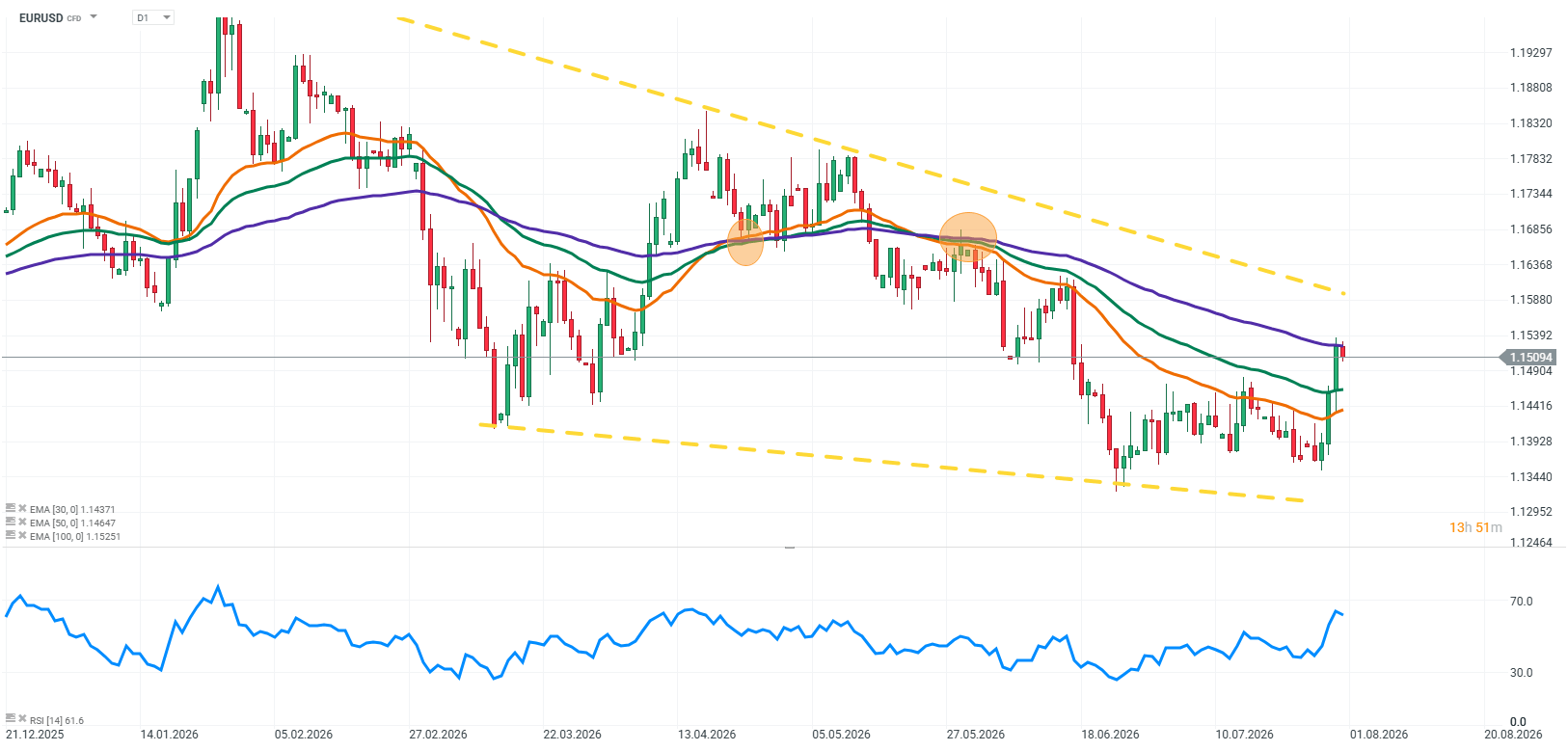
Friday’s session on EURUSD is focused on the market’s continued assessment of Wednesday’s Federal Reserve meeting and the latest macroeconomic data from the United States. The market is increasingly assuming that the Fed will not rush into further rate hikes, although recent data still shows that the US economy remains relatively resilient. Wednesday’s Fed decision did not bring any change in interest rates, but the communication from the central bank was more important than the decision itself. Kevin Warsh stressed that the Fed needs to remain cautious and cannot declare victory over inflation too quickly. At the same time, the lack of a clear signal pointing towards the need for further policy tightening was interpreted by the market as confirmation that the current hiking cycle may be close to an end. Before the meeting, market pricing suggested the possibility of two more rate hikes this year. This scenario is now significantly less likely, which removes one of the key sources of support for the US dollar. Another factor affecting the US currency was yesterday’s macroeconomic data. US GDP growth is slowing, PCE inflation is gradually declining, although it remains elevated, while the labour market continues to show strong resilience. Today’s CPI inflation release from the euro area will be another important signal for future European Central Bank decisions. EURUSD is currently caught between two opposing narratives. On one side, reduced expectations for further Fed rate hikes are weighing on the dollar. On the other hand, the US economy continues to perform relatively well, allowing the Fed to maintain a restrictive stance. On the euro side, the market is waiting for confirmation that inflation in Europe will continue to decline and that the ECB will have room to begin easing monetary policy.
Source: xStation5
Factors currently shaping EURUSD
Fed moves closer to the end of the hiking cycle
The most important event for the currency market in recent days was the Federal Reserve meeting. The decision to leave interest rates unchanged was largely expected, which is why the main focus was placed on the central bank’s communication. Kevin Warsh did not reinforce expectations of further interest rate hikes. The Fed continues to emphasise the need for caution in its fight against inflation, but at the same time it is not signalling that additional increases in borrowing costs are currently the base-case scenario. This marks a significant shift compared with the situation before the meeting. Previously, the market was pricing in the possibility of further rate increases as inflation remained elevated and the US economy continued to show considerable resilience. Those expectations have now been clearly reduced. For the dollar, this means a loss of some support from the prospect of further interest rate increases. However, this does not automatically signal the beginning of a sustained downward trend for the US currency. The Fed will continue to react to incoming data, and persistent inflation leaves the possibility of keeping rates higher for longer.
US data points to a slowdown, but the economy remains resilient
The latest macroeconomic releases paint an increasingly complex picture of the US economy. GDP growth is gradually slowing, which reflects the impact of previous rate hikes and tighter financial conditions. Slower economic momentum reduces the scope for further monetary tightening. At the same time, PCE inflation, one of the most important indicators for the Federal Reserve, remains above levels considered consistent with the central bank’s target. However, the direction of travel is positive, as price pressures are gradually easing. The strongest argument for continued Fed caution remains the labour market. Despite high interest rates, employment conditions remain relatively strong, and consumer spending in the US continues to show resilience. For the dollar, this creates a mixed picture. Slower growth and declining inflation do not support the case for another hiking cycle, but economic resilience allows the Fed to maintain elevated interest rates for an extended period.
Eurozone inflation as an important test for the ECB
On the euro side, the key event remains today’s CPI inflation release from the euro area. The market will focus not only on the inflation level itself, but also on the pace of price moderation. For the ECB, the key question is whether inflation is declining quickly enough to allow the central bank to begin easing monetary policy in the future. If the data show that inflation remains persistent, particularly in the services sector, this could reduce expectations for rapid rate cuts in Europe. Such a scenario would provide support for the euro. On the other hand, a stronger decline in inflation would increase expectations that the ECB has greater room to lower interest rates. In that case, the advantage from the interest rate differential could shift back in favour of the dollar.
Bond yields remain crucial for the dollar
Despite the change in expectations surrounding the Fed, US bond yields remain a very important factor for the currency market. A decline in inflation alone does not necessarily mean a lasting weakening of the dollar. If the Fed keeps interest rates at elevated levels for longer, dollar-denominated assets may continue to remain attractive. For this reason, the market is currently focused not only on economic data itself, but also on how central banks respond to those developments. The key issue will be how quickly expectations for future Fed and ECB policy paths change.
EURUSD waits for the next catalyst
The current situation on EURUSD reflects a clash between two different scenarios. The Fed has signalled that the room for further rate hikes is becoming limited, which is negative for the dollar. At the same time, the US economy remains relatively resilient, and the labour market does not yet provide a strong argument for rapid rate cuts. For the euro, inflation data and future ECB decisions will remain crucial. If inflation in Europe declines more slowly than the market expects, the euro could receive support. If the disinflation process accelerates, pressure on the common currency could increase. EURUSD therefore remains primarily a reflection of differences in monetary policy expectations. For the market, the key issue is no longer only the current inflation level, but which central bank will have more room to maintain a restrictive policy stance for longer.
Key takeaways
The Fed left interest rates unchanged, and the lack of a clear signal for further tightening reduced expectations of additional rate hikes.
The market has significantly lowered the pricing of further rate increases in the US.
US data point to slower economic growth and gradually easing inflation, but the labour market remains strong.
Today’s eurozone CPI inflation data will be an important signal for future ECB decisions.
The direction of EURUSD will largely depend on whether the Fed’s stance changes faster or whether the ECB will be forced to maintain higher interest rates for longer.
GBP/USD loses momentum to near 1.3445 in Friday’s early European session.
Iranian official said the US will ‘pay the price’ for killing Iranian civilians.
The constructive outlook of the pair remains intact above the 100-day SMA, with bullish RSI momentum.
The initial support level to watch is 1.3400; the first upside barrier is located at 1.3515.
The GBP/USD pair trades in negative territory around 1.3445 during the early European trading hours on Friday. Heightened Middle East tensions and rising global oil prices provide some support to a safe-haven currency such as the US Dollar (USD) against the British Pound (GBP). The Michigan Consumer Sentiment Index will be published later on Friday.
Iranian Parliament Speaker Mohammad Bagher Ghalibaf on Thursday denounced the US attack on civilian homes on Qeshm Island, describing it as a continuation of American crimes in the southern Iranian cities of Minab and Lamerd. Earlier on Thursday, the US launched missile strikes across southern Iran, including Qeshm Island as well as parts of Bushehr, Fars and Khuzestan provinces.
Financial markets have priced in a more than 90% chance of the Bank of England (BoE) keeping borrowing costs on hold, with the outside chance of a hike. Traders expect a rise in borrowing costs to 4.0% before the end of the year.
BoE seen on hold as softer UK inflation eases pressure
Analysts at Brown Brothers Harriman note that the Bank of England is “widely expected to keep the policy rate at 3.75% for a fifth straight meeting,” arguing that a “less worrisome UK inflation backdrop gives the BoE room to stand pat.” In their view, the recent moderation in price pressures allows policymakers to maintain the current stance without rushing to adjust rates, reinforcing expectations for an extended pause in the tightening cycle.
Technical Analysis:
In the daily chart, GBP/USD holds a modest bullish bias as spot remains above the 100-day simple moving average (SMA) and the Bollinger middle band around, suggesting underlying dip-buying interest after recent consolidation. The Relative Strength Index (RSI) at about 57 stays in positive but not overbought territory, hinting that upside momentum is constructive yet still measured.
On the downside, immediate support is seen around the 100-day SMA at 1.3400, reinforced by the nearby Bollinger middle band at roughly 1.3390, while a deeper cushion emerges at the lower Bollinger band near 1.3265 should sellers regain control. On the topside, initial resistance aligns with the upper Bollinger band around 1.3515; a sustained break above this cap would open the door for the July 15 high of 1.3558.
USD/CAD attracts some buyers amid a goodish USD recovery from the lowest level since June 17.
Escalating US-Iran tensions keep inflation risks and Fed hike bets in play, supporting the Greenback.
Supply concerns act as a tailwind for oil prices, underpinning the Loonie and capping spot prices.
The USD/CAD pair edges higher during the Asian session on Friday and, for now, seems to have snapped a three-day losing streak to the lowest level since June 17, touched the previous day. Spot prices currently trade above the 1.4000 psychological mark, though the intraday uptick lacks bullish conviction.
As investors look past Thursday’s unimpressive US macro data, the US Dollar (USD) regains some positive traction amid prospects for at least one interest rate hike by the US Federal Reserve (Fed) and offers some support to the USD/CAD pair. The Advance US GDP report showed moderating economic growth in the second quarter, while the US Personal Consumption Expenditures (PCE) Price Index pointed to signs of cooling inflation, tempering hawkish Fed expectations.
However, volatile crude oil prices suggest that inflation remains a concern, which could force the US central bank to adopt a more hawkish stance. Adding to this, escalating US-Iran tensions and the risk of a broader regional conflict in the Middle East act as a tailwind for the safe-haven USD. In the latest development, the US military announced it had completed a heavy wave of strikes against Iranian targets, in response to Tehran’s missile attacks on American forces earlier this week.
Meanwhile, Iran rejected Oman’s proposal, which would see Tehran partially control the Strait of Hormuz and collect voluntary fees for using the waterway. Furthermore, On the other hand, repeated attacks by Yemen’s Houthi militias in the Bab al-Mandab Strait, the Red Sea, and the Gulf of Aden add to concerns about disruptions to global energy supplies. This, in turn, could lend support to crude oil prices and underpin the commodity-linked Loonie, warranting some caution for USD/CAD bulls.
To provide the best experiences, we use technologies like cookies to store and/or access device information. Consenting to these technologies will allow us to process data such as browsing behavior or unique IDs on this site. Not consenting or withdrawing consent, may adversely affect certain features and functions.
Functional
Always active
The technical storage or access is strictly necessary for the legitimate purpose of enabling the use of a specific service explicitly requested by the subscriber or user, or for the sole purpose of carrying out the transmission of a communication over an electronic communications network.
Preferences
The technical storage or access is necessary for the legitimate purpose of storing preferences that are not requested by the subscriber or user.
Statistics
The technical storage or access that is used exclusively for statistical purposes.The technical storage or access that is used exclusively for anonymous statistical purposes. Without a subpoena, voluntary compliance on the part of your Internet Service Provider, or additional records from a third party, information stored or retrieved for this purpose alone cannot usually be used to identify you.
Marketing
The technical storage or access is required to create user profiles to send advertising, or to track the user on a website or across several websites for similar marketing purposes.