USD/CAD rises as the US Dollar holds gains amid renewed geopolitical tensions in the Strait of Hormuz.
The Greenback’s upside could be restrained as traders price out any Fed rate hike for this month and September.
The commodity-linked Canadian Dollar may gain support from higher oil prices.
USD/CAD gains ground for the third successive day, trading around 1.4210 during the European hours on Tuesday. The pair appreciates as the US Dollar (USD) holds ground, which could be attributed to the renewed geopolitical tensions in the Strait of Hormuz.
However, the upside of the Greenback could be restrained as traders price out any Federal Reserve rate hikes this month and in September. This shift in sentiment followed a cooling employment report that revealed fewer jobs added across April, May, and June than Wall Street had anticipated.
Furthermore, a recent drop in crude oil prices, driven by an OPEC+ production boost and a US-Iran peace deal, has alleviated broader inflationary pressures, softening the urgency for an aggressive Fed policy outlook.
The upside of the USD/CAD pair could be capped as the commodity-linked Canadian Dollar (CAD) gains support from higher oil prices. Although Canada is a major crude exporter, lower oil prices diminish foreign capital inflows, ultimately weighing on the loonie dollar.
West Texas Intermediate (WTI) oil price gains ground after registering modest losses in the previous day, trading around $69.40 per barrel at the time of writing. Crude oil prices received a temporary boost following reports that Iran fired at least two missiles at commercial vessels transiting the strategic waterway late Monday.
While two ships sustained significant damage, no casualties were reported. Separately, the UK Maritime Trade Operations (UKMTO) confirmed that a southbound tanker was struck on its port side by an unknown projectile, which ignited a fire on board.
NZD/USD falls as a steady US Dollar draws support from renewed geopolitical tensions in the Strait of Hormuz.
Traders expect the Fed to keep rates unchanged this month and in September.
ING anticipates the RBNZ will implement a 25-basis-point rate hike to 2.50% this Wednesday.
NZD/USD inches lower for the second successive day, trading around 0.5700 during the Asian hours on Tuesday. The currency pair depreciates as the US Dollar (USD) holds ground, which could be attributed to the renewed geopolitical tensions in the Strait of Hormuz.
Bloomberg reported, citing a United States (US) official, that Iran fired at least two missiles at commercial vessels transiting the strategic waterway late Monday. While two ships sustained significant damage, no casualties were reported. Separately, the UK Maritime Trade Operations (UKMTO) confirmed that a southbound tanker was struck on its port side by an unknown projectile, which ignited a fire on board.
Market participants scaled back expectations for Federal Reserve rate hikes this month and in September. This shift in sentiment followed a cooling employment report that revealed fewer jobs added across April, May, and June than Wall Street had anticipated. Furthermore, a recent drop in crude oil prices, driven by an OPEC+ production boost and a US-Iran peace deal, has alleviated broader inflationary pressures, softening the urgency for an aggressive Fed policy outlook.
Despite a sharp collapse in oil prices, ING anticipates the Reserve Bank of New Zealand (RBNZ) will implement a 25-basis-point “insurance” rate hike to 2.50% on Wednesday. However, the firm cautions that the tightening could be a one-off move, offering little sustained upward momentum for the New Zealand Dollar (NZD).
Goldman Sachs has significantly raised its forecasts for the USD/JPY pair, becoming one of the most bearish investment banks on the Japanese currency. The bank’s strategists now expect the exchange rate to rise from their previous 12-month target of 155 to 165 yen per U.S. dollar, which would mark the weakest level for the yen since 1986—nearly 40 years ago.
Key Takeaways
Goldman Sachs raised its 12-month USD/JPY forecast from 155 to 165.
The bank also lifted its 3-month forecast from 160 to 162 and its 6-month target from 158 to 163.
The yen remains close to its weakest levels in four decades, with USD/JPY currently trading around 162.
According to Bloomberg’s survey, Goldman is now among the most bearish institutions on the Japanese currency.
Options markets imply roughly a 72% probability that USD/JPY reaches 165 by June next year.
Hedge funds are holding their largest net short positions in the yen since 2017.
Why Does Goldman Expect Further Yen Weakness?
According to Goldman Sachs FX strategist Karen Reichgott Fishman, three key factors are driving the bank’s revised outlook:
persistently high U.S. Treasury yields,
mounting fiscal pressures in Japan,
and the Bank of Japan’s very gradual pace of interest rate hikes.
At the same time, Goldman acknowledges that the yen already appears significantly undervalued based on its fundamental valuation models. However, that alone is not enough to trigger a sustained recovery. The bank argues that the wide interest rate differential between the United States and Japan, together with the divergence in monetary policy, continues to strongly favor the U.S. dollar.
Carry Trades Remain a Major Driver
Goldman Sachs continues to favor using the yen as the preferred funding currency for carry trades. The strategy is straightforward:
investors borrow low-cost yen,
sell the currency in the FX market,
and invest the proceeds in higher-yielding assets such as U.S. bonds or emerging-market currencies.
As long as the Bank of Japan maintains relatively accommodative financial conditions, carry trades are likely to remain attractive, adding further depreciation pressure on the yen.
Can Japan Stop USD/JPY From Rising?
Goldman remains skeptical about the effectiveness of future currency interventions. Although Japan’s Ministry of Finance has hinted that future interventions could become less predictable, the bank believes even direct yen-buying operations would likely generate only a temporary correction. Unless there is a meaningful decline in U.S. Treasury yields, a more hawkish Bank of Japan, or a significant narrowing of the U.S.-Japan interest rate gap, the fundamental drivers of yen weakness are likely to remain firmly in place.
Markets Are Increasingly Pricing in USD/JPY at 165
One notable aspect of Goldman’s outlook is how closely it aligns with broader market positioning. Currently:
hedge funds hold their largest net short yen positions in eight years,
FX derivatives imply roughly a 72% probability of USD/JPY reaching 165 by the middle of next year,
and an increasing number of investors view shorting the yen as one of the most crowded trades in global currency markets.
While this reinforces the prevailing uptrend, it also increases the risk of sharp corrections should expectations for the Federal Reserve or the Bank of Japan change unexpectedly.
What Could Change the Outlook?
The key near-term event will be the release of this week’s Federal Reserve meeting minutes. Investors will focus primarily on:
signals regarding future Fed rate cuts,
the direction of U.S. Treasury yields,
upcoming Bank of Japan policy decisions,
and the possibility of intervention by Japanese authorities.
A hawkish set of Fed minutes could strengthen the U.S. dollar further, putting renewed pressure on both the yen and the euro. Conversely, weaker U.S. economic data could lower Treasury yields and provide temporary relief for non-dollar currencies.
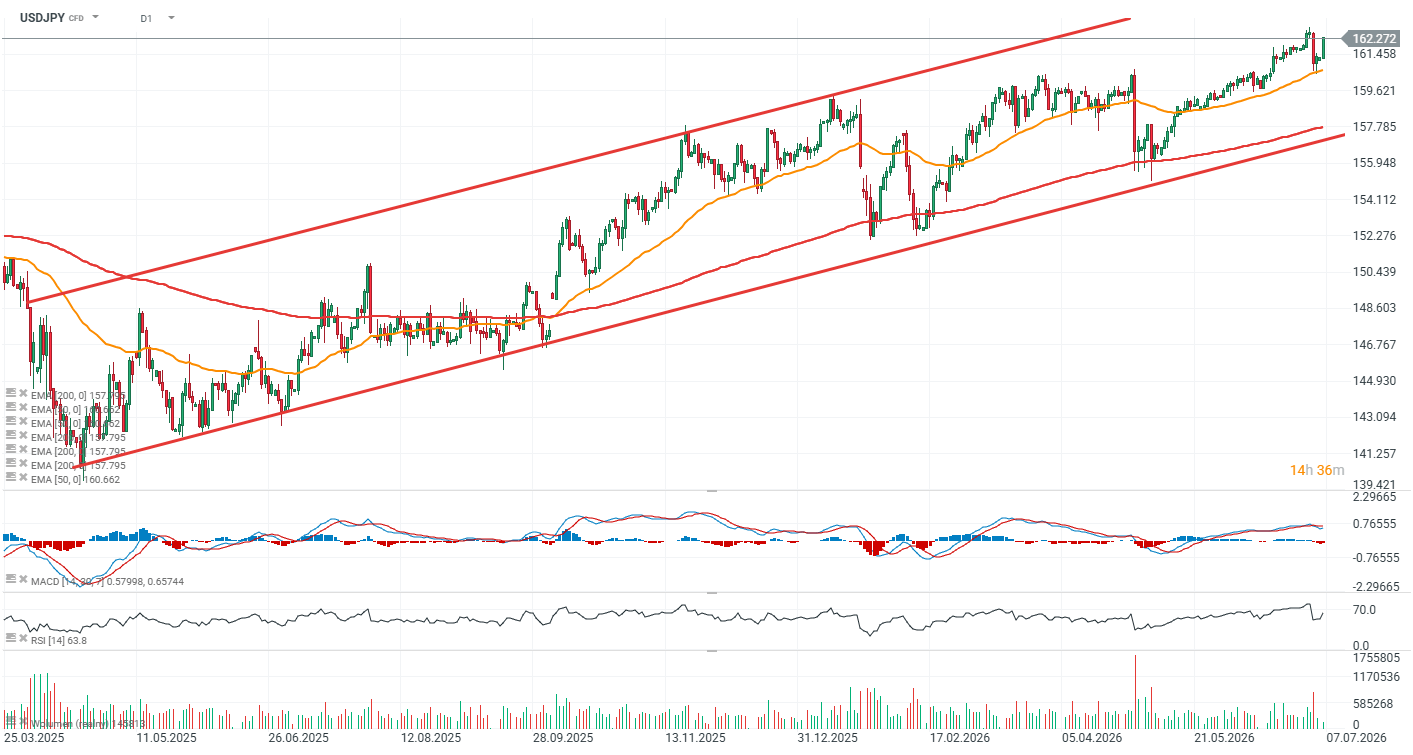
USD/JPY Technical Analysis (D1)
USD/JPY remains in a strong uptrend and continues to trade within a well-defined ascending price channel. The lower boundary of the channel is currently located near 158, a level that was last tested in May. In the short term, resistance is seen around 162.8 , corresponding to the pair’s recent swing highs. A sustained break above this level could reinforce bullish momentum, while a rejection may trigger another pullback toward the lower boundary of the ascending channel. 165 level i now probably the strongest resistance zone.
EUR/JPY could test the upper boundary of the symmetrical triangle around 185.90.
The 14-day Relative Strength Index is at 51, hinting at neutral-to-firm momentum.
Initial support aligns with the 50-day EMA of 184.91.
EUR/JPY gains ground for the second successive day, trading around 185.00 during the Asian hours on Monday. The currency cross holds a constructive near-term bias as it trades above the nine-period and 50-period Exponential Moving Averages (EMAs).
The volume-weighted average price (VWAP) is reinforcing underlying demand around 184.31. The 14-day Relative Strength Index (RSI) hovers near 51, reflecting neutral-to-firm momentum as the spot price solidifies above key dynamic support levels.
The technical analysis of the daily chart suggests that the EUR/JPY cross is remaining within the symmetrical triangle, indicating that both buyers and sellers are becoming increasingly aggressive, squeezing the price into a tighter and tighter range. Neither side has taken control yet, creating a temporary balance of power.
Further advances would support the EUR/JPY cross to test the upper boundary of the symmetrical triangle around 185.90. A break above the triangle would cause the bullish emergence and expose the all-time high of 187.95, which was recorded on April 17.
On the downside, initial support lies at the 50-day EMA of 184.91, followed by the nine-day EMA at 184.71. Further declines would expose the symmetrical triangle’s lower boundary around 183.60, followed by the four-month low of 181.87, recorded on March 16, and the six-month low of 180.81.
EUR/JPY: Daily Chart
Euro Price Today
The table below shows the percentage change of Euro (EUR) against listed major currencies today. Euro was the strongest against the New Zealand Dollar.
USD
EUR
GBP
JPY
CAD
AUD
NZD
CHF
USD
0.02%
0.05%
0.29%
0.07%
0.13%
0.37%
0.11%
EUR
-0.02%
0.03%
0.26%
0.05%
0.12%
0.38%
0.09%
GBP
-0.05%
-0.03%
0.22%
-0.02%
0.04%
0.32%
0.07%
JPY
-0.29%
-0.26%
-0.22%
-0.23%
-0.16%
0.06%
-0.12%
CAD
-0.07%
-0.05%
0.02%
0.23%
0.05%
0.31%
0.07%
AUD
-0.13%
-0.12%
-0.04%
0.16%
-0.05%
0.26%
0.04%
NZD
-0.37%
-0.38%
-0.32%
-0.06%
-0.31%
-0.26%
-0.26%
CHF
-0.11%
-0.09%
-0.07%
0.12%
-0.07%
-0.04%
0.26%
The heat map shows percentage changes of major currencies against each other. The base currency is picked from the left column, while the quote currency is picked from the top row. For example, if you pick the Euro from the left column and move along the horizontal line to the US Dollar, the percentage change displayed in the box will represent EUR (base)/USD (quote).
USD/JPY rises as the Japanese Yen falls amid high import costs.
10-year JGB yield reaches a fresh 30-year high of 2.79%.
The US Dollar remains strong as markets price in multiple Fed rate hikes this year.
USD/JPY extends its gains for the second successive day, trading around 161.70 during the Asian hours on Monday. The Japanese Yen (JPY) is caught in a high-stakes tug-of-war, buckling under surging import costs even as 10-year JGB yields hit a fresh 30-year high of 2.79%. This deep market divide has traders on high alert for immediate verbal intervention from Tokyo.
The USD/JPY pair appreciates as the US Dollar (USD) holds its ground, buoyed by market expectations of multiple Federal Reserve (Fed) rate hikes later this year. This comes despite easing global inflation concerns, which have been helped by oil flows normalizing through the critical Strait of Hormuz.
The CME FedWatch tool shows financial markets are pricing in a 77.3% chance of interest rate hikes by year-end. Investors are now looking ahead to Wednesday’s release of the Fed’s June policy Meeting Minutes to gain clearer insights into the future path of interest rates.
Recent US labor data have forced Wall Street to aggressively rethink this hawkish outlook. The latest Nonfarm Payrolls (NFP) report revealed the US economy added a mere 57,000 jobs last month, severely missing the market’s forecast of 110,000. While the headline unemployment rate did manage an unexpected drop to 4.2% from May’s 4.3%, the dramatic hiring slowdown strongly signals that the broader economy is cooling down.
Fed Chair Kevin Warsh firmly reaffirmed the central bank’s independent commitment to its 2% price stability target. Notably, he also acknowledged that inflation risks and expectations have finally begun to moderate over the past month.
NZD/USD falls as a 1.0% drop in June’s ANZ Commodity Price Index weakened the NZD.
The NZD faces volatility as an evenly split NZIER shadow board creates deep uncertainty ahead of the July policy decision.
The US Dollar advances as markets continue to price in multiple Fed rate hikes this year.
NZD/USD depreciates after two days of gains, trading around 0.5690 during the Asian hours on Monday. The pair loses ground as the New Zealand Dollar (NZD) weakens following the ANZ World Commodity Price Index, which fell 1.0% in June as easing Middle East tensions and lower oil prices weighed.
The New Zealand Dollar faces an immediate challenge as NZIER economists look past immediate disagreements to project higher interest rates over the coming year. While the shadow board is nearly evenly split on the upcoming July policy decision, creating genuine uncertainty and potential market volatility, its medium-term outlook remains unified. Regardless of the immediate decision, members firmly agree that the Official Cash Rate (OCR) must climb to a range of 3.00% to 3.25% over the next twelve months, establishing a solid anchor for interest rate expectations.
In line with this hawkish medium-term trajectory, ANZ anticipates the Reserve Bank of New Zealand (RBNZ) will raise the OCR by 25 basis points to 2.50% next Wednesday. Despite a sharp decline in global oil prices, ANZ maintains that persistent inflation risks and a weakened domestic currency warrant immediate action. They argue that delivering a neutral-to-dovish rate hike provides the RBNZ with the most comfortable tactical footing to navigate current economic pressures without overly roiling the markets.
The NZD/USD pair depreciates as the US Dollar (USD) rises, as traders expect multiple Federal Reserve (Fed) rate hikes later this year. This comes despite easing global inflation concerns, which have been helped by oil flows normalizing through the critical Strait of Hormuz.
The CME FedWatch tool shows financial markets are pricing in a 77.3% chance of interest rate hikes by year-end. Investors are now looking ahead to Wednesday’s release of the Fed’s June policy Meeting Minutes to gain clearer insights into the future path of interest rates.
USD/CAD may decline as the commodity-linked Canadian Dollar may receive support from higher oil prices.
OPEC+ approved an 188,000-barrel-per-day output hike led by Saudi Arabia and Russia, signaling confidence in regional stability.
The US Dollar strengthens as markets expect multiple Fed rate hikes this year.
USD/CAD gains ground for the second consecutive day, trading around 1.4210 during the Asian hours on Monday. The upside of the pair could be restrained as the commodity-linked Canadian Dollar (CAD) could receive support from higher oil prices.
Oil traders are moving cautiously while traffic through the Strait of Hormuz appears to be stabilizing; expected production hikes from OPEC+ (The Organization of Petroleum Exporting Countries and its allies (OPEC+), including Russia) have renewed fears of a global supply glut.
Several tankers made unexplained detours on Saturday, and shipping lanes through the critical chokepoint normalized by Sunday. Meanwhile, OPEC+ approved a modest output hike of 188,000 barrels per day for next month, led by Saudi Arabia and Russia, a move signaling confidence in regional stability.
The USD/CAD pair appreciates as the US Dollar (USD) rises, as traders expect multiple Federal Reserve (Fed) rate hikes later this year. This comes despite easing global inflation concerns, which have been helped by oil flows normalizing through the critical Strait of Hormuz.
The CME FedWatch tool shows financial markets are pricing in a 77.3% chance of interest rate hikes by year-end. Investors are now looking ahead to Wednesday’s release of the Fed’s June policy Meeting Minutes to gain clearer insights into the future path of interest rates.
The dollar index remained below 101 on Monday after posting weekly losses, as softer-than-expected US jobs data and lower oil prices led traders to scale back expectations for Federal Reserve interest rate hikes. Data released last week showed US nonfarm payrolls increased by just 57,000 in June, the smallest gain in four months and well below forecasts of 110,000, prompting markets to reduce bets on a September rate hike. Oil prices also edged lower as recovering energy flows through the Strait of Hormuz and the prospect of higher OPEC+ output fueled concerns about a potential supply glut. That has helped ease inflationary pressures that had previously bolstered expectations of further rate hikes. Investors now await the minutes of the Federal Reserve’s June policy meeting later this week for fresh clues on the outlook for interest rates.
To provide the best experiences, we use technologies like cookies to store and/or access device information. Consenting to these technologies will allow us to process data such as browsing behavior or unique IDs on this site. Not consenting or withdrawing consent, may adversely affect certain features and functions.
Functional
Always active
The technical storage or access is strictly necessary for the legitimate purpose of enabling the use of a specific service explicitly requested by the subscriber or user, or for the sole purpose of carrying out the transmission of a communication over an electronic communications network.
Preferences
The technical storage or access is necessary for the legitimate purpose of storing preferences that are not requested by the subscriber or user.
Statistics
The technical storage or access that is used exclusively for statistical purposes.The technical storage or access that is used exclusively for anonymous statistical purposes. Without a subpoena, voluntary compliance on the part of your Internet Service Provider, or additional records from a third party, information stored or retrieved for this purpose alone cannot usually be used to identify you.
Marketing
The technical storage or access is required to create user profiles to send advertising, or to track the user on a website or across several websites for similar marketing purposes.