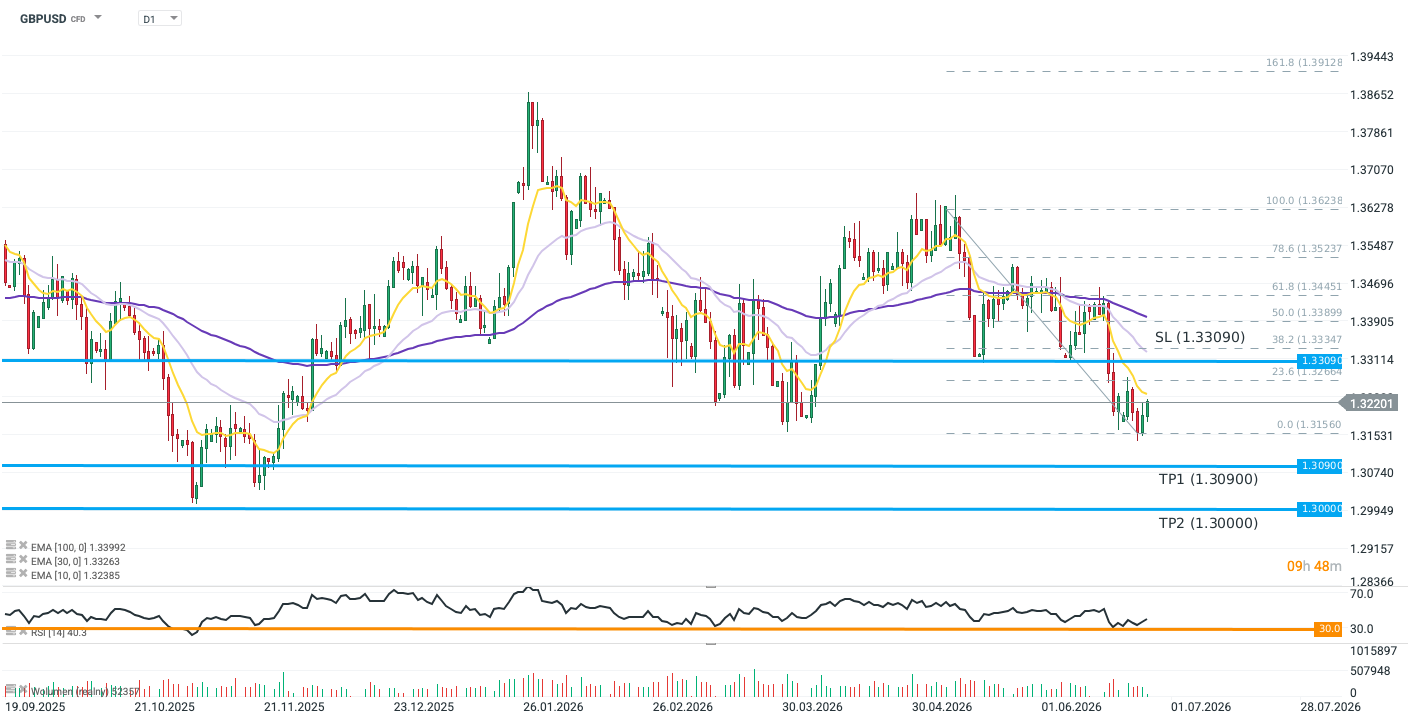
The GBP/USD rate is rebounding slightly as the dollar (specifically the dollar index, USDIDX) corrects across the broader market after breaking out to a 13-month high. Technically, however, we are far from breaking the downward trend on GBPUSD. Even after the recent bounce, the price has been moving below the 10-day exponential moving average (EMA10; yellow) for 9 days. Furthermore, the cascade of the remaining EMAs (longer over shorter: EMA100 over EMA30, and EMA30 over EMA10) signals a clear downtrend, the reversal of which would require a series of bullish turnarounds. The chances of a strictly pro-pound turnaround remain slim. The British currency is primarily weighed down by a period of political uncertainty and the ongoing leadership transition within the ruling Labour Party following Prime Minister Starmer’s resignation.
The Guardian reported that according to preliminary internal party plans, Burnham could assume the office of Prime Minister as early as July 17. However, the anticipation—especially regarding the appointments of key cabinet members such as the Chancellor—should continue to test the pound. On the dollar side, we see a persistently hawkish Fed narrative, an increase in core PCE inflation to 3.4%, and a Q1 2026 GDP revision from 1.6% to 2.1%. The backdrop of a gathering momentum in the US economy alongside elevated inflation contrasts sharply with stagflationary tendencies in the UK. This divergence should extend the current trend on GBPUSD and the UK/US 10-year bond yield spread, until potential wage effects emerge from the recent UK energy shock, which could force the Bank of England into a more hawkish monetary policy stance. However, UK policy is already restrictive, which limits the potential for a sharp pivot.
Methodology
This recommendation was prepared based on a technical analysis of the GBPUSD chart and a fundamental analysis of the economies in question (monetary policy in the United Kingdom and the United States). The directional bias of the recommendation was determined using moving averages and market expectations regarding central bank policies. Take Profit and Stop Loss levels were established using Fibonacci retracements and price action:
TP1 and TP2 are located at the nearest support levels from November 2025.
SL is placed halfway between the EMA10 and EMA30, as well as between the 23.6% and 38.2% Fibo levels.
GBP/USD attracts some buyers for the second straight day amid a mildly softer US Dollar.
The UK political crisis holds back GBP bulls from placing fresh bets and caps spot prices.
The bearish technical setup suggests that a further move up is more likely to be sold into.
The GBP/USD pair sticks to its positive bias for the second straight day, though it lacks bullish conviction and trades just above the 1.3200 mark during the early European session on Friday. The US Dollar (USD) remains depressed below its highest level since May 2025, touched on Thursday, and acts as a tailwind for spot prices.
However, the UK political crisis holds back traders from placing aggressive bullish bets around the British Pound (GBP) and caps the upside for the GBP/USD pair. Furthermore, a bearish technical setup warrants caution before positioning for any meaningful recovery from the 1.3140 area, or the lowest since November, set on Wednesday.
Against the backdrop of the recent repeated failures near the 200-period Simple Moving Average (SMA) on the 4-hour chart, this week’s break below the 1.3300 mark was seen as a key trigger for the GBP/USD bears. Moreover, the Relative Strength Index (RSI) is at 47, suggesting consolidative conditions rather than clear trend strength.
However, the Moving Average Convergence Divergence (MACD) indicator shows the MACD line modestly above the signal line and hovering around zero. This hints at tentative bullish momentum that is not yet strong enough to challenge the GBP/USD pair’s dominant downtrend witnessed over the past two months or so.
On the topside, initial resistance is located at the 200-period SMA at 1.3384, and spot prices would need a sustained break above this level to ease the broader bearish bias and open the way for a more constructive recovery phase. On the downside, intraday setbacks are likely to be driven more by price action than by clearly defined structural supports.
Meanwhile, traders will be watching the recent lows around the mid-1.3100s as a provisional near-term floor for the GBP/USD pair until fresh technical levels emerge.
(The technical analysis of this story was written with the help of an AI tool.)
GBP/USD 4-hour chart
US Dollar Price Today
The table below shows the percentage change of US Dollar (USD) against listed major currencies today. US Dollar was the strongest against the Australian Dollar.
USD
EUR
GBP
JPY
CAD
AUD
NZD
CHF
USD
-0.14%
-0.07%
-0.10%
-0.04%
0.29%
0.04%
-0.22%
EUR
0.14%
0.07%
0.06%
0.13%
0.44%
0.16%
-0.07%
GBP
0.07%
-0.07%
0.00%
0.06%
0.38%
0.12%
-0.13%
JPY
0.10%
-0.06%
0.00%
0.06%
0.39%
0.11%
-0.12%
CAD
0.04%
-0.13%
-0.06%
-0.06%
0.33%
0.05%
-0.20%
AUD
-0.29%
-0.44%
-0.38%
-0.39%
-0.33%
-0.26%
-0.52%
NZD
-0.04%
-0.16%
-0.12%
-0.11%
-0.05%
0.26%
-0.24%
CHF
0.22%
0.07%
0.13%
0.12%
0.20%
0.52%
0.24%
The heat map shows percentage changes of major currencies against each other. The base currency is picked from the left column, while the quote currency is picked from the top row. For example, if you pick the US Dollar from the left column and move along the horizontal line to the Japanese Yen, the percentage change displayed in the box will represent USD (base)/JPY (quote).
USD/CHF gains ground amid rising expectations of a Fed rate hike.
The CME FedWatch tool shows that markets are pricing in a 63.4% probability of an interest rate increase in September.
Swiss investor sentiment plunged to -25.0 in June from -11.1 in May, remaining deeply in negative territory.
USD/CHF gains ground after registering nearly 0.30%, trading around 0.8100 during the Asian hours on Friday. The pair rises as the US Dollar (USD) finds support from growing expectations of a Federal Reserve (Fed) rate hike. According to the CME FedWatch tool, markets have priced in a 63.4% probability that the Fed will raise interest rates during its September 15–16 meeting.
This hawkish sentiment is fueled by accelerating inflation data, with the headline Personal Consumption Expenditures (PCE) Price Index climbing to 4.1% year-over-year in May, up from 3.3% in April. This surge, the first time the headline figure has breached 4.0% in three years, is largely attributed to rising energy prices stemming from the Middle East conflict, keeping the prospect of further rate increases this year firmly on the table.
Furthermore, the Fed’s preferred inflation gauge, the core PCE index, rose to 3.4% year-over-year, up from 3.3%. This represents the highest annual core reading since October 2023.
Swiss investor sentiment worsened significantly in June 2026, dropping to -25.0 from -11.1 in May and remaining deeply negative. According to the latest UBS & CFA Society Switzerland survey, the economic expectations index experienced a sharp month-on-month decline of 13.9 points.
The Swiss National Bank (SNB) elected to keep its benchmark policy rate unchanged at 0% for the fourth consecutive meeting, reiterating that its current monetary stance supports both economic growth and price stability. However, the central bank also raised its inflation forecasts and reminded markets that it remains fully prepared to step into the foreign exchange markets if currency pressures demand it.
EUR/USD struggles to lure buyers on Friday as Hormuz risks support the safe-haven USD.
Receding Fed rate hike bets keep a lid on the USD appreciation and limit losses for the pair.
The bearish technical setup suggests that the path of least resistance is to the downside.
The EUR/USD pair struggles to capitalize on the previous day’s modest recovery gains and oscillates in a narrow band during the Asian session on Friday. Spot prices, however, hold above mid-1.1300s and the lowest level since May 2025, set on Thursday, warranting some caution for bearish traders.
Reports that Iran’s Islamic Revolutionary Guard Corps (IRGC) attacked a Singapore-flagged cargo ship in the Strait of Hormuz reignite worries about the sustainability of an interim US-Iran peace deal and support the safe-haven US Dollar (USD). This, in turn, is seen as a key factor acting as a headwind for the EUR/USD pair.
Meanwhile, traders trimmed their bets for interest rate hikes by the US Federal Reserve (Fed) this year amid expectations that inflation likely peaked last month or is close to doing so in the face of the recent fall in Crude Oil prices. This caps the upside for the USD and helps limit any further downside for the EUR/USD pair.
The recent repeated failures to find acceptance above the 100-period Simple Moving Average (SMA) on the 4-hour chart and the EUR/USD pair’s inability to gain any meaningful traction favor bears. Moreover, the Relative Strength Index (RSI) near 42 hints at a gradual recovery from oversold conditions rather than a bullish shift.
Meanwhile, the Moving Average Convergence Divergence (MACD) has now turned modestly positive, though the EUR/USD pair remains structurally pressured in the near-term. This, in turn, suggests that any meaningful recovery attempt might still be seen as a selling opportunity and runs the risk of fizzling out rather quickly.
Immediate resistance is located at the 1.1440 region, and a break above could lift the EUR/USD pair back to the 100-period SMA at 1.1514. A move beyond this hurdle is needed to ease the current bearish tone and open the way for a more meaningful correction higher. Until then, the pair seems vulnerable to test fresh lows.
(The technical analysis of this story was written with the help of an AI tool.)
EUR/USD 4-hour chart
US Dollar Price Today
The table below shows the percentage change of US Dollar (USD) against listed major currencies today. US Dollar was the strongest against the Australian Dollar.
USD
EUR
GBP
JPY
CAD
AUD
NZD
CHF
USD
-0.02%
-0.05%
-0.10%
-0.06%
0.25%
0.14%
-0.08%
EUR
0.02%
-0.05%
-0.06%
-0.02%
0.27%
0.12%
-0.06%
GBP
0.05%
0.05%
0.00%
0.00%
0.32%
0.19%
-0.02%
JPY
0.10%
0.06%
0.00%
0.02%
0.33%
0.19%
-0.01%
CAD
0.06%
0.02%
0.00%
-0.02%
0.31%
0.16%
-0.05%
AUD
-0.25%
-0.27%
-0.32%
-0.33%
-0.31%
-0.13%
-0.35%
NZD
-0.14%
-0.12%
-0.19%
-0.19%
-0.16%
0.13%
-0.20%
CHF
0.08%
0.06%
0.02%
0.00%
0.05%
0.35%
0.20%
The heat map shows percentage changes of major currencies against each other. The base currency is picked from the left column, while the quote currency is picked from the top row. For example, if you pick the US Dollar from the left column and move along the horizontal line to the Japanese Yen, the percentage change displayed in the box will represent USD (base)/JPY (quote).
AUD/USD meets with a fresh supply on Friday, though the RBA’s hawkish tilt limits losses.
Hormuz risks and Fed rate hike bets revive USD demand, exerting pressure on spot prices.
Traders now look to the US Consumer Sentiment Index and Fedspeak for a fresh impetus.
The AUD/USD pair attracts fresh sellers following the previous day’s modest gains and drops to a fresh low since early April during the Asian session on Friday. Spot prices, however, recover a few pips in the last hour and currently trade just below the 0.6900 mark, still down over 0.25% for the day.
According to the third and final reading published by the US Bureau of Economic Analysis on Thursday, the economy grew at an annualized rate of 2.1% in the first quarter of 2026 compared to the second estimate of 1.6% rise. Adding to this, the US Personal Consumption Expenditures (PCE) Price Index highlighted persistent inflationary pressures, keeping an interest rate hike by the US Federal Reserve (Fed) this year firmly on the table. Apart from this, the cautious market mood helps the safe-haven US Dollar (USD) stall its corrective pullback from the highest level since May 2025, touched on Thursday, and exerts downward pressure on the AUD/USD pair.
Reports suggested that Iran’s Islamic Revolutionary Guard Corps (IRGC) attacked a Singapore-flagged cargo ship in the Strait of Hormuz. The latest development reignites worries about the sustainability of the preliminary US-Iran peace deal. Apart from this, the recent tech-driven selloff in the equity markets has triggered global risk aversion, which is seen as another factor behind the Greenback’s relative outperformance against the perceived riskier Australian Dollar (AUD). That said, expectations that the Reserve Bank of Australia (RBA) will stick to its hawkish stance hold back bearish traders from placing aggressive bets around the AUD/USD pair.
Traders now look forward to the release of the revived University of Michigan US Consumer Sentiment Index, which, along with Fedspeak, might influence the USD price dynamics. The focus will then shift to RBA Governor Michele Bullock’s speech on Sunday, which should provide a fresh impetus to the AUD/USD pair at the start of a new week. Nevertheless, spot prices remain on track to register heavy weekly losses, also marking the second straight week of a negative move.
The dollar index steadied around 101.5 on Friday after coming under pressure in the previous session, but remained on track for a weekly gain as markets continued to expect the Federal Reserve to raise interest rates later this year. On Thursday, the greenback weakened after the latest US PCE inflation report came in broadly in line with expectations. Although inflation remains well above the Fed’s 2% target, the data helped ease concerns about a sharper-than-anticipated pickup in price pressures. Even so, markets are pricing in an 80% chance of a Fed rate hike in December following last week’s hawkish pause, while the probability of a September increase stands at around 63%. New York Fed President John Williams also said on Thursday that inflationary pressures are likely to moderate this year but remain uncomfortably high.
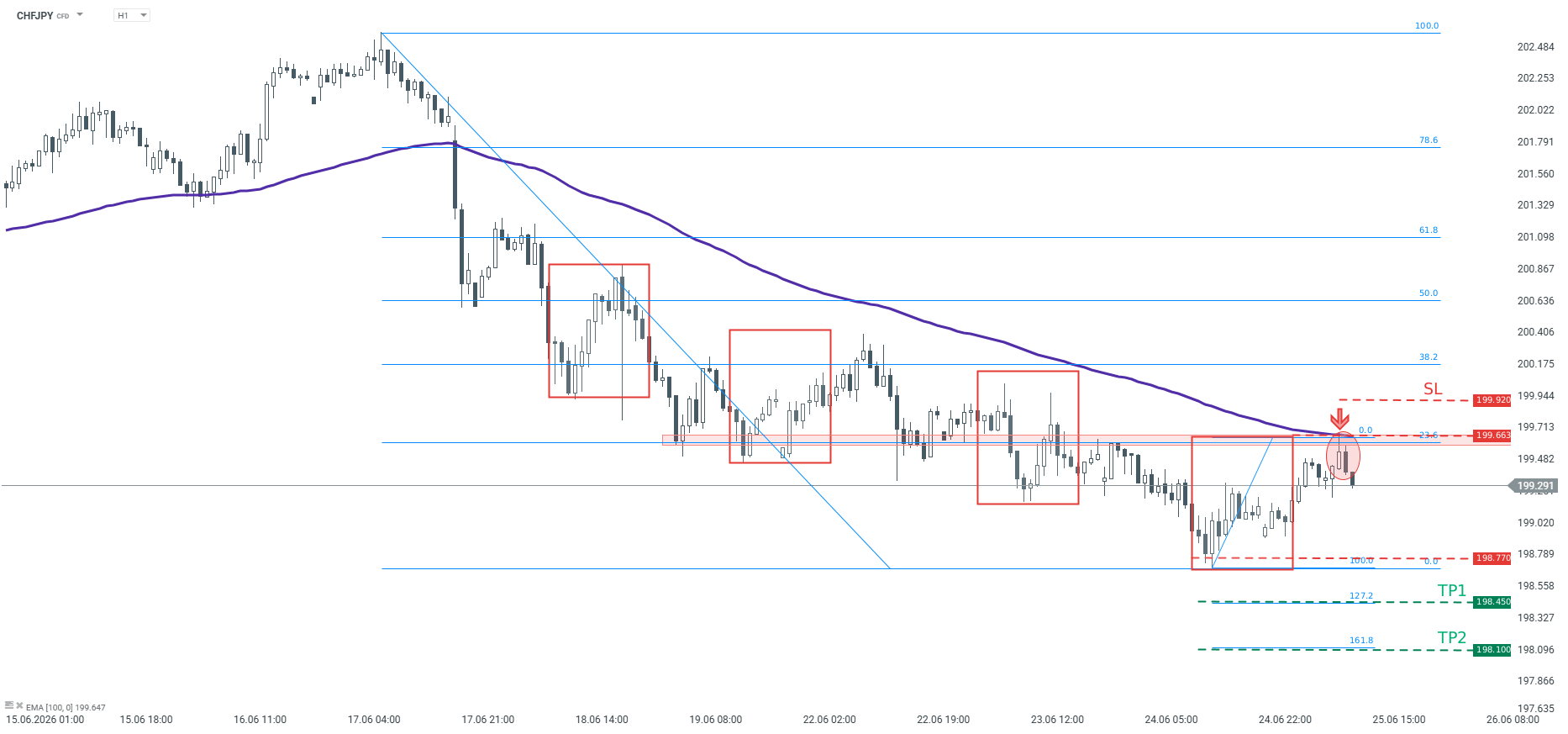
CHFJPY reversed from the key resistance level at 199.66
The pair has been trading in a downtrend since June 17
Trade RecommendationTrade:
Open a short position on CHFJPY at the current market price.
Target 1: 198.45
Target 2: 198.10
Stop Loss: 199.92
Analysis
CHFJPY has remained in a downtrend in recent sessions. On the H1 chart , the pair staged a local bullish correction, but buyers failed to break above the key 199.66 resistance , which is defined by the upper boundary of the 1:1 Overbalance structure and the 100-period moving average . According to the Overbalance methodology , as long as the price remains below this resistance level, the prevailing market sentiment stays bearish. With this in mind, further downside in CHFJPY appears likely. We recommend opening a short position at the current market price, targeting 198.45 and 198.10 , with a stop loss at 199.92 .
n labour market proved more resilient than expected, with the unemployment rate falling to 4.4% from a five-year high of 4.5% , while employment increased by 40.3k , comfortably beating expectations for a gain of around 30k . At the same time, household spending surprised to the upside, rising 1.3% in May versus market expectations of just 0.5% . For investors, the key takeaway is that the combination of a strong labour market, resilient consumers and still-elevated inflation complicates the case for an early policy easing by the Reserve Bank of Australia (RBA). Money markets continue to price roughly an 80% probability that the RBA will leave interest rates unchanged in August , but the latest data has strengthened the arguments in favour of another rate hike. For the Australian dollar, this provides potential support from a relatively hawkish central bank, although the medium-term direction of the AUD will depend on upcoming inflation and labour market data.
Labour market: Headline numbers beat expectations
The latest figures from the Australian Bureau of Statistics (ABS) showed that the unemployment rate declined to 4.4% , after previously rising to 4.5% , its highest level in five years. This was an important surprise, as economists had expected unemployment to remain unchanged at 4.5%. Employment increased by 40.3k , significantly outperforming market forecasts. At the same time, around 18.3k people lost their jobs, leaving the overall balance of the labour market firmly positive. The ABS also noted that the backlog of people waiting to start new jobs eased during May, helping boost employment and reduce unemployment. One weaker aspect of the report was a 1.1% decline in hours worked . According to the ABS, this was largely due to Australians catching up on leave that had not been taken during April. At first glance, the report appears very strong: unemployment is falling, employment is rising, and consumers are spending more. These are typically supportive conditions for both the Australian dollar and government bond yields. However, the decline in hours worked and sluggish employment growth over recent quarters suggest the labour market may not be as strong beneath the surface as the headline figures imply. The economy could be approaching a turning point, but it has not reached one yet. For the RBA, the latest data still do not provide sufficient evidence that economic conditions are cooling sustainably.
RBA faces a difficult balancing act
The Reserve Bank of Australia has a dual mandate: maintaining inflation within its 2–3% target range while supporting full employment. The latest economic releases suggest that the Australian economy remains too resilient for the central bank to comfortably shift toward a more dovish stance. The next set of inflation and labour market data for June will therefore be crucial, as it will represent the final major batch of macroeconomic information before the RBA’s August policy meeting. The RBA recently left its cash rate unchanged at 4.35% , following three consecutive 25-basis-point rate hikes in 2026. Since the beginning of the year, the official cash rate has increased from 3.60% to 4.35% . For financial markets, the August meeting remains finely balanced. Money markets still assign roughly an 80% probability to a pause , but stronger employment data and the rebound in household spending make such a decision less straightforward.
Inflation remains the key risk
Australia’s headline CPI inflation eased to 4.0% YoY in May , down from 4.2% in April. At first glance, this appears to be encouraging news for the RBA. However, much of the improvement was driven by the Australian government’s temporary reduction in fuel excise taxes. Automotive fuel prices declined 11.9% in May , following a 7.0% decline in April. More importantly, the trimmed mean inflation rate —the RBA’s preferred measure of underlying inflation—rose to 3.6% from 3.4% , indicating that underlying price pressures remain persistent after excluding the most volatile components. For traders, this is the critical part of the inflation story. Unless core inflation begins to decline more convincingly, the RBA may have little choice but to maintain its hawkish rhetoric or even consider another rate increase.
Household spending rebounds
Another important feature of the latest data release was the 1.3% increase in household spending during May . This marked a sharp recovery following declines of 1.1% in April and 1.7% in March . The figure significantly exceeded expectations of a 0.5% increase , suggesting Australian consumers remain surprisingly resilient despite elevated living costs, higher energy bills and rising mortgage repayments. Part of the increase reflected the normalisation of airline ticket refunds following disruptions related to the Middle East conflict. Nevertheless, the broader picture remains unchanged: household spending has yet to show signs of a meaningful slowdown. For the RBA, this creates another challenge. A resilient labour market continues to support household incomes, helping sustain consumption and making it more difficult to return inflation to target.
Mortgage holders remain under pressure
Since the beginning of 2026, the RBA’s cash rate has increased from 3.60% to 4.35% . Three consecutive quarter-point rate hikes have added approximately AUD 342 to the average monthly repayment on a typical AUD 736,000 mortgage. On an annual basis, this translates into roughly AUD 4,128 in additional borrowing costs. Should the RBA deliver a fourth rate increase, Compare the Market estimates average monthly repayments would rise by a further AUD 114 . Combined with the previous hikes, annual mortgage servicing costs would increase by around AUD 5,472 . This is particularly important for investors because household finances remain one of the key transmission channels of monetary policy in Australia. The paradox is that despite mounting pressure on borrowers, consumer spending has yet to weaken materially. This increases the likelihood that the RBA continues to view the economy as too resilient.
Labour shortages remain widespread
Despite record migration levels, Australian businesses continue to report significant labour shortages. According to ABS data, job vacancies remain 45% above pre-pandemic levels and have stayed above 325,000 vacancies for five consecutive years. The most acute shortages remain in healthcare and social assistance , where vacancies are 90% higher than before the pandemic. Manufacturing vacancies are 78% higher , electricity, gas, water and waste services are 76% above pre-pandemic levels, while mining vacancies remain 58% higher . This matters because persistent labour shortages tend to keep wage pressures elevated. As long as businesses continue competing for workers, wage inflation could remain stronger than desired even if overall economic growth slows. For the RBA, this means the labour market may stay too tight for underlying inflation to return quickly to target. For investors, it raises the probability that monetary policy will remain restrictive for longer.
Implications for the Australian dollar – AUD/USD chart
The latest labour market report is broadly supportive for the Australian dollar because it reinforces the case for higher interest rates for longer. Stronger employment, lower unemployment and resilient consumer spending all reduce the scope for the RBA to pivot toward easier monetary policy. For currency pairs such as AUD/USD , AUD/JPY and EUR/AUD , the key question is whether markets begin shifting expectations from a rate pause toward another hike. If rate hike probabilities continue to increase, the Australian dollar could receive additional support through the interest rate channel. At the same time, the Australian dollar remains highly sensitive to global risk sentiment, commodity prices and developments in China. Consequently, stronger domestic macroeconomic data alone may not be sufficient to generate a sustained uptrend if global conditions become less supportive for cyclical currencies. The main conclusion for investors is straightforward: the latest labour market report has reduced expectations of an early dovish shift by the RBA while significantly increasing the importance of the next inflation release.
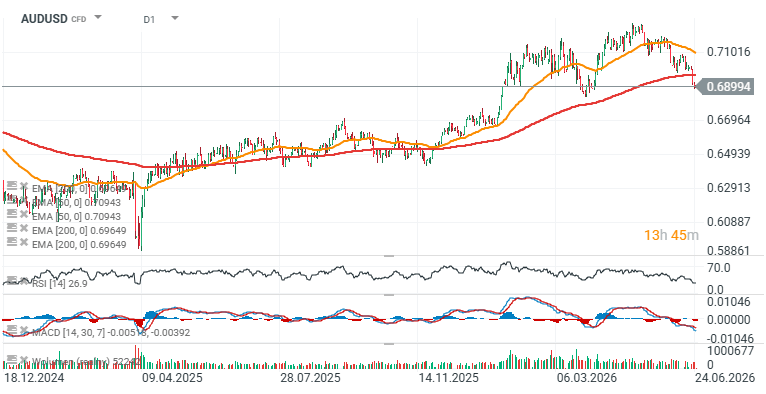
Looking at the AUD/USD chart, the pair has fallen below the 200-period EMA (red line), which has generally acted as a springboard for rebounds since April 2025. The key question now is whether this latest decline marks the beginning of a more durable trend reversal or simply a deeper correction similar to previous pullbacks. The nearest major support is located around 0.67 , corresponding to the March swing lows, while the 200-period EMA near 0.70 now represents the primary resistance level.
To provide the best experiences, we use technologies like cookies to store and/or access device information. Consenting to these technologies will allow us to process data such as browsing behavior or unique IDs on this site. Not consenting or withdrawing consent, may adversely affect certain features and functions.
Functional
Always active
The technical storage or access is strictly necessary for the legitimate purpose of enabling the use of a specific service explicitly requested by the subscriber or user, or for the sole purpose of carrying out the transmission of a communication over an electronic communications network.
Preferences
The technical storage or access is necessary for the legitimate purpose of storing preferences that are not requested by the subscriber or user.
Statistics
The technical storage or access that is used exclusively for statistical purposes.The technical storage or access that is used exclusively for anonymous statistical purposes. Without a subpoena, voluntary compliance on the part of your Internet Service Provider, or additional records from a third party, information stored or retrieved for this purpose alone cannot usually be used to identify you.
Marketing
The technical storage or access is required to create user profiles to send advertising, or to track the user on a website or across several websites for similar marketing purposes.