

Currency Hedger No Comments

Euro recovers early losses amid waning hopes of peace in Iran, higher Crude prices

  • EUR/USD picks up to the 1.1775 area but remains within previous ranges below 1.1800.
  • The Euro faltered at Monday’s opening after Trump dismissed Iran’s peace plan.
  • The recent jump in Oil prices is likely to keep Euro bulls in check.

The Euro (EUR) is trading moderately higher against the Dollar (USD), yet moving within previous ranges on Monday. The pair has returned to the upper side of the 1.1700s range, and is trading at 1.1775 at the time of writing after a negative opening, following US President Donald Trumpโ€™s rejection of Iranโ€™s peace plan.

Trump posted on social media that Tehranโ€™s latest peace proposal was โ€œtotally unacceptableโ€, crushing market hopes of a swift end to the war in the Middle East and the reopening of the Strait of Hormuz. Oil prices jumped after the news, with the barrel of Brent returning above $100, which puts the Eurozoneโ€™s Crude-importing economies under pressure and undermines the Euroโ€™s upside attempts.

On the macroeconomic front, US Nonfarm Payrolls beat expectations on Friday, showing a 115K increase, almost twice the 62K expected. These figures strengthen the case for Federal Reserve (Fed) hawks and ease pressure on the bank to cut interest rates, which provides support to the Greenback.

The economic calendar is thin in the US and Europe on Monday. Later this week, US Consumer Prices Index (CPI) data, due on Tuesday, and US Retail Sales on Thursday, together with Fed speakers throughout the week, will provide the fundamental guidance for the USD. In Europe, Germanyโ€™s final consumer inflation data on Tuesday, but above all, Wednesdayโ€™s Eurozone Gross Domestic Product (GDP) and European Central Bank (ECB) President Lagardeโ€™s speech, will be the highlights of the week.

Technical Analysis: Bulls to be tested at 1.1800

EUR/USD CHART ANALYSIS

,
EUR/USD shows a modest bullish bias with momentum readings backing this constructive tone. The 4-hour Relative Strength Index is near 60, and the Moving Average Convergence Divergence (MACD) remains in positive territory, hinting that buyers retain control.

Bulls, however, are likely to meet significant resistance at the area between 1.1790 and 1.1800 (around April 20, May 6, 8 highs), which, so far, is closing the path to April’s high, in the 1.1850 area. Further up, February’s top, at the 1.1930 area, would come into focus.

On the downside, session lows at the 1.1750 area and Friday’s lows, near 1.1725, are likely to provide some support to a potential bearish reversal, although the key support is at the area between 1.1645 and 1.1675, which contained downside attempts in April.

Currency Hedger No Comments

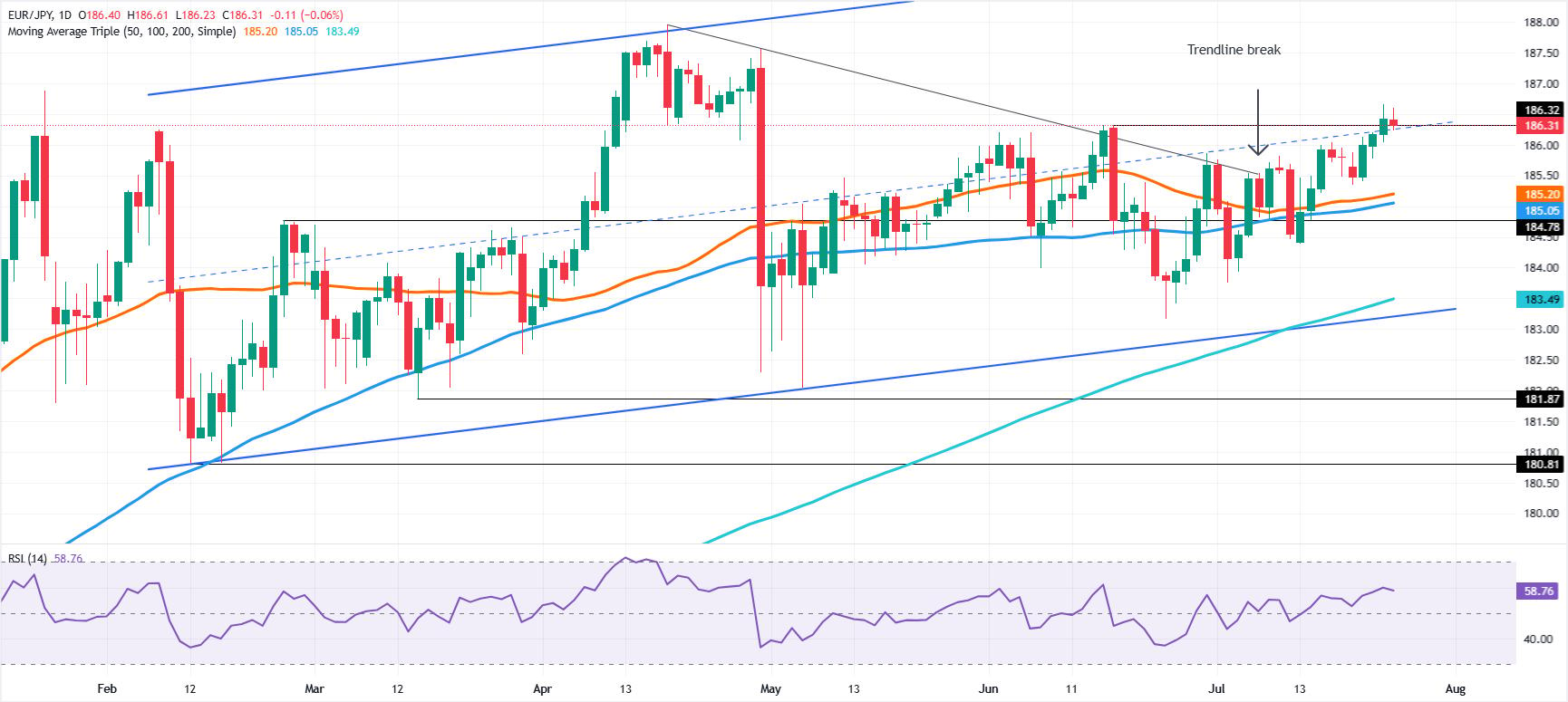
EUR/JPY – Tests 50-day EMA barrier near 185.00

  • EUR/JPY is challenging immediate resistance at the 50-day EMA of 184.86.
  • The 14-day Relative Strength Index around 47 indicates momentum has eased toward neutral territory.
  • The primary barrier lies at the nine-day EMA at 184.75.

EUR/JPY extends its winning streak for the third successive day, trading around 184.80 during the Asian hours on Monday. The technical analysis of the daily chart indicates the currency cross consolidating in a neutral tone as it holds just above the nine-day Exponential Moving Average (EMA) but remains capped by the 50-day EMA.

This tight EMA squeeze hints at an indecisive market after the recent pullback, while the 14-day Relative Strength Index (RSI) near 47 suggests momentum has cooled toward neutral rather than signaling outright oversold conditions.

On the upside, the EUR/JPY cross is testing the immediate resistance at the 50-day EMA of 184.86. A successful break above the medium-term averages would support the bullish momentum and lead the currency cross to explore the region around the all-time high of 187.95, which was recorded on April 17.

The EUR/JPY cross is positioned slightly above the nine-day EMA at 184.75. A sustained break below the short-term average would cause the bearish emergence and put downward pressure on the currency cross to navigate the region around a nearly 11-week low of 181.87, recorded on March 16, followed by a five-month low of 180.81, which was reached on February 12.

EUR/JPY: Daily Chart

(The technical analysis of this story was written with the help of an AI tool.)

Euro Price Today

The table below shows the percentage change of Euro (EUR) against listed major currencies today. Euro was the strongest against the New Zealand Dollar.

USDEURGBPJPYCADAUDNZDCHF
USD0.25%0.32%0.31%0.10%0.22%0.36%0.34%
EUR-0.25%0.07%0.04%-0.18%-0.01%0.12%0.08%
GBP-0.32%-0.07%-0.02%-0.25%-0.10%0.04%0.00%
JPY-0.31%-0.04%0.02%-0.21%-0.04%0.07%0.03%
CAD-0.10%0.18%0.25%0.21%0.17%0.24%0.24%
AUD-0.22%0.01%0.10%0.04%-0.17%0.11%0.09%
NZD-0.36%-0.12%-0.04%-0.07%-0.24%-0.11%-0.02%
CHF-0.34%-0.08%-0.00%-0.03%-0.24%-0.09%0.02%

The heat map shows percentage changes of major currencies against each other. The base currency is picked from the left column, while the quote currency is picked from the top row. For example, if you pick the Euro from the left column and move along the horizontal line to the US Dollar, the percentage change displayed in the box will represent EUR (base)/USD (quote).

Currency Hedger No Comments

EUR/USD up 0.4% Before The NFP

Key takeaways

  • The US dollar is weakening ahead of the report’s release.
  • The market is pricing in no change to US interest rates through the end of the year.
  • A weak reading could boost expectations for rate cuts.

USD remains under pressure despite this morning’s headlines, which cast doubt on the sustainability of the ceasefire between the US and Iran. The April NFP report on the US labour market is due to be released at 14:30, and will serve as a significant test for the dollar, which has been losing ground in recent days. The US currency remains under pressure despite this morningโ€™s headlines, which cast doubt on the sustainability of the US-Iran ceasefire.

Latest reading March saw a particularly strong reading. The number of non-farm payrolls far exceeded even the most optimistic expectations, reaching its highest level since December 2024 (178k). In contrast, the unemployment rate (4.3%) and wage growth (3.5%) fell unexpectedly. The reading signalled that the Fed is not forced to cut interest rates hastily, which, given the rapid rise in energy prices, was exceptionally valuable.

Geopolitical context The situation on the geopolitical front remains tense. A glimmer of optimism came from Wednesdayโ€™s reports by Axios regarding work on a peace memorandum. Yesterday evening, however, the press was abuzz with speculation about a resumption of military action should a lasting agreement between the US and Iran not be reached before Trumpโ€™s visit to China. This is scheduled for 14โ€“15 May.

Monetary policy

The data is of fundamental importance to the Federal Reserve, which has a dual mandate requiring it to focus on both price stability and maximising employment. The markets are undecided as to the direction the FOMC will take in the coming months. The inflation situation is causing growing concern, which led to a significant split within the committee at its last meeting โ€“ as many as three of its members opposed the so-called โ€œeasing biasโ€, i.e. the preference for lower interest rates in the medium term. The April inflation reading, due next Tuesday, is expected to show the headline measure rising to 3.7%. However, policymakers will focus primarily on the core measure, wage growth and inflation expectations, as they are unable to exert much influence over inflation driven by supply-side factors, such as rising energy prices. Markets are currently pricing in no change to interest rates until the end of 2026.

A weak reading, suggesting that the labour market situation is deteriorating, moving away from the still relatively safe low fire-low hire status, may signal that the economy will need a monetary stimulus. This is, in any case, consistent with the rather dovish rhetoric presented by Kevin Warsh, who will take the helm of the FOMC from its next meeting. A strong reading could, in turn, help the Committee to focus almost all its attention on the inflation situation, swelling the ranks of the hawks, which already appear to be numerous following the last meeting.

Current data

The most recent data โ€“ weekly jobless claims โ€“ are particularly noteworthy; a week ago they fell to 189k, the lowest level since 1969, remaining at low levels this week (200k). The ADP data also showed healthy levels (although since the pandemic, their correlation with the NFPs has been significantly weaker). Chart: NFP and ADP data (2015 – 2026)

Source: XTB, 08/05/2026

Currency Hedger No Comments

Trade of The Day – USD/CAD

Facts:

  • The pair is testing the +1 standard deviation line of the anchored VWAP, calculated from 2 January 2025
  • Canada is one of the worldโ€™s leading oil exporters

Recommendation:

  • Long position on USDCAD at market price
  • SL: 1.35575
  • Target Price: 1.38880

Opinion:

The USD/CAD pair is currently trading around 1.3647, within a support zone defined by key volume patterns from the volume profile built since the start of 2025. Both the Stop Loss (1.35575) and Take Profit (1.38880) levels have been set in relation to the largest volume clusters visible on the profile โ€“ zones of historically high market activity which act as strong technical barriers. The price is approaching the lower boundary of a multi-month consolidation phase, and the 1.3620โ€“1.3660 zone has repeatedly acted as a support level triggering upward movements, which confirms the validity of opening a technical long position.

The key fundamental argument is the CADโ€™s dependence on oil prices โ€“ Canada is one of the leading exporters of crude oil, and the Canadian dollar functions de facto as a petrodollar, meaning that any further falls in oil prices directly weaken the CAD and support an increase in USD/CAD. Given the growing oversupply in the oil market and the expected increase in production by OPEC countries, the risk of continued pressure on oil prices remains real, which further favours the long side on this pair, following a fairly significant depreciation over the long term.

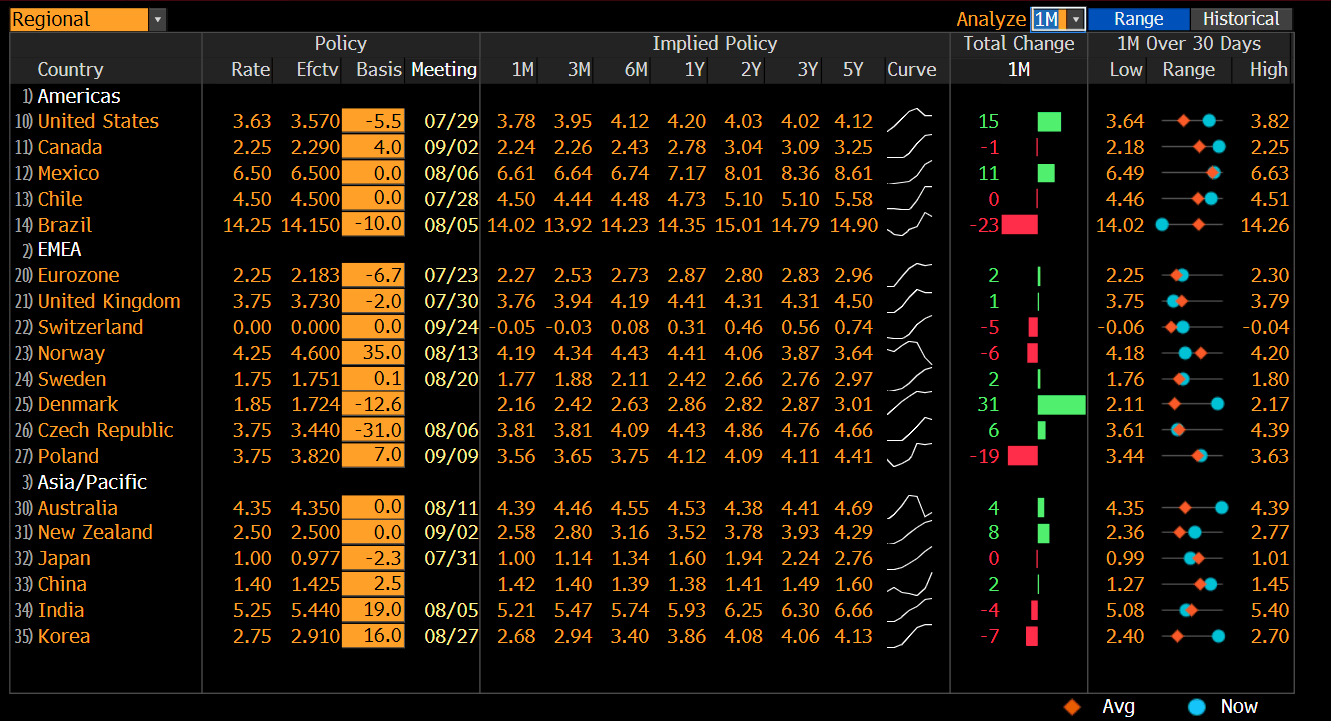
Although the money markets are pricing in a more hawkish shift in the Bank of Canadaโ€™s stance in the future compared to the current one, the spread in short-term yields between the US and Canada (1M: 3.64 vs. 2.25) still points to a carry trade in favour of the USD. However, we recommend exercising particular caution, as the fundamental environment for this pair may change rapidly and thus undermine the current basis for this recommendation.

Source: xStation

Methodology and assumptions:

The recommendation is based on a technical and fundamental analysis of the USD/CAD chart. Classical technical analysis was used to assess the situation and analyse the trend.

Currency Hedger No Comments

EUR/JPY Price Forecast: Hovers around 184.00 as near-term bearish bias maintains

  • EUR/JPY may fall toward the 11-week low around 181.87.
  • The 14-day Relative Strength Index stands at 41.75, signaling persistent downside pressure.
  • The primary resistance lies at the nine-day EMA at 184.62.

EUR/JPY steadies after posting a little gain in the previous trading day, hovering around 184.00 during the Asian hours on Friday. The technical analysis of the daily chart indicates the currency cross maintains a bearish near-term bias as spot holds beneath both the 50-day and nine-day Exponential Moving Averages (EMAs).

The EUR/JPY cross extends a corrective phase below the nine-period and 50-period Exponential Moving Averages (EMAs), which together reinforce a bearish near-term bias as dynamic resistance overhead.

The 14-day Relative Strength Index (RSI) at 41.75 hovers below the midline, hinting that downside pressure persists but without entering oversold territory, leaving room for further weakness if sellers retain control.

On the downside, the EUR/JPY cross may navigate the region around the initial support, around the 11-week low of 181.87, recorded on March 16, followed by a five-month low of 180.81, which was reached on February 12.

The EUR/JPY cross may rebound toward the primary resistance at the nine-day EMA of 184.62, followed by the 50-day EMA of 184.84. A successful break above the short- and medium-term averages would revive the bullish bias and support the currency cross to explore the region around the all-time high of 187.95, which was recorded on April 17.

EUR/JPY: Daily Chart

Euro Price Today

The table below shows the percentage change of Euro (EUR) against listed major currencies today. Euro was the weakest against the Australian Dollar.

USDEURGBPJPYCADAUDNZDCHF
USD-0.05%-0.03%-0.09%-0.07%-0.15%-0.11%-0.03%
EUR0.05%0.00%-0.04%-0.02%-0.10%-0.02%0.04%
GBP0.03%-0.00%-0.04%-0.03%-0.11%-0.03%0.03%
JPY0.09%0.04%0.04%0.03%-0.08%-0.01%0.07%
CAD0.07%0.02%0.03%-0.03%-0.12%-0.04%0.04%
AUD0.15%0.10%0.11%0.08%0.12%0.09%0.14%
NZD0.11%0.02%0.03%0.01%0.04%-0.09%0.06%
CHF0.03%-0.04%-0.03%-0.07%-0.04%-0.14%-0.06%

The heat map shows percentage changes of major currencies against each other. The base currency is picked from the left column, while the quote currency is picked from the top row. For example, if you pick the Euro from the left column and move along the horizontal line to the US Dollar, the percentage change displayed in the box will represent EUR (base)/USD (quote).

Currency Hedger No Comments

NOK surges following Norges Bank’s rate hike

Key takeaways

  • Norges Bank raises interest rates by 25 bp.
  • The key interest rate is up to 4.25%.
  • The move represents the first hike from a major European central bank.
  • EUR/NOK is down by approx. 0.5%

Contrary to most economists’ expectations, Norges Bank decided to raise interest rates by 25 bp, bringing the benchmark rate up to 4.25%. Norges Bank is thus the first major European central bank to decide on such move. Earlier, the ECB, BoE, and Riksbank had opted to hold rates steady. In response to the move, the Norwegian krone strengthened by approx. 0.5% against the benchmark euro, recouping a significant share of yesterdayโ€™s losses, which were largely the result of declining energy commodity prices.

Figure: EUR/NOK (2025-2026)

Source: xStation,

07/05/2026 The hike is primarily intended to anchor inflation expectations, especially in light of fairly persistent core inflation, which remained at 3% in March, and still elevated wage growth, which exceeds 4% YoY in many sectors. Officialsโ€™ statements lacked clear indications regarding future moves. The meeting was not accompanied by a new interest rate projection. The March one suggested a single rate hike before the end of the yearโ€”under current conditions, however, it seems likely that the bank will continue to tighten its monetary policy in the coming months. A rate hike at the June (18/06) meeting is almost fully priced in by the markets. Yet another hike in September is considered a base case scenario.

Currency Hedger No Comments

Chart of The Day – EUR/USD Higher, but Still a Game of Expectations, Not a Trend

In todayโ€™s session, EUR/USD is strengthening around the 1.17 area, but the move is not driven by a single dominant factor. Instead, it reflects a combination of several parallel impulses, including unchanged policy rates from both the Fed and the ECB, improving sentiment linked to potential de-escalation of tensions around Iran, and stronger-than-expected German industrial data. It is important to stress that the current appreciation looks more like a repricing of expectations than a durable shift in underlying fundamentals.

Source: xStation5

What is shaping EUR/USD price action? Fed on hold, but the market is already pricing rate cuts

The Federal Reserve kept interest rates unchanged, while signalling a gradual slowdown in economic momentum and increasing sensitivity in the labour market. At the same time, inflation in the US is still not fully under control, particularly in services and core inflation, where price pressures remain persistent. Despite this, markets are increasingly pricing in future rate cuts, not as a response to rapidly falling inflation, but rather as a reaction to a potential weakening in economic activity. This scenario reduces the attractiveness of the US dollar and gradually supports EUR/USD through expectations of a narrowing interest rate differential.

The ECB remains cautious, with no automatic path to hikes

The European Central Bank also left rates unchanged, maintaining a cautious and data-dependent communication stance. While some forecasts still allow for further tightening, the dominant view remains one of stabilisation and inflation-driven decisions rather than an aggressive hiking cycle. At the same time, improving real economy data, especially from Germany, is limiting earlier expectations of a deeper slowdown in the euro area, supporting the single currency through the activity channel rather than monetary policy expectations alone.

Geopolitics and hopes for an Iran agreement

Reports of potential de-escalation in tensions surrounding Iran are improving global risk sentiment. A decline in the geopolitical risk premium reduces demand for the US dollar as a traditional safe-haven currency, while benefiting risk-sensitive assets such as the euro. In addition, a potential easing of tensions in the Middle East lowers pressure on energy prices, which in the medium term could reduce inflationary pressures and strengthen expectations of a more accommodative Fed stance.

Germany surprises to the upside, lifting European sentiment

Stronger-than-expected German industrial data is an important element of todayโ€™s market picture. Against the backdrop of earlier concerns about stagnation in Europe, this release is helping stabilise perceptions of the euro area. As a result, the euro is increasingly seen not only through the lens of cyclical weakness, but also as a relatively stable alternative to the US dollar, particularly in an environment of shifting monetary policy expectations.

What else is influencing the market in the background

Beyond central bank decisions and macroeconomic data, the key driver remains the pace of change in market expectations regarding future Fed and ECB policy. The market is currently in a repricing phase rather than a full economic cycle shift. This makes EUR/USD particularly sensitive to incoming data and central bank communication that could either confirm or challenge the scenario of faster US easing combined with relatively stable policy in Europe. In such an environment, even moderately positive European data can support the euro in the short term, but the sustainability of the trend will ultimately depend on whether the Fed actually moves towards more decisive monetary easing.

Currency Hedger No Comments

Trade of The Day – EUR/CHF

Facts:

  • The pair returned below the horizontal resistance area at 0.9220
  • EURCHF is trading below the 100-period exponential moving average from D1 interval

Recommendation: Trade: Short EURCHF at market price Target: 0.8995 Stop: 0.9272

Opinion:

Looking at EURCHF on the D1 interval, one can see a potential downward trend resumption. Following a break above the 1:1 geometry, the pair quickly returned below the upper limit of the aforementioned 1:1 structure. According to the Overbalance methodology, the main trend remains downward. In addition the pair sits below the 100-period moving average from the D1 interval. We recommend going short USDCAD at market price with a target of 0.8995. We also recommend placing a stop loss order at 0.9272.

Source: xStation