

Currency Hedger No Comments

Currency Talk – USDCAD, AUDUSD, EURNZD

Key takeaways

  • What is the technical outlook for USDCAD, AUDUSD and EURNZD?

This analysis from the Overbalance series aims to identify three financial instruments, analysed primarily on the daily/four-hour (D1/H4) timeframe. The analysis utilises only the Overbalance methodology, which helps to identify points where a trend may continue or where a reversal may occur. Todayโ€™s analysis covers three instruments, assessed solely in terms of 1:1 correction structures. USDCAD USDCAD prices remained in a downtrend throughout April, but in recent days the 1:1 downtrend pattern has been negated at the 1.3630 level, which, according to the Overbalance methodology, may signal a significant upward correction or even a trend reversal. Currently, the key support level remains at 1.3655, where the lower boundary of the local 1:1 pattern is located. As long as the price remains above this level, the bullish scenario remains in place. Conversely, a return below 1.3630, i.e. below the polarity of the previously negated pattern, could once again open the way for further declines.
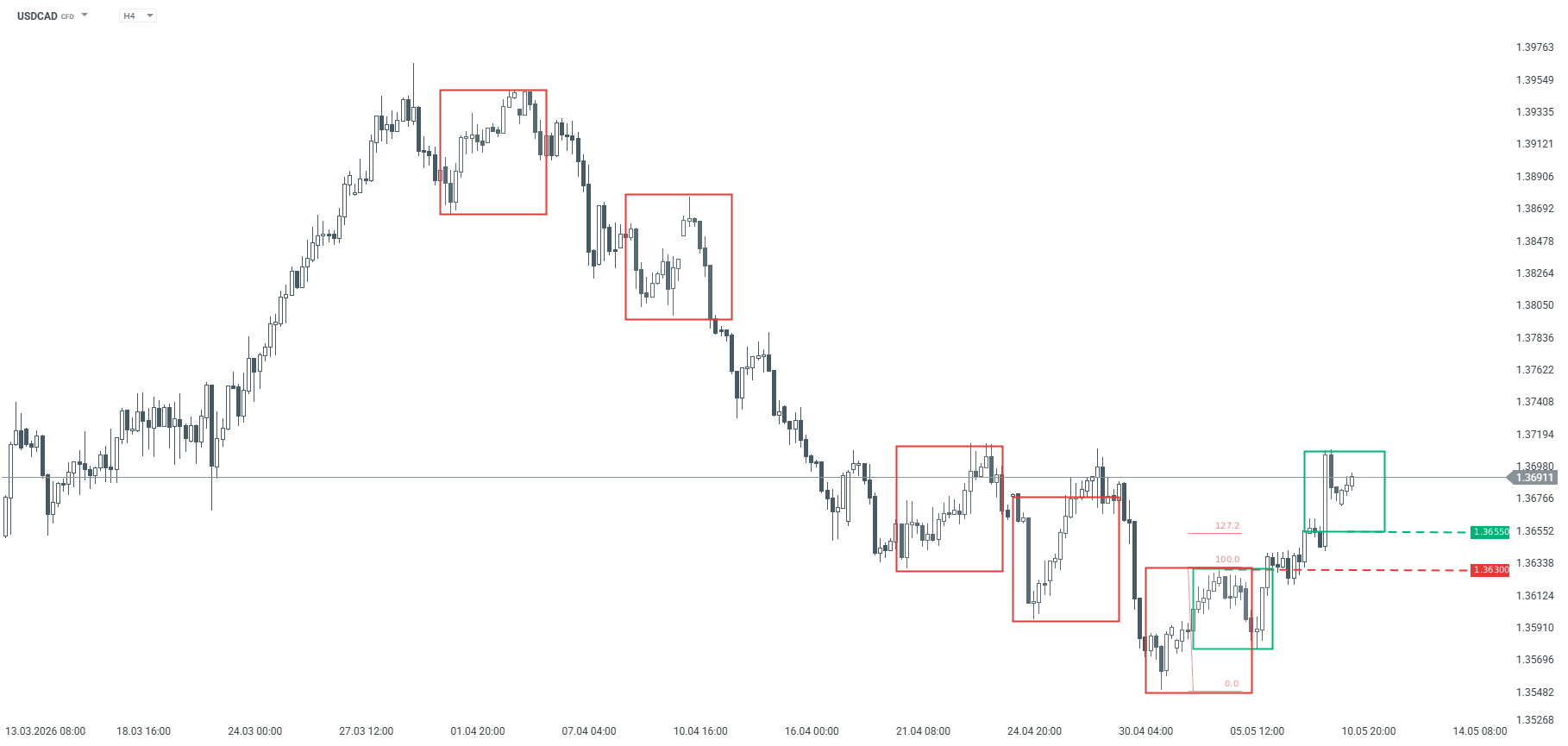
USDCAD โ€“ H4 timeframe. Source: xStation AUDUSD The AUDUSD exchange rate has been on an upward trend since the beginning of April. The key support level for the exchange rate is currently 0.7170. According to the Overbalance methodology, as long as the price remains above this level, the upward trend remains in place.
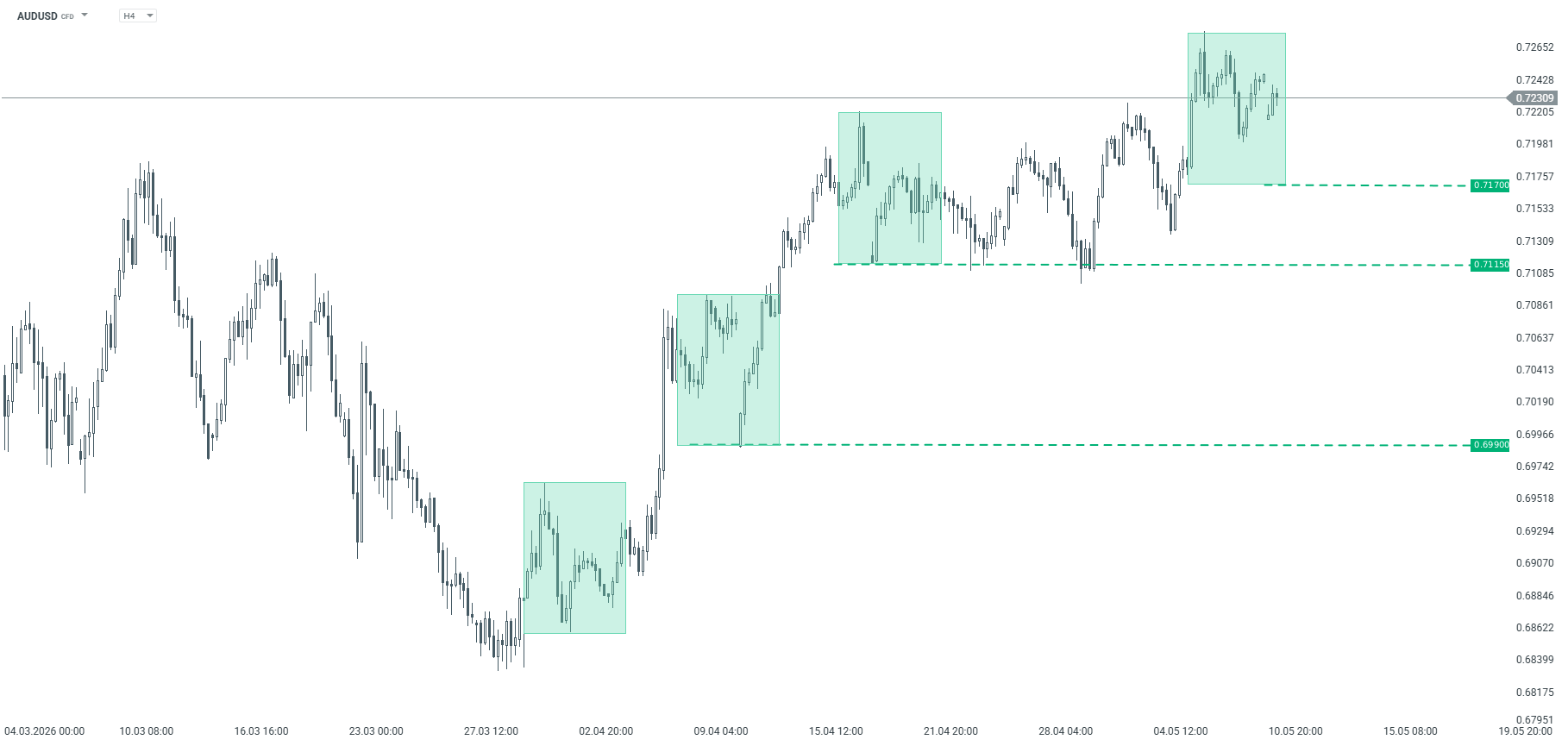
AUDUSD โ€“ H4 chart. Source: xStation EURNZD Since 7 April, the EURNZD has been trading in a downtrend. Should the upward correction extend, the key resistance level remains at 1.9872. As long as the price stays below this level, the bearish scenario remains in place. Conversely, for a return to the uptrend to be considered, the price would need to rise above the 1.9969 level, where the polarity of the previously negated 1:1 upward geometry is located.
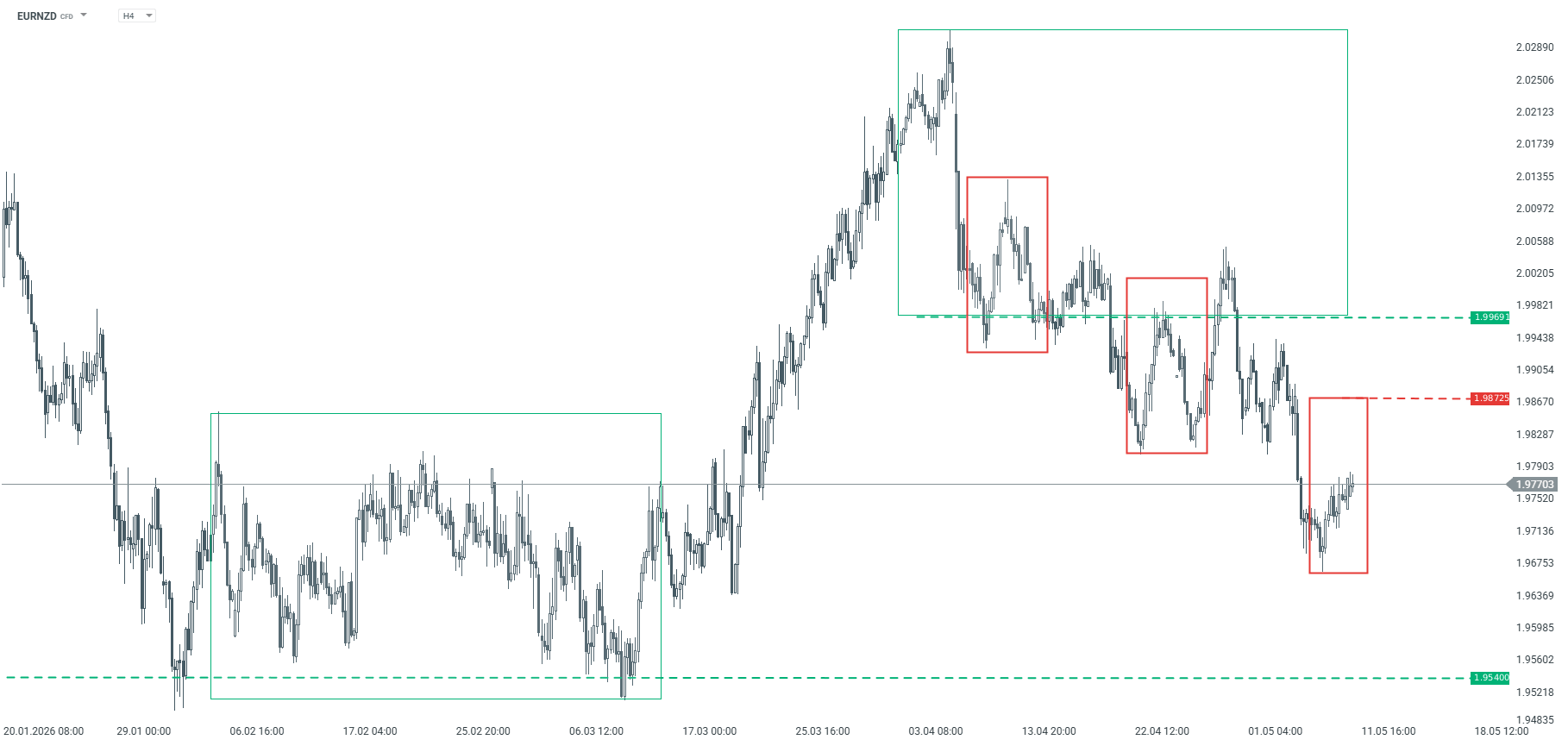
EURNZD โ€“ H4 timeframe. Source: xStation

Currency Hedger No Comments

Australian Dollar strengthens against Japanese Yen on hawkish RBA path

  • AUD/JPY trades with mild gains around 113.60 in Mondayโ€™s early European session. 
  • Market pricing indicates the OCR could reach 4.7% by the end of 2026, with no cuts expected until 2028. 
  • Japanโ€™s officials intervened in the FX market during the holidays in early May. 

The AUD/JPY cross posts modest gains near 113.60 during the early European trading hours on Monday. The Australian Dollar (AUD) edges higher against the Japanese Yen (JPY) on a hawkish tone from the Reserve Bank of Australia (RBA). Nonetheless, traders remain cautious of potential further interventions from the Japanese authorities. 

The Australian central bank raised its Official Cash Rate (OCR) to 4.35% last week, matching its December 2024 peak, as inflation remains elevated. This marks the third consecutive rate hike this year. According to the statement, the RBA said inflation had picked up materially in the second half of 2025, with conflict in the Middle East pushing up fuel and commodity prices. 

The RBA signaled that more rate hikes were on the horizon, with its economic forecasts pencilling in a 4.70% policy rate by the end of 2026, with no cuts expected until 2028, according to CNBC.

However, the potential upside for the cross might be limited amid intervention fears. Japanese officials reportedly intervened in the currency market again during the Golden week. 

Markets estimated the cost of these additional moves at approximately ยฅ4 trillion to ยฅ5 trillion ($32 billion). Japanโ€™s top foreign exchange official, Atsushi Mimura, said last week that continued intervention was possible.

Currency Hedger No Comments

AUD holds losses following Chinaโ€™s CPI inflation data

  • AUD/USD weakened as the US Dollar strengthened amid rising market risk aversion.
  • Chinaโ€™s CPI rose 1.2% YoY in April, above Marchโ€™s 1.0% increase and the 0.8% forecast.
  • US Nonfarm Payrolls rose by 115K in April, beating forecasts despite slowing from Marchโ€™s 185K increase.

AUD/USD gains ground after opening at a bearish gap but still remains in the negative territory, trading around 0.7240 during the Asian hours on Monday. The pair moves little despite stronger-than-expected Chinaโ€™s Consumer Price Index (CPI) data. Any change in the Chinese economy could impact the Australian Dollar (AUD) as China and Australia are close trading partners.

Chinaโ€™s Consumer Price Index (CPI) rose 1.2% YoY in April, accelerating from Marchโ€™s 1.0% increase and beating the 0.8% forecast. CPI inflation arrived at 0.3% MoM in April, versus a fall of 0.7% prior, hotter than the expectation of a 0.1% decline. Producer Price Index (PPI) rose 2.8% YoY in April, following a 0.5% increase in March. The data came in above the market consensus of a 1.5% rise.

The AUD/USD pair came under pressure as the US Dollar (USD) strengthened amid growing risk aversion after US President Donald Trump and Iran dismissed each otherโ€™s latest peace initiatives aimed at ending the Middle East conflict.

According to Bloomberg on Sunday, Trump turned down Iranโ€™s latest peace proposal, describing it as โ€œtotally unacceptable.โ€ Iranian state television reported that an Iranian official said Tehranโ€™s response emphasized ending the conflict across all fronts, particularly in Lebanon, while also addressing the security of shipping routes through the strait, though no details were provided regarding how or when the key waterway could reopen.

An extended Middle East conflict and the fragile ceasefire between the US and Iran may continue to support safe-haven demand for the Greenback, potentially weighing on the major currency pair in the near term.

The US Bureau of Labor Statistics released data on Friday indicating that Nonfarm Payrolls (NFP) increased by 115K in April, down from Marchโ€™s 185K reading but still exceeding the market forecast of 62K. At the same time, the Unemployment Rate remained unchanged at 4.3% in April, matching analystsโ€™ expectations.

Currency Hedger No Comments

AUD/JPY Price Forecast: Advances on improved risk sentiment, holds bullish bias above 100-day EMA

  • AUD/JPY gains ground near 113.20 in Fridayโ€™s early European session.ย 
  • The positive outlook of the cross remains intact above the key 100-day EMA, with modest bullish RSI momentum.ย 
  • The first upside barrier emerges at 113.65; the initial support level to watch is 112.50.ย 

The AUD/JPY cross trades in positive territory around 113.20 during the early European session on Friday. A potential truce between the United States (US) and Iran improves risk sentiment, supporting the Australian Dollar (AUD) against the Japanese Yen (JPY). The US President Donald Trump administration has been waiting for Iran to respond to its proposal to reopen the Strait of Hormuz and end the war.

On the other hand, fears of further interventions from Japanese authorities might help limit the JPYโ€™s losses. Reuters reported on Friday, citing a source familiar with the matter, that Japanโ€™s officials intervened in the foreign exchange market during holidays in early May after having conducted Japanese Yen-buying operations on April 30. The source said: โ€œThe intervention since the start of May was timed to coincide with the holiday period, when market liquidity was thin.โ€

Chart Analysis AUD/JPY

Technical Analysis:

In the daily chart, AUD/JPY holds a constructive near-term bias as it trades well above the 100-day exponential moving average (EMA), while the Bollinger Bands (20) show price consolidating in the upper half of the envelope. The Relative Strength Index (14) at 52 keeps a neutral-to-positive tone, hinting that upside pressure is moderating but not yet reversing.

On the topside, initial resistance emerges at the Bollinger middle band, the 20-day simple moving average near 113.65, ahead of the recent Bollinger upper band peak around 114.75. On the downside, the lower Bollinger band at 112.50 offers the first line of support. The key contention level to watch is the 100.00 psychological level, with the more important dynamic floor coming in at the 100-day EMA around 109.65, where a break would be needed to undermine the prevailing bullish structure.

Currency Hedger No Comments

Australian Dollar recovers latest losses following Trade Balance data

  • AUD/USD may rebound as easing US-Iran tensions weaken safe-haven demand for the US Dollar.
  • Iran said a US proposal to end the war remains under consideration after reports of a possible agreement.
  • The US Dollar may weaken as easing inflation pressures strengthen expectations for Fed interest rate cuts.

AUD/USDย gains ground for the third successive day, trading around 0.7240 during the Asian hours on Thursday. The Australian Dollar (AUD) recovers its daily losses against the US Dollar (USD) following the release of Australiaโ€™s Trade Balance data.

The Australian Bureau of Statistics reported on Thursday that Australia posted a Trade Deficit of $1,841M in March, compared with a revised $5,026M surplus in February (previously $5,686M). Markets had expected a $4,250M surplus. Meanwhile, Exports fell 2.7% month-over-month (MoM) after rising 4.2% previously, while monthly imports surged 14.1% following a prior 2.7% decline.

The Australian Dollar may further receive support from hopes that the US and Iran are moving closer to an agreement to end the war. The BBC reported on Wednesday that Iran said a US proposal to end the war is “still being considered” after reports that the two countries could be close to an agreement. The US has presented a one-page memorandum of understanding to Iran that would gradually reopen the Strait of Hormuz and lift the American blockade on Iranian ports. Detailed talks on Iranโ€™s nuclear program would come later in the process, the person said, adding that nothing has been agreed upon yet.

CNBC reported on Wednesday that US President Donald Trump said that Iran will be bombed โ€œat a much higher levelโ€ if it doesnโ€™t agree to a peace deal. Trump, in a Truth Social post, said the US military offensive known as Operation Epic Fury โ€œwill be at an endโ€ if Iran โ€œagrees to give what has been agreed to, which is, perhaps, a big assumption.โ€

The US Dollar could face challenges as easing concerns over price pressures could convince the USย Federal Reserveย (Fed) to cut the interest rate rather than keep policy restrictive for longer.

Currency Hedger No Comments

AUD/USD Price Forecast: Rallies to June 2022 high, closer to mid-0.7200s on weaker USD

  • AUD/USD attracts strong follow-through buyers amid a combination of supporting factors.
  • US-Iran peace deal hopes and receding hawkish Fed expectations weigh heavily on the USD.
  • The RBAโ€™s hawkish outlook benefits the Aussie and contributes to the positive momentum.

Theย AUD/USDย pair is seen building on the previous day’s bounce from the 0.7135 region, or the weekly low, and gaining strong follow-through positive traction for the second straight day on Wednesday. The momentum lifts spot prices to a fresh high since June 2022, closer to mid-0.7200s, during the Asian session, and is sponsored by a broadly weaker US Dollar (USD).

The incoming headlines fuel optimism over a potential US-Iran peace deal and boost investors’ confidence, undermining the safe-haven buck and benefiting the risk-sensitive Aussie. Furthermore, sliding Crude Oil prices ease inflationary concerns and temper bets for a rate hike by the USย Federal Reserveย (Fed). This exerts additional pressure on the USD, which, along with the Reserve Bank of Australia’s (RBA) hawkishย outlook, contributes to the bid tone surrounding the AUD/USD pair.

From a technical perspective, spot prices hold a bullish near-term bias following the recent resilience below the 100-period Exponential Moving Average (EMA) on the 4-hour chart. The said support is pegged at 0.7145, which now underpins the broader upturn from recent lows. Moreover, a firm Relative Strength Index (RSI) around 65 suggests strong but maturing upside momentum, while the positive Moving Average Convergence Divergence (MACD) reading hints that buyers still retain control.

This, in turn, suggests that any corrective pullback might still be seen as a buying opportunity near the 100-period EMA on H4, at 0.7145, as the broader structure remains constructive above this zone. A sustained break beneath this moving average would weaken the current bullish tone and open the door to a deeper corrective phase on the four-hour timeframe.

(The technical analysis of this story was written with the help of an AI tool.)

AUD/USD 4-hour chart

Chart Analysis AUD/USD

US Dollar Price Today

The table below shows the percentage change of US Dollar (USD) against listed major currencies today. US Dollar was the strongest against the Japanese Yen.

USDEURGBPJPYCADAUDNZDCHF
USD-0.20%-0.18%-0.06%-0.14%-0.69%-0.75%-0.20%
EUR0.20%0.02%0.15%0.07%-0.48%-0.57%0.00%
GBP0.18%-0.02%0.13%0.06%-0.50%-0.57%0.00%
JPY0.06%-0.15%-0.13%-0.09%-0.64%-0.72%-0.12%
CAD0.14%-0.07%-0.06%0.09%-0.55%-0.62%-0.04%
AUD0.69%0.48%0.50%0.64%0.55%-0.07%0.50%
NZD0.75%0.57%0.57%0.72%0.62%0.07%0.57%
CHF0.20%-0.00%-0.00%0.12%0.04%-0.50%-0.57%

The heat map shows percentage changes of major currencies against each other. The base currency is picked from the left column, while the quote currency is picked from the top row. For example, if you pick the US Dollar from the left column and move along the horizontal line to the Japanese Yen, the percentage change displayed in the box will represent USD (base)/JPY (quote).

Currency Hedger No Comments

Currency Talk – AUDCAD, GBPUSD, AUDUSD

Key takeaways

  • What is the technical outlook for AUD/CAD, GBP/USD and AUD/USD?

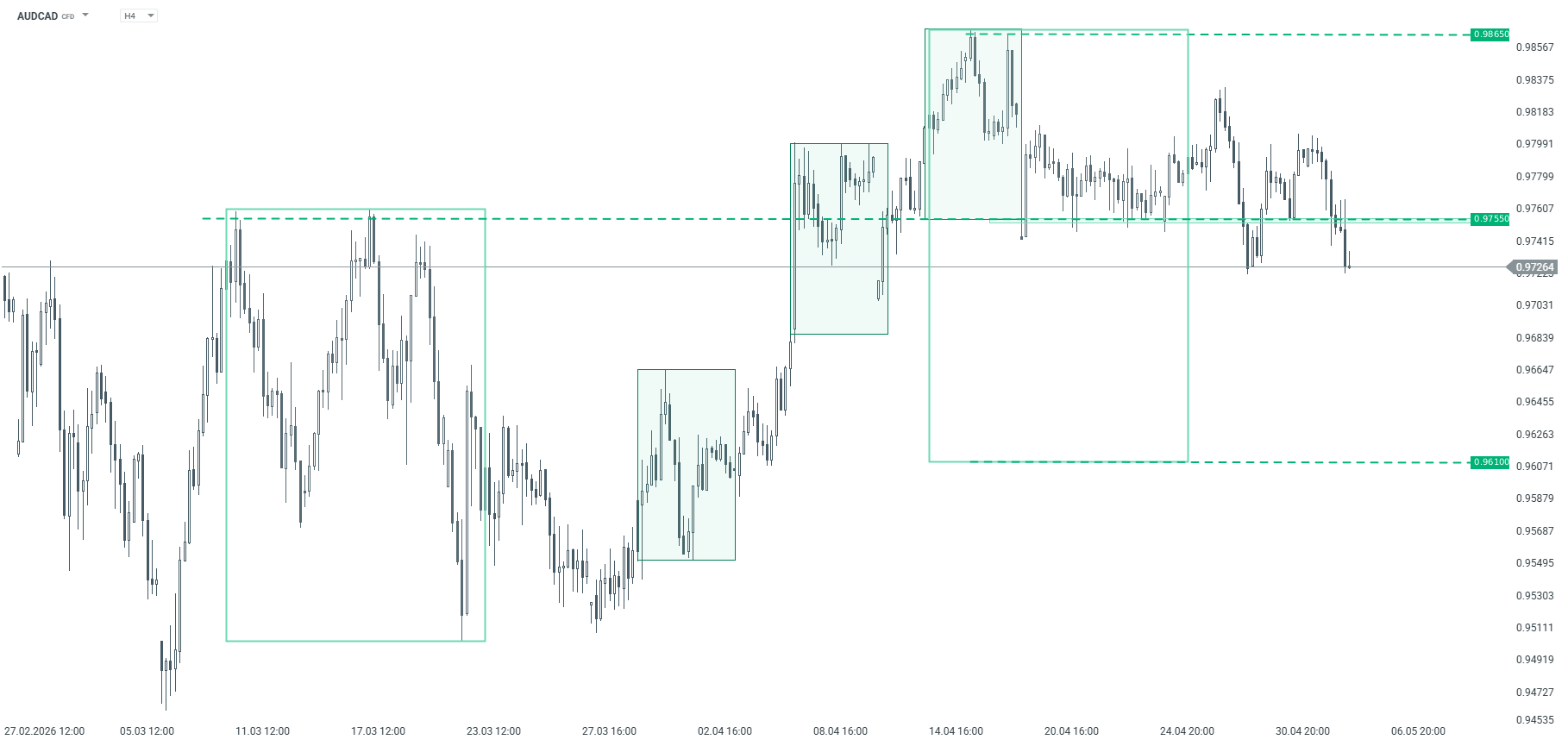
This analysis from the Overbalance series aims to identify three financial instruments, analysed primarily on the daily/four-hour timeframe (D1/H4). The analysis utilises only the Overbalance methodology, which helps to identify points where a trend may continue or where a reversal may occur. Todayโ€™s analysis covers three instruments, assessed solely in terms of 1:1 correction structures. AUDCAD After several tests, the AUDCAD exchange rate has broken through the key support level at 0.9755, which, according to the Overbalance methodology, paves the way for a deeper downward correction. A potential target for the downside is the 0.9610 level, where the lower boundary of the large 1:1 pattern is located. Currently, the 0.9755 level is acting as resistance, and only a sustained return of the price above this zone could restore the bullish scenario.

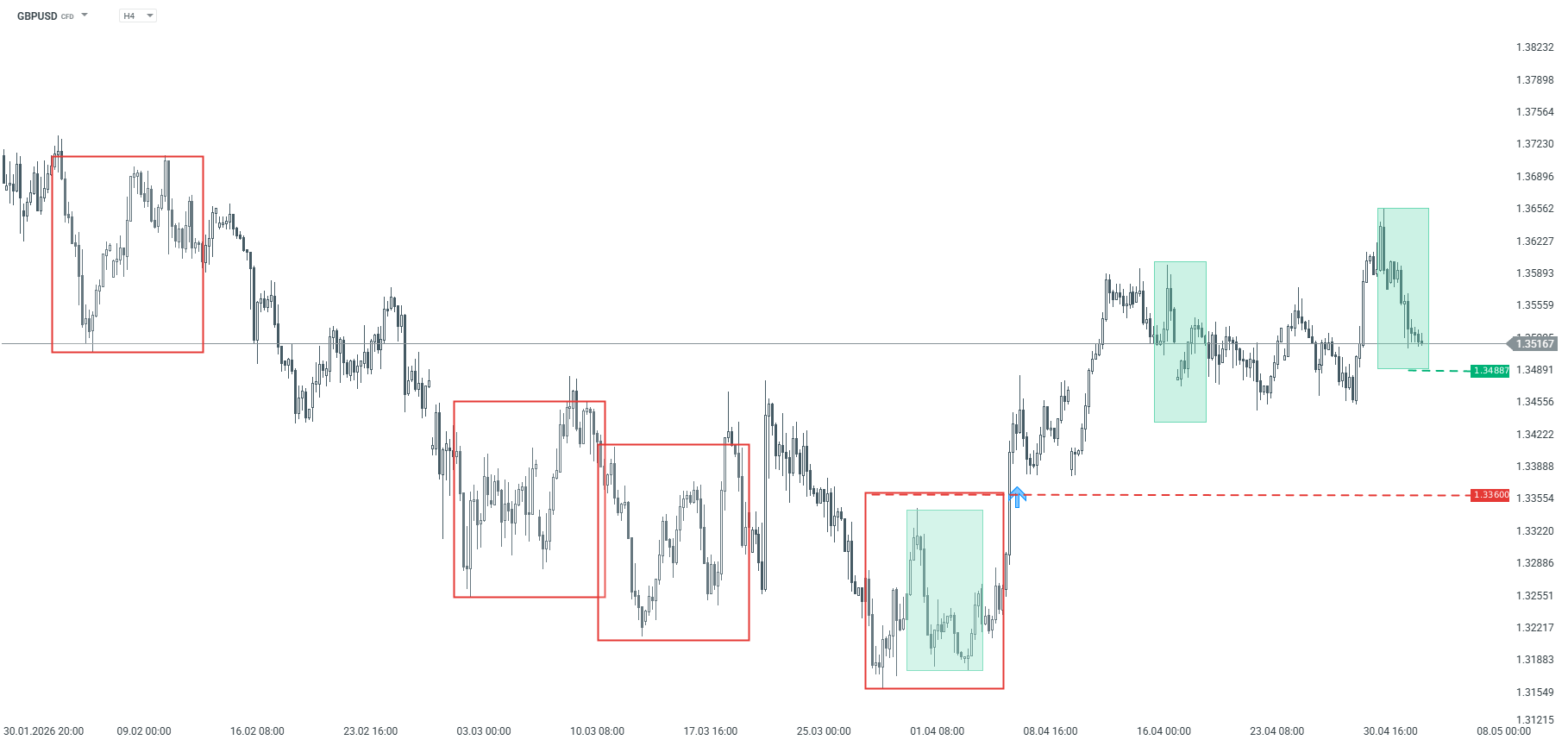
AUDCAD โ€“ H4 timeframe. Source: xStation GBPUSD Since the beginning of April, GBPUSD has been trading within a local uptrend, supported by the 1:1 bullish pattern highlighted in green. The key support level remains at 1.3488. A potential bounce at this point could lead to the generation of another upward impulse. Conversely, a break below this level would open the way for a decline towards 1.3360, where the polarity of the previously broken downward pattern lies.

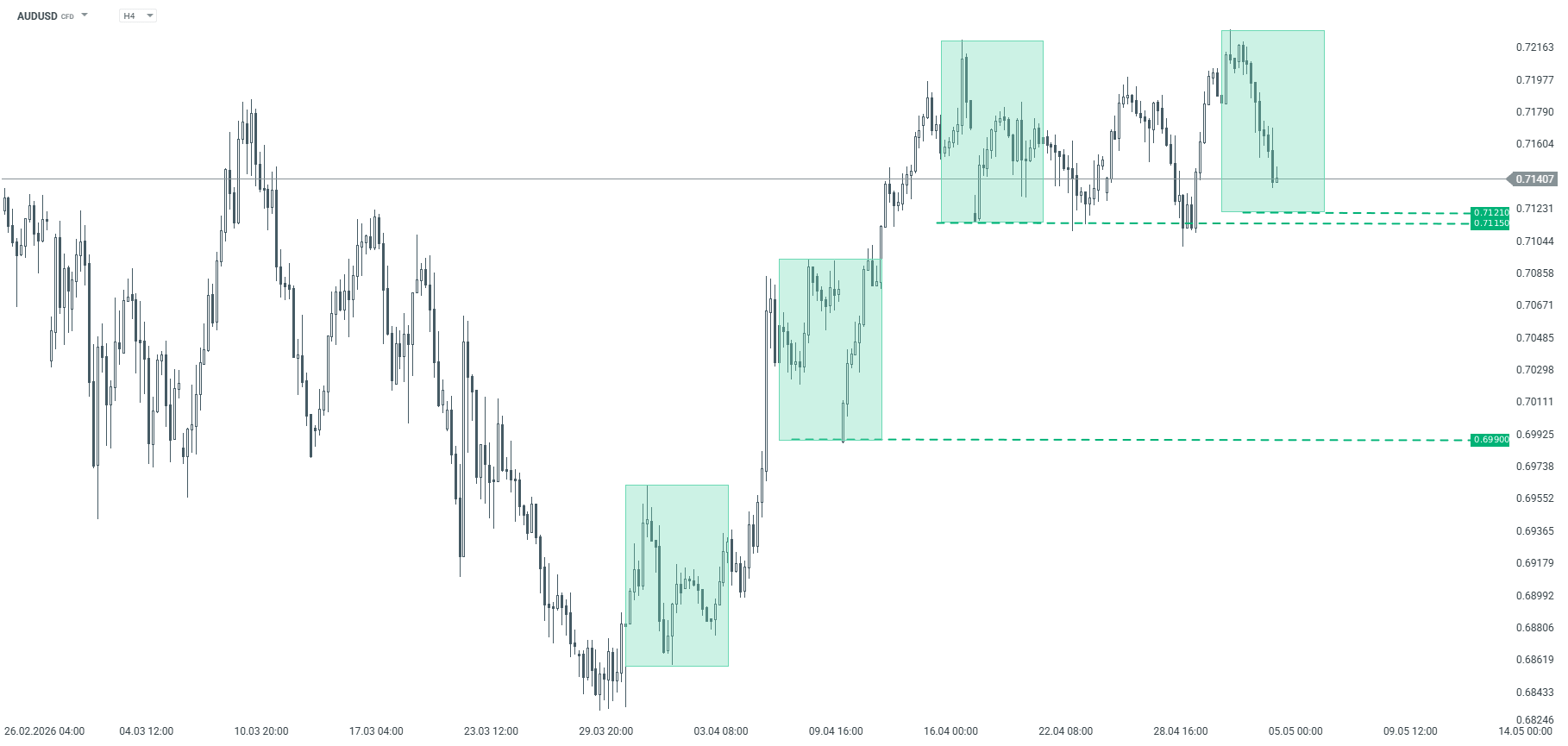
GBPUSD โ€“ H4 chart. Source: xStation AUDUSD The AUDUSD pair remains in an uptrend. Recently, the pair reached a new local high, followed by a rapid correction. Should this correction deepen, the key support level is 0.7121, derived from the lower boundary of the 1:1 pattern. As long as this level holds, the base case scenario remains a continuation of the upward trend.

AUDUSD โ€“ H4 chart. Source: xStation

Currency Hedger No Comments

AUD/USD: Consolidation risk after RBA pause โ€“ Societe Generale

Societe Generale strategists noteย AUD/USDย has pulled back after the Reserve Bank of Australia (RBA) delivered a third 25bp hike to 4.35% while signalling a pause. The pair is drifting below 0.7150 despite earlier reclaiming its 50โ€‘DMA, with risk sentiment and the RBAโ€™s dataโ€‘dependent stance expected to guide direction around key 0.7060 and 0.7225 levels.

Key supports and RBA-driven outlook

“Three hikes and done, receive the front end in Australia? Not so fast. The third rate increase today by the RBA puts the CRT at 4.35% but this is below the new higher projection of 4.7% for Dec-26 (raised from 4.2% in February). In other words, the central bank is holding powder in reserve to tighten at least once more. The rate then stays at 4.7% through 2027 and 1H-28. Core inflation peaks at 3.8% in 2Q and then drifts down to 3.1% by the end of this year, to 2.6% in 2027 and 2.5% in 1H-28. Headline CPI falls back from 4.0% in Dec-26 to 2.4% by mid-2027. “

“Governor Bullock sounded more neutral this time in her comments, prompting the receiving interest in the front end and bull steepening in 2s/10s. The further crystallisation of upside risks to inflation and inflation expectations will determine ifย ratesย are hoisted again to 4.6%, probably in August or September. A pause in June looks a done deal. The statement highlighted the risk of second-round effects across goods and services.ย Governor Bullockย reiterated that the Board has no predetermined path and will remain data-dependent, ruling nothing in or out.”

“AUD/USD reclaimed its 50โ€‘DMA in April and subsequently staged a strong rebound. However, the pair has struggled to establish itself beyond the March peak, carving out an interim high near 0.7225; this points to a lack of steady upward momentum.”

“A period of consolidation cannot be ruled out. Defence of the 50โ€‘DMA around 0.7060 is crucial for continuation of the up move. A break above 0.7225 may lead to a larger uptrend.”