
Currency Hedger No Comments

Eur softens below 1.1800 on US-Iran ceasefire risks, traders await US CPI data

  • EUR/USD weakens to around 1.1775 in Tuesdayโ€™s early Asian session.
  • Trump said the US-Iran ceasefire was on โ€˜massive life support.โ€™
  • Hawkish expectations for the ECB might help limit the Euroโ€™s losses. 

The EUR/USD pair loses ground to near 1.1775 during the early Asian session on Tuesday. The Euro (EUR) softens against the US Dollar (USD) as traders turn cautious ahead of the US April inflation report and ongoing geopolitical tensions in the Middle East. 

Reuters reported on Monday that Iranian Parliament speaker Mohammad Bagher Ghalibaf warned that Iranโ€™s military was fully prepared to retaliate against any future attacks after rising tensions threatened the fragile ceasefire in the Middle East. 

Earlier Monday, US President Donald Trump said the ceasefire between the US and Iran is on โ€œmassive life supportโ€ after he rejected Tehranโ€™s latest peace offer, which he called โ€œsimply unacceptable.โ€ Signs of a prolonged conflict between the US and Iran could boost a safe-haven currency such as the Greenback and act as a headwind for the major pair in the near term. 

On the other hand, a hawkish stance from the European Central Bank (ECB) could provide some support to the shared currency. ECB Governing Council member Martin Kocher said on Monday that thereโ€™s no need to delay the interest rate hikes if energy prices donโ€™t improve swiftly.

Financial markets are now pricing in a 92% chance of a 25 basis point (bps) hike at the June meeting, with a total of three hikes anticipated by the end of 2026, according to Reuters.


Currency Hedger No Comments

British Pound – Political risks drags against Euro โ€“ ING

INGโ€™s Chris Turner notes Sterling is softening after UK local elections, as Labourโ€™s losses fuel talk of a leadership contest and a leftward policy shift. He highlights the risk of developments around Manchester Mayor Andy Burnham re-entering parliament. Turner says markets will focus on Prime Minister Keir Starmerโ€™s policy speech and expectsย EUR/GBPย to revisit the overnight high at 0.8675.

Sterling pressured by Labour uncertainty

“Sterling is softening a little as markets digest the fall-out from local UK elections held late last week. While Labour losses were not quite as bad as feared, they have failed to quell speculation over a Labour leadership contest and a clear leftward drift in government policy.”

“Manchester Mayor Andy Burnham remains waiting in the wings and the markets will react to anyย newsย such as Burnham resigning as mayor or a sitting Labour MP resigning to make way for Burnham’s return to parliament.”

“The key focus this morning will be a policy speech from PM Keir Starmer on how he plans to address Labour’s falling popularity and take the party into the next election. The wild card here is how far he intends to embrace a return to Europe, whether that be rejoining the customs union or more controversially, the single market. “

“It will be tough for Starmer to win over his critics, and we suspect EUR/GBP finds its way back to the overnight high at 0.8675.”

Currency Hedger No Comments

Currency Talk – USDCAD, AUDUSD, EURNZD

Key takeaways

  • What is the technical outlook for USDCAD, AUDUSD and EURNZD?

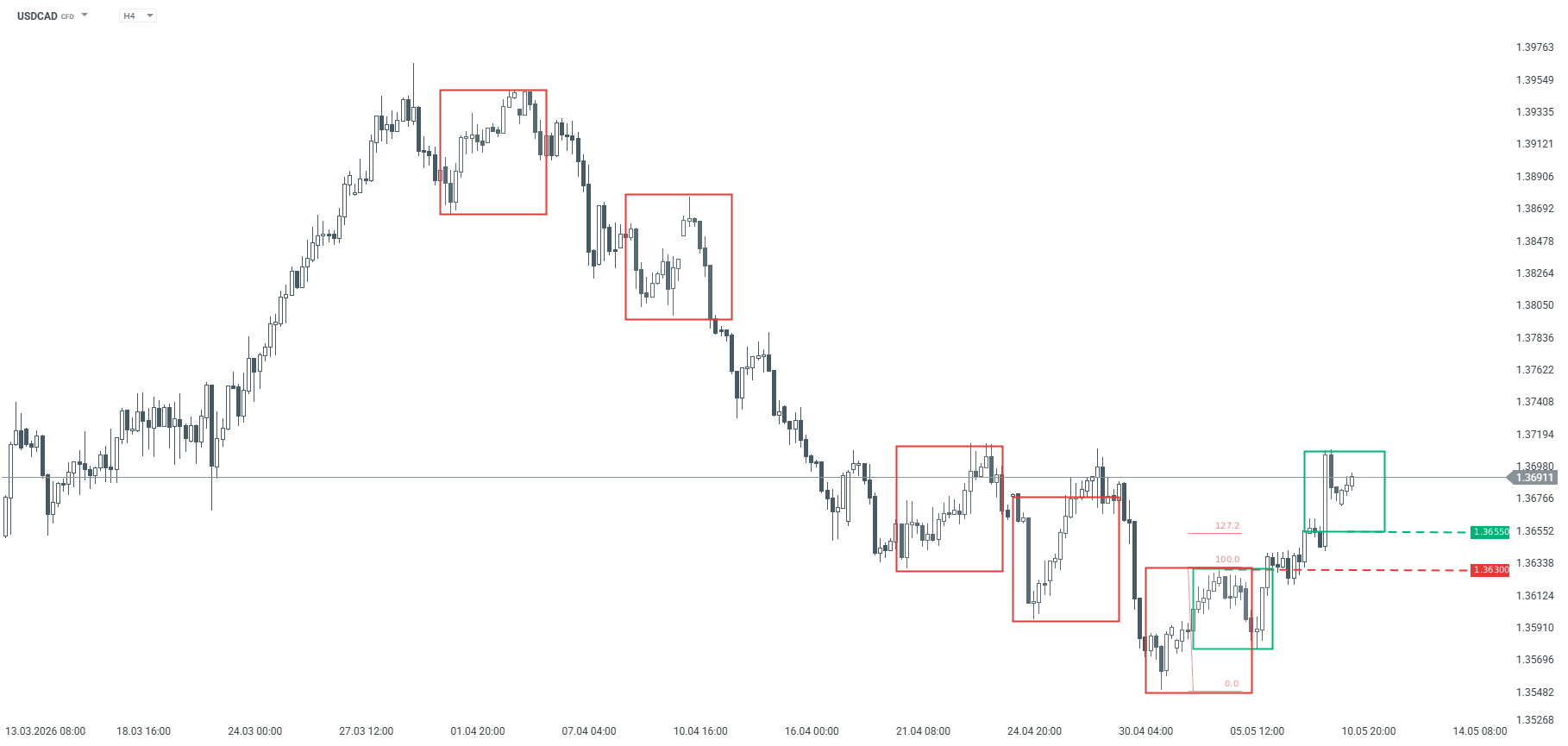
This analysis from the Overbalance series aims to identify three financial instruments, analysed primarily on the daily/four-hour (D1/H4) timeframe. The analysis utilises only the Overbalance methodology, which helps to identify points where a trend may continue or where a reversal may occur. Todayโ€™s analysis covers three instruments, assessed solely in terms of 1:1 correction structures. USDCAD USDCAD prices remained in a downtrend throughout April, but in recent days the 1:1 downtrend pattern has been negated at the 1.3630 level, which, according to the Overbalance methodology, may signal a significant upward correction or even a trend reversal. Currently, the key support level remains at 1.3655, where the lower boundary of the local 1:1 pattern is located. As long as the price remains above this level, the bullish scenario remains in place. Conversely, a return below 1.3630, i.e. below the polarity of the previously negated pattern, could once again open the way for further declines.

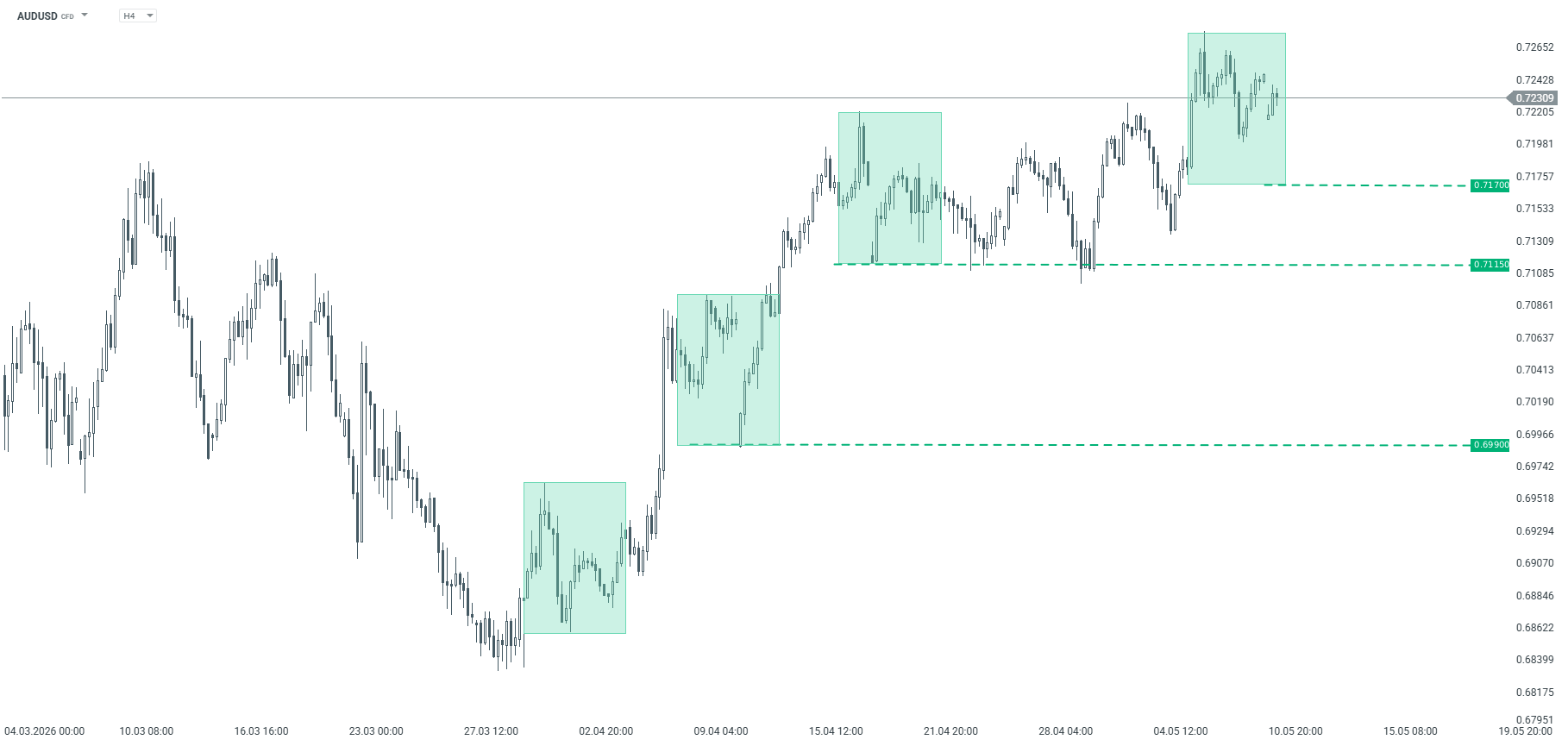
USDCAD โ€“ H4 timeframe. Source: xStation AUDUSD The AUDUSD exchange rate has been on an upward trend since the beginning of April. The key support level for the exchange rate is currently 0.7170. According to the Overbalance methodology, as long as the price remains above this level, the upward trend remains in place.

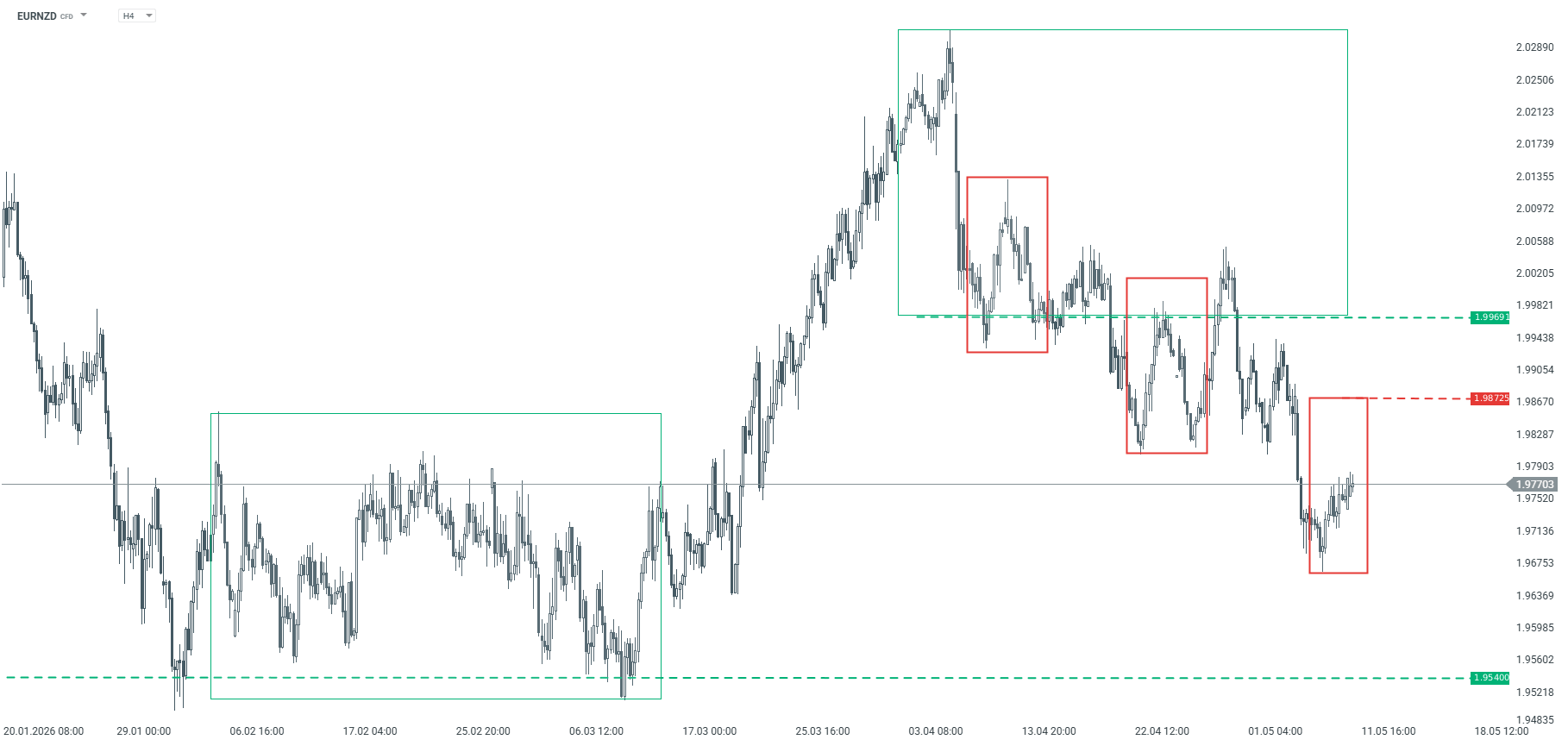
AUDUSD โ€“ H4 chart. Source: xStation EURNZD Since 7 April, the EURNZD has been trading in a downtrend. Should the upward correction extend, the key resistance level remains at 1.9872. As long as the price stays below this level, the bearish scenario remains in place. Conversely, for a return to the uptrend to be considered, the price would need to rise above the 1.9969 level, where the polarity of the previously negated 1:1 upward geometry is located.

EURNZD โ€“ H4 timeframe. Source: xStation

Currency Hedger No Comments

Euro recovers early losses amid waning hopes of peace in Iran, higher Crude prices

  • EUR/USD picks up to the 1.1775 area but remains within previous ranges below 1.1800.
  • The Euro faltered at Monday’s opening after Trump dismissed Iran’s peace plan.
  • The recent jump in Oil prices is likely to keep Euro bulls in check.

The Euro (EUR) is trading moderately higher against the Dollar (USD), yet moving within previous ranges on Monday. The pair has returned to the upper side of the 1.1700s range, and is trading at 1.1775 at the time of writing after a negative opening, following US President Donald Trumpโ€™s rejection of Iranโ€™s peace plan.

Trump posted on social media that Tehranโ€™s latest peace proposal was โ€œtotally unacceptableโ€, crushing market hopes of a swift end to the war in the Middle East and the reopening of the Strait of Hormuz. Oil prices jumped after the news, with the barrel of Brent returning above $100, which puts the Eurozoneโ€™s Crude-importing economies under pressure and undermines the Euroโ€™s upside attempts.

On the macroeconomic front, US Nonfarm Payrolls beat expectations on Friday, showing a 115K increase, almost twice the 62K expected. These figures strengthen the case for Federal Reserve (Fed) hawks and ease pressure on the bank to cut interest rates, which provides support to the Greenback.

The economic calendar is thin in the US and Europe on Monday. Later this week, US Consumer Prices Index (CPI) data, due on Tuesday, and US Retail Sales on Thursday, together with Fed speakers throughout the week, will provide the fundamental guidance for the USD. In Europe, Germanyโ€™s final consumer inflation data on Tuesday, but above all, Wednesdayโ€™s Eurozone Gross Domestic Product (GDP) and European Central Bank (ECB) President Lagardeโ€™s speech, will be the highlights of the week.

Technical Analysis: Bulls to be tested at 1.1800

EUR/USD CHART ANALYSIS

,
EUR/USD shows a modest bullish bias with momentum readings backing this constructive tone. The 4-hour Relative Strength Index is near 60, and the Moving Average Convergence Divergence (MACD) remains in positive territory, hinting that buyers retain control.

Bulls, however, are likely to meet significant resistance at the area between 1.1790 and 1.1800 (around April 20, May 6, 8 highs), which, so far, is closing the path to April’s high, in the 1.1850 area. Further up, February’s top, at the 1.1930 area, would come into focus.

On the downside, session lows at the 1.1750 area and Friday’s lows, near 1.1725, are likely to provide some support to a potential bearish reversal, although the key support is at the area between 1.1645 and 1.1675, which contained downside attempts in April.

Currency Hedger No Comments

Euro: Vulnerable against US dollar ahead of US CPI โ€“ Deutsche Bank

Deutsche Bankโ€™s Jim Reid and team say markets are digesting a firm US payrolls report that reinforced views of a resilient labour market and persistent inflation risks. They highlight a dense United States (US) data calendar, led by April Consumer Price Index (CPI), Producer Price Index (PPI), retail sales and industrial production, which will shape expectations for the US Dollar (USD) and US yields over coming days.

US data and inflation in focus

“Before that, the new week arrives with markets still processing last Fridayโ€™s US payrolls report, which came in broadly firm and reinforced the view that labour market conditions remain resilient.”

“While not strong enough to decisively alter the policy outlook, the release did little to ease concerns that underlying inflation pressures could persist, especially given still-solid wage dynamics.”

“Against this backdrop, outside of the Iran War developments which will of course take centre stage, the coming week will remain centred on the US, with a dense run of data and policy developments.”

“The focal point will be tomorrowโ€™s April CPI report.”

“Our economists expect headline inflation to rise by +0.58% month-on-month, moderating from Marchโ€™s +0.9%, but still relatively firm.”

“In contrast, the core measure is projected to accelerate to +0.39% MoM from +0.2%, suggesting underlying price pressures remain sticky even as energy-related effects fade.”

“The YoY rates would move from 3.3% to 3.8% for the former and from 2.6% to 2.8% for the latter.”

“Producer price data follows on Wednesday and then the remainder of the week shifts towards activity indicators.”

“Our economists expect retail sales to decline by -0.3% MoM after Marchโ€™s strong +1.7% increase, pointing to some payback in consumer spending.”

“Meanwhile, industrial production is forecast to rise modestly by +0.2% MoM following a -0.5% drop previously, suggesting a tentative stabilisation in manufacturing output.”

Currency Hedger No Comments

EUR/JPY – Tests 50-day EMA barrier near 185.00

  • EUR/JPY is challenging immediate resistance at the 50-day EMA of 184.86.
  • The 14-day Relative Strength Index around 47 indicates momentum has eased toward neutral territory.
  • The primary barrier lies at the nine-day EMA at 184.75.

EUR/JPY extends its winning streak for the third successive day, trading around 184.80 during the Asian hours on Monday. The technical analysis of the daily chart indicates the currency cross consolidating in a neutral tone as it holds just above the nine-day Exponential Moving Average (EMA) but remains capped by the 50-day EMA.

This tight EMA squeeze hints at an indecisive market after the recent pullback, while the 14-day Relative Strength Index (RSI) near 47 suggests momentum has cooled toward neutral rather than signaling outright oversold conditions.

On the upside, the EUR/JPY cross is testing the immediate resistance at the 50-day EMA of 184.86. A successful break above the medium-term averages would support the bullish momentum and lead the currency cross to explore the region around the all-time high of 187.95, which was recorded on April 17.

The EUR/JPY cross is positioned slightly above the nine-day EMA at 184.75. A sustained break below the short-term average would cause the bearish emergence and put downward pressure on the currency cross to navigate the region around a nearly 11-week low of 181.87, recorded on March 16, followed by a five-month low of 180.81, which was reached on February 12.

EUR/JPY: Daily Chart

(The technical analysis of this story was written with the help of an AI tool.)

Euro Price Today

The table below shows the percentage change of Euro (EUR) against listed major currencies today. Euro was the strongest against the New Zealand Dollar.

USDEURGBPJPYCADAUDNZDCHF
USD0.25%0.32%0.31%0.10%0.22%0.36%0.34%
EUR-0.25%0.07%0.04%-0.18%-0.01%0.12%0.08%
GBP-0.32%-0.07%-0.02%-0.25%-0.10%0.04%0.00%
JPY-0.31%-0.04%0.02%-0.21%-0.04%0.07%0.03%
CAD-0.10%0.18%0.25%0.21%0.17%0.24%0.24%
AUD-0.22%0.01%0.10%0.04%-0.17%0.11%0.09%
NZD-0.36%-0.12%-0.04%-0.07%-0.24%-0.11%-0.02%
CHF-0.34%-0.08%-0.00%-0.03%-0.24%-0.09%0.02%

The heat map shows percentage changes of major currencies against each other. The base currency is picked from the left column, while the quote currency is picked from the top row. For example, if you pick the Euro from the left column and move along the horizontal line to the US Dollar, the percentage change displayed in the box will represent EUR (base)/USD (quote).

Currency Hedger No Comments

EUR/USD up 0.4% Before The NFP

Key takeaways

  • The US dollar is weakening ahead of the report’s release.
  • The market is pricing in no change to US interest rates through the end of the year.
  • A weak reading could boost expectations for rate cuts.

USD remains under pressure despite this morning’s headlines, which cast doubt on the sustainability of the ceasefire between the US and Iran. The April NFP report on the US labour market is due to be released at 14:30, and will serve as a significant test for the dollar, which has been losing ground in recent days. The US currency remains under pressure despite this morningโ€™s headlines, which cast doubt on the sustainability of the US-Iran ceasefire.

Latest reading March saw a particularly strong reading. The number of non-farm payrolls far exceeded even the most optimistic expectations, reaching its highest level since December 2024 (178k). In contrast, the unemployment rate (4.3%) and wage growth (3.5%) fell unexpectedly. The reading signalled that the Fed is not forced to cut interest rates hastily, which, given the rapid rise in energy prices, was exceptionally valuable.

Geopolitical context The situation on the geopolitical front remains tense. A glimmer of optimism came from Wednesdayโ€™s reports by Axios regarding work on a peace memorandum. Yesterday evening, however, the press was abuzz with speculation about a resumption of military action should a lasting agreement between the US and Iran not be reached before Trumpโ€™s visit to China. This is scheduled for 14โ€“15 May.

Monetary policy

The data is of fundamental importance to the Federal Reserve, which has a dual mandate requiring it to focus on both price stability and maximising employment. The markets are undecided as to the direction the FOMC will take in the coming months. The inflation situation is causing growing concern, which led to a significant split within the committee at its last meeting โ€“ as many as three of its members opposed the so-called โ€œeasing biasโ€, i.e. the preference for lower interest rates in the medium term. The April inflation reading, due next Tuesday, is expected to show the headline measure rising to 3.7%. However, policymakers will focus primarily on the core measure, wage growth and inflation expectations, as they are unable to exert much influence over inflation driven by supply-side factors, such as rising energy prices. Markets are currently pricing in no change to interest rates until the end of 2026.

A weak reading, suggesting that the labour market situation is deteriorating, moving away from the still relatively safe low fire-low hire status, may signal that the economy will need a monetary stimulus. This is, in any case, consistent with the rather dovish rhetoric presented by Kevin Warsh, who will take the helm of the FOMC from its next meeting. A strong reading could, in turn, help the Committee to focus almost all its attention on the inflation situation, swelling the ranks of the hawks, which already appear to be numerous following the last meeting.

Current data

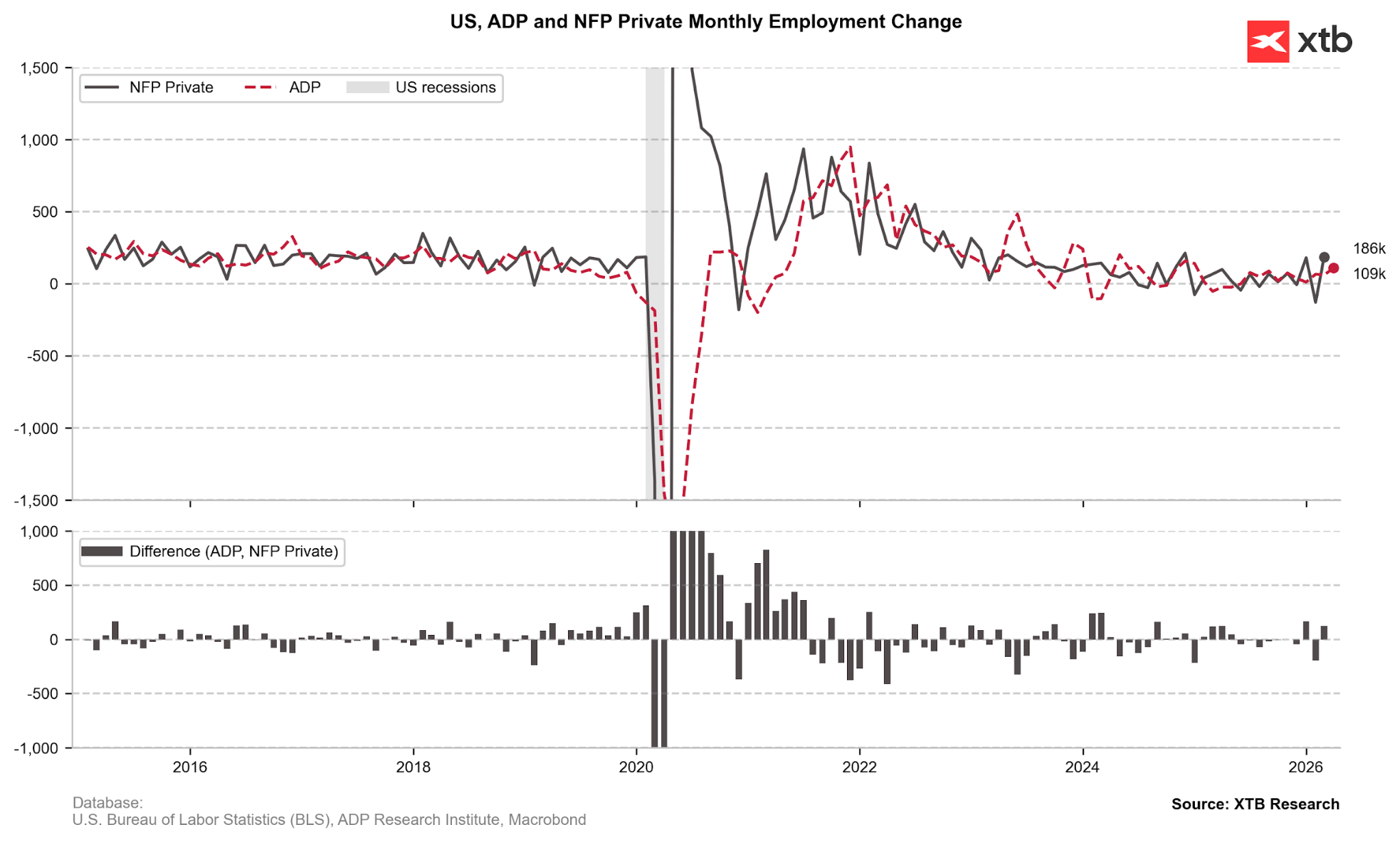
The most recent data โ€“ weekly jobless claims โ€“ are particularly noteworthy; a week ago they fell to 189k, the lowest level since 1969, remaining at low levels this week (200k). The ADP data also showed healthy levels (although since the pandemic, their correlation with the NFPs has been significantly weaker). Chart: NFP and ADP data (2015 – 2026)

Source: XTB, 08/05/2026

Currency Hedger No Comments

EUR/GBP holds losses near 0.8650 after weaker German Industrial Production data

  • EUR/GBP loses ground to near 0.8650 in Fridayโ€™s early European session.ย 
  • German Industrial Production falls 0.7% MoM in March, weaker than expected.ย 
  • BoEโ€™s Bailey warned of “forceful tightening” if energy price shocks from the Middle East conflict continue to drive inflation.ย 

Theย EUR/GBPย cross holds losses around 0.8650 during the early European session on Friday. The Euro (EUR) softens against the Pound Sterling (GBP) on the downbeat German economic data. Traders brace for the speeches from the European Central Bank policymakers later on Friday, includingย Christine Lagarde, ย Luis de Guindos, Piero Cipollone,ย Isabel Schnabelย , and Joachim Nagel.ย 

Data released by Destatis on Friday revealed that Germanyโ€™s industrial sector activity fell sharply in March, with Industrial Production falling by 0.7% MoM, versus a decline of 0.5% prior (revised from -0.3%). This figure came in weaker than the expectation of a 0.5% rise. 

Annually, German Industrial Production arrived at -2.8% in March, following Februaryโ€™s revised 0.2% decrease.ย The Euroย edges slightly lower against the GBP in an immediate reaction to the worse-than-expected German report.

Hawkish remarks from the ECB officials might help limit the EURโ€™s losses. ECB Executive Board member Isabel Schnabel bolstered expectations that the bank could raise interestย ratesย as soon as next month, saying companies and households were now reacting in a concerning way to surging global energy prices.

Meanwhile, ECB board member Piero Cipollone noted on Wednesday that the chance of a central bank rate hike has risen as โ€Œinflation pressures are high, even as negotiated wage data showed pay demands had yet to increase.

On the UKโ€™s front, the Bank of England (BoE) decided to hold the bank rate steady at 3.75% as widely expected at the last meeting, presenting a scenario framework that suggests rate hikes could be appropriate but avoiding any pre-commitment. BoE Governor Andrew Bailey warned of “forceful tightening” if energy price shocks from the Middle East conflict continue to drive inflation.