GBP/USD kicks off the new week on a softer note as geopolitical uncertainties support the USD.
The disappointing US NFP further tempers Fed hike bets, which might cap the upside for the buck.
Market focus now shifts to this week’s release of US inflation figures and the prelim UK Q2 report.
The GBP/USD pair edges lower at the start of a new week and moves further away from an over three-week high, or levels just above the 1.3500 psychological mark touched on Friday.
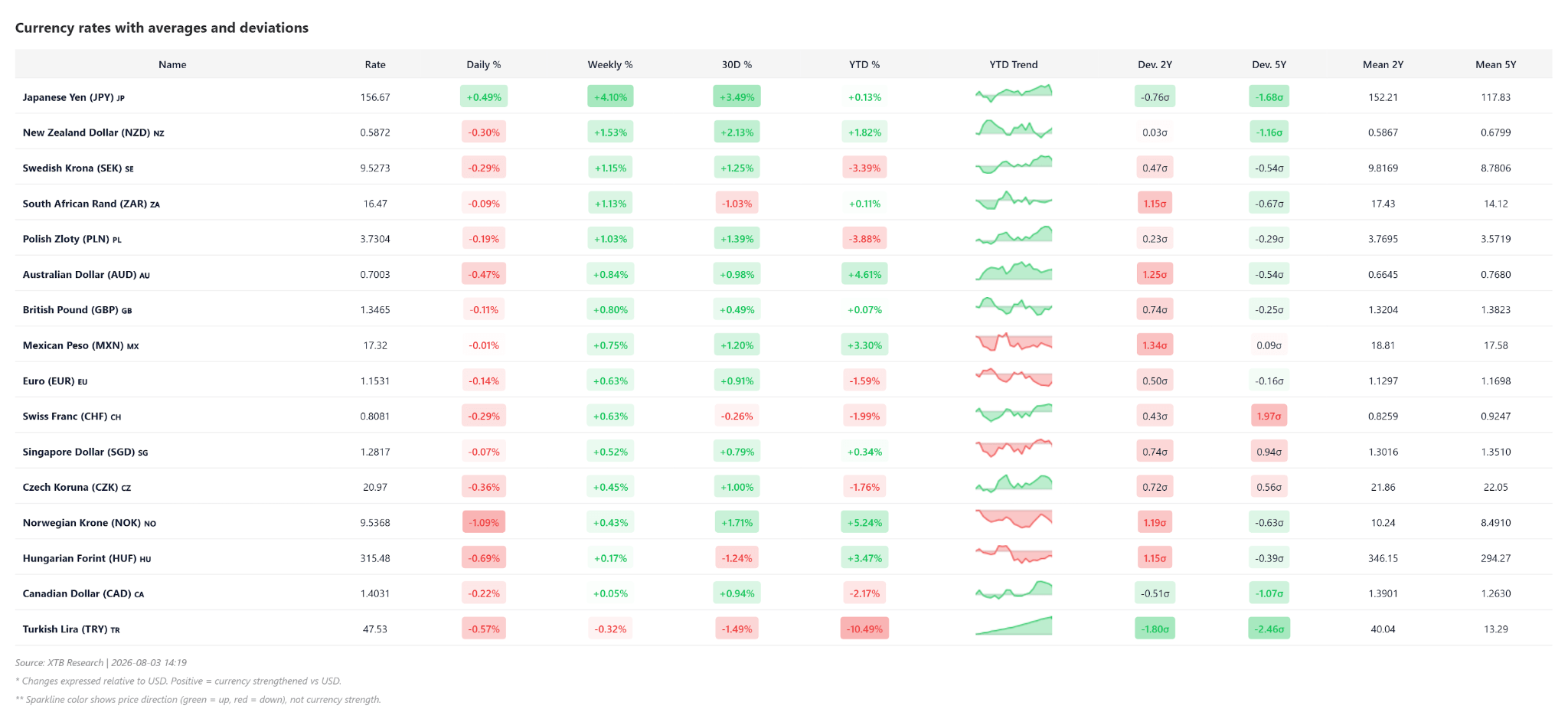
The US Dollar (USD) is looking to build on its recovery from the post-NFP swing low amid persistent uncertainties surrounding the Middle East crisis and efforts to reopen the Strait of Hormuz. This, in turn, acts as a headwind for the GBP/USD pair, though the downside seems limited as receding US Federal Reserve (Fed) rate hike bets could limit any meaningful USD appreciation.
The closely-watched US monthly jobs data showed that the economy lost 23Kjobs in July, while the previous month’s reading was revised lower to 20K from 57K, pointing to signs of a cooling labor market. Traders were quick to react and are now pricing in a less than 45% chance that the US central bank will raise borrowing costs in September, down from 67% a week ago.
However, investors are still assigning a greater probability of at least one 25-basis-point (bps) rate increase before the end of this year amid concerns that recovering oil prices will rekindle inflationary pressures. Hence, the focus shifts to the latest US inflation figures, due this week. Apart from this, the incoming geopolitical headlines will drive the USD and influence the GBP/USD pair.
Investors will further confront the release of the prelim UK Q2 GDP report on Thursday, which will play a key role in providing a fresh impetus to the British Pound (GBP). Nevertheless, the aforementioned fundamental backdrop warrants some caution before placing fresh bullish bets on the GBP/USD pair and positioning for an extension of a nearly two-week-old uptrend.
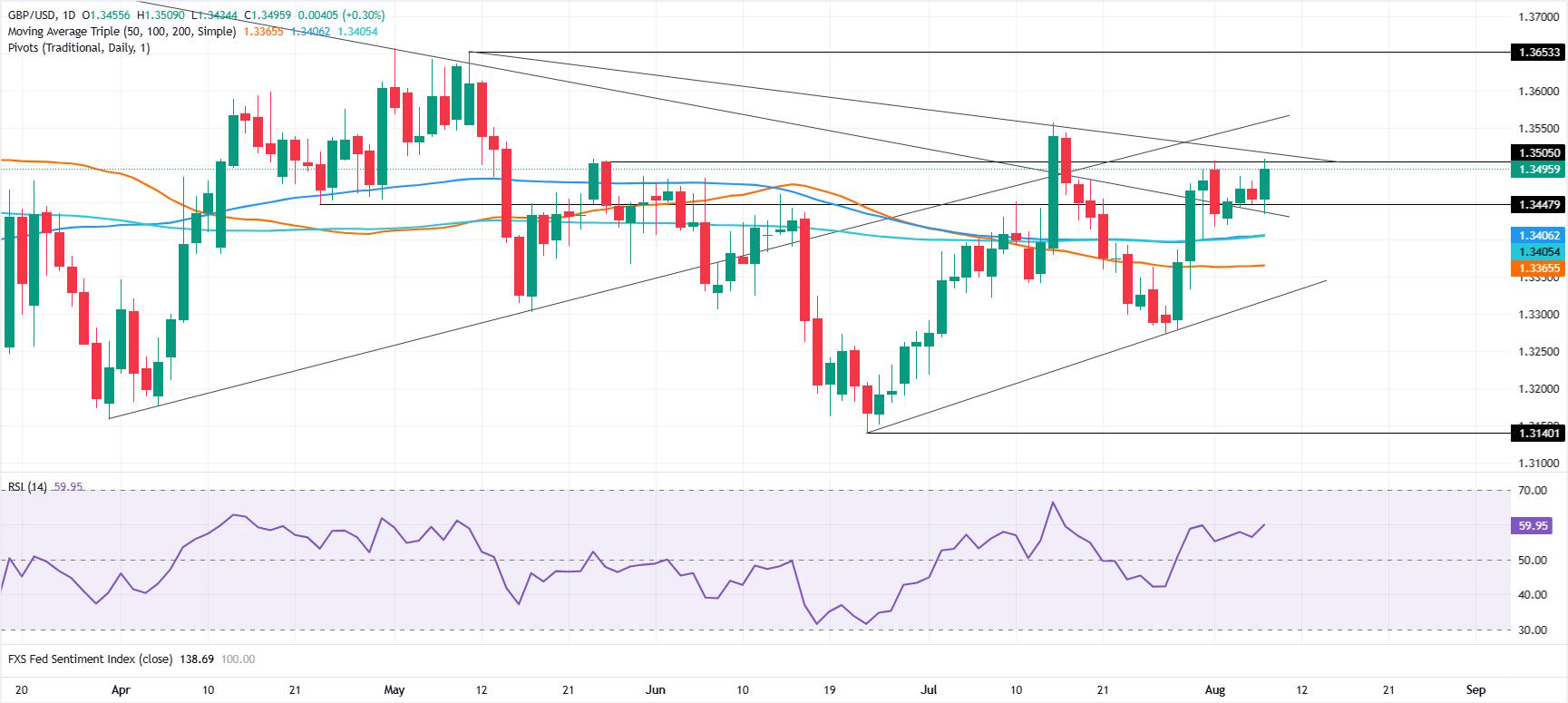
GBP/USD holds sideways, but upside bias survives above 1.3406.
Break above 1.3558 opens the path toward 1.3600.
Failure below 1.3500 risks a pullback toward key SMA support.
The Pound Sterling (GBP) edges higher by some 0.29% against the US Dollar (USD) on Friday, yet it remains trading sideways, unable to decisively crack 1.3500 after reaching a three-week peak of 1.3509, and has retreated to the 1.3490 area.
GBP/USD Price Forecast: Technical outlook
The technical picture shows that GBP/USD is consolidating, yet it is slightly tilted to the upside after clearing the 200-day Simple Moving Average (SMA) at 1.3406. Market structure suggests the uptrend might resume once buyers reclaim the July 15 swing high at 1.3558, opening the door to a test of 1.3600.
In that scenario, the next area of interest for GBP/USD would be the May 11 swing high at 1.3653, followed by 1.3700.
On the flip side, if GBP/USD remains below 1.3500, look for a pullback towards August’s 3 low of the day at 1.3417. A breach of the latter will expose the convergence of the 100- and 200-day SMAs at 1.3406/05, followed by the 50-day SMA at 1.3365.
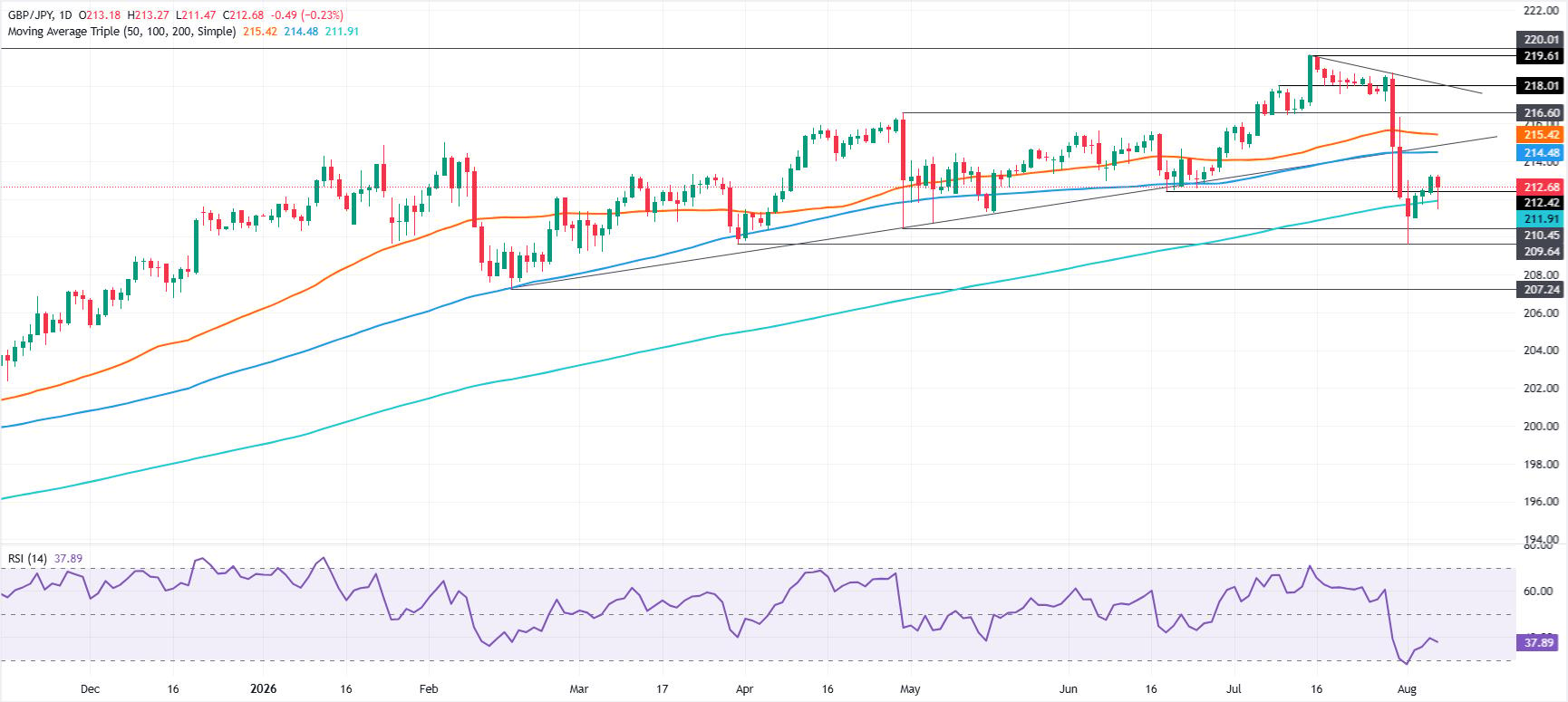
GBP/JPY recovers 200-day SMA after sliding to 211.47.
Upside remains capped by 100- and 50-day SMA resistance.
Break below 211.91 exposes 211.00 and 209.58 support.
The British Pound retreats against the Japanese Yen, down about 0.24%, as the Yen is poised to end the week on a higher note. However, GBP/JPY is poised to finish the week with minimal gains, trading at 212.64.
GBP/JPY Price Forecast: Technical outlook
The GBP/JPY trades sideways, though slightly tilted to the downside, following an intervention in the FX markets by US and Japanese authorities. Worth noting that after soft US jobs data, Japanese Finance Minister Katayama said she agreed with US Treasury Secretary Scott Bessent that FX markets had been affected by moves rather than fundamentals.
This pushed GBP/JPY to the day’s low of 211.47, slightly below the 200-day SMA of 211.91, but buyers reclaimed the latter and surpassed 212.00. After the rebound, the cross is about to end Friday’s session near the highs, but it will face key resistance at the 100-day SMA at 214.48, followed by the 50-day SMA at 215.42.
In the event of further losses, the first GBP/JPY support is 212.00. Below the next support is the 200-day SMA at 211.91, followed by 211.00. Beneath emerges the August 3 low of 209.58.
Scotiabank analysts warn that narrowing UK-US yield spreads are weakening fundamental support for the British pound.
Rising oil prices revive UK stagflation fears, posing a dilemma for the Bank of England.
Safe-haven demand from escalating Strait of Hormuz tensions boosts the US Dollar as global market instability grows.
GBP/USD extends its losses for the second consecutive day, trading around 1.3450 during the Asian hours on Friday. The pair depreciates as the British Pound (GBP) softens even as United Kingdom (UK) political risk fades.
Analysts at Scotiabank observe that “fundamentals appear to be somewhat less supportive for the GBP, as we note the renewed softening in yield spreads,” tempering the near-term backdrop for the currency. However, they also highlight that “sentiment continues to improve” as “market participants continue to fade politically-motivated concerns following the recent political transition and arrival of PM Burnham.” In their view, “the new PM’s commitment to fiscal responsibility appears to be much stronger than expected,” helping to offset the drag from softer yield differentials and underpinning a more constructive tone toward the Pound.
Rising oil prices have reignited fears of sticky inflation and sluggish economic growth in the UK, presenting the Bank of England (BoE) with a challenging “stagflationary” dilemma. This pressure directly tests the central bank’s stance following last week’s monetary policy meeting, where Governor Andrew Bailey downplayed the necessity for further rate hikes. At the time, Bailey expressed confidence that the UK’s disinflation process remains firmly on track, even against a backdrop of ongoing geopolitical uncertainty.
The GBP/USD pair faces downward pressure as the US Dollar (USD) gains strength, propelled by renewed safe-haven demand among global investors. Escalating tensions in the Strait of Hormuz have rattled market stability and created significant skepticism regarding the reopening of this critical shipping route. Market caution remains elevated as Iran’s parliament evaluates a draft proposal that seeks to prohibit US and Israeli vessels, levy a 20% cargo penalty on hostile nations, and maintain restrictions on the corridor until the US blockade is removed.
Musalem flags upside inflation risks and defends surprise moves, keeping Dollar bulls alert
Fed’s Musalem delivers a slightly more hawkish tone, with a 7.4/10 FXS Speechtracker score relative to the historical average of 7/10, emphasizing that inflation expectations risk losing their anchor even as they currently align with the 2% target. The focus on core inflation amid energy volatility, a preference for incremental rate hikes, and an assessment that core inflation likely sits between 2.5% and 3% underscore the concern that inflation may stay above target, while the assertion that sometimes it is acceptable for the central bank to surprise markets signals a willingness to prioritize the mandate over market guidance. Musalem’s view that the Dollar’s reserve status is secure, the labor market is strong but not an inflation driver, and financial conditions remain highly accommodative reinforces a backdrop where upside rate risks remain on the table.
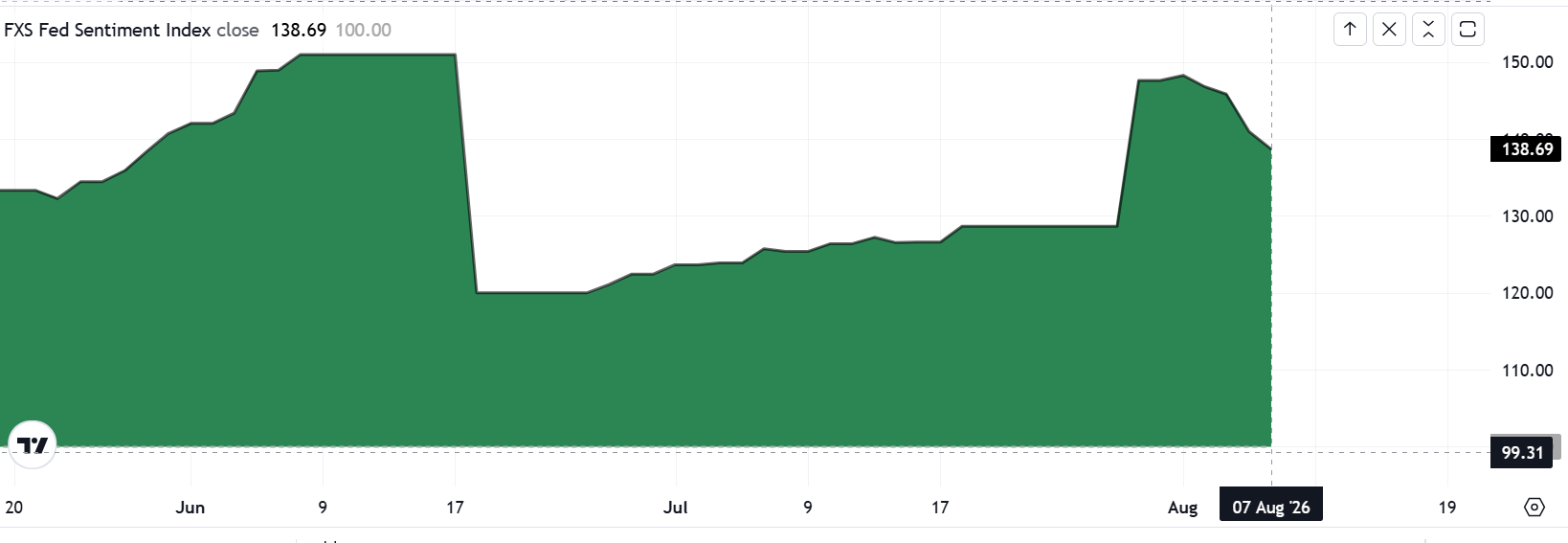
The FXS Fed Sentiment Index was unchanged, moving 0.00 points to a still distinctly hawkish level of 138.69, indicating that Musalem’s remarks fit comfortably within the prevailing hawkish bias rather than shifting it further. The combination of a slightly above-baseline FXS Speechtracker score and a stable, elevated FXS Fed Sentiment Index suggests the speech consolidates existing expectations for a Fed inclined to keep policy tight, supporting the Dollar while limiting fresh directional impetus.
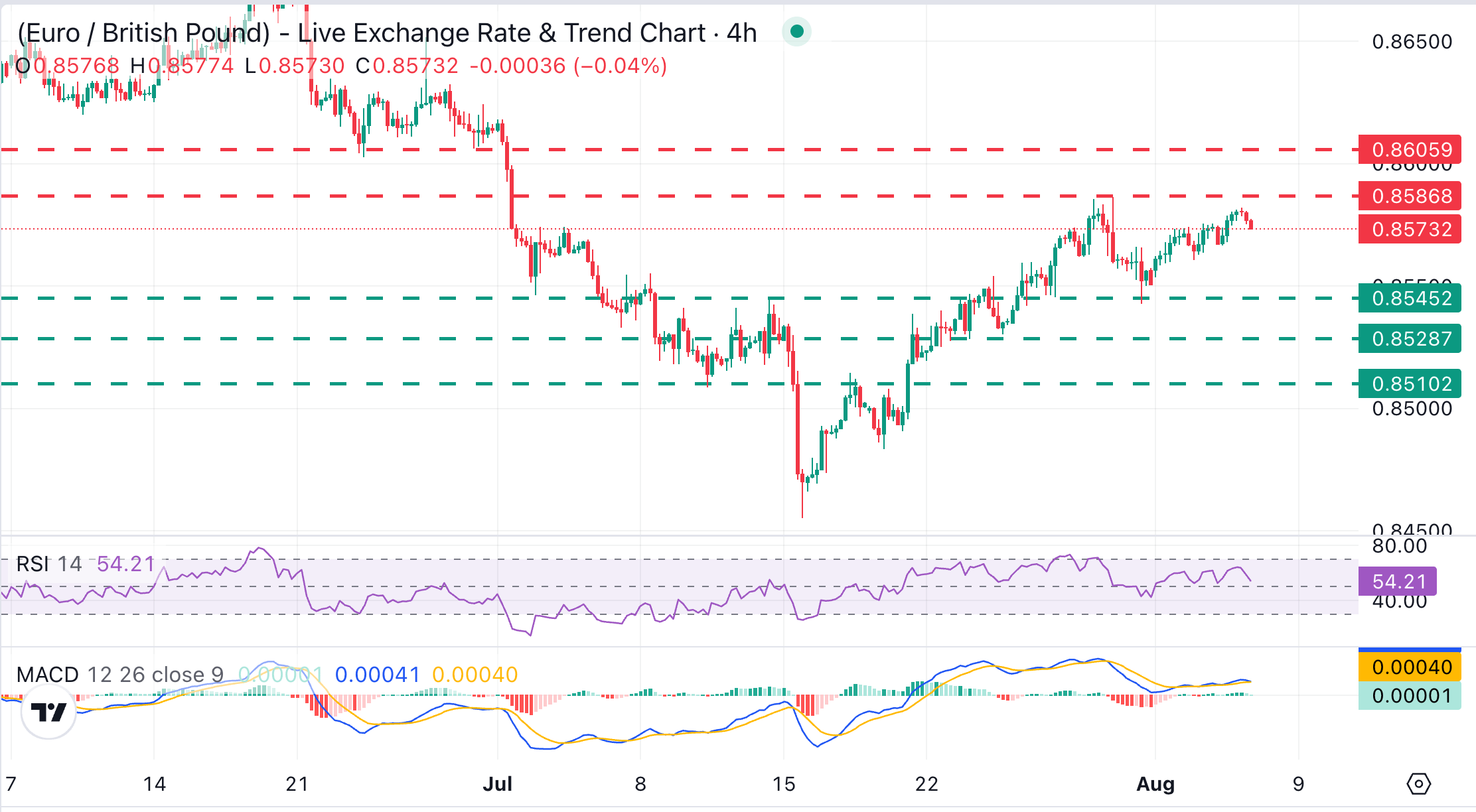
EUR/GBP eases to 0.8575 on Thursday after being rejected at the 0.8580 area.
Lower oil prices and positive Eurozone data are keeping the Euro downside attempts limited.
Failure to extend gains beyond the late-July top, at 0.8586, might give bears fresh hopes.
The Euro (EUR) nudges lower against the British Pound (GBP) on Thursday, following a three-day rally. The EUR/GBP remains capped below the late-July top of 0.8586, trading at 0.8575 at the time of writing, yet with downside attempts subdued so far.
Eurozone data was supportive on Thursday, as German Factory Orders beat expectations with a 3.1% increase in June, largely exceeding the 0.3% market forecast, and a downwardly revised 0.3% reading in May.
Regarding the Pound, FX strategists at Rabobank argue that “a re-pricing in policy expectations towards steady policy from the BoE this year combined with the prospect of nervousness ahead of the October budget suggests scope for downside pressure on the pound as the summer draws to a close.”
In this context, Rabobank continues to see value in the cross, stating that “we favour buying EUR/GBP on dips to the 0.8550 area,” and adding that “a break above the recent high in the 0.8588 region could increase upside potential.”
Technical Analysis: Failure to break 0.8586 might encourage bears
The technical picture shows the EUR/GBP pair trading at 0.8576, with momentum indicators highlighting weaker bullish traction. The Relative Strength Index (14) is trending towards the 50 midline, while the Moving Average Convergence Divergence (MACD) indicator hovers around zero, suggesting that bullish momentum is present but tentative.
Bulls need to break the mentioned 0.8586 resistance area level (July 29, 30 highs) to confirm the positive trend and target late June lows at the 0.8605 area. Failure to do so might give fresh hopes for bears to break the August 4 and 5 lows in the 0.8560-0.8565 area and aim for the July 31 low, near 0.8540, which will be the neckline of a double top pattern.
On the downside, immediate support is seen at 0.8548, followed by additional underlying demand at 0.8529 and 0.8510, with deeper structural levels resting at 0.8419 and 0.8327. On the topside, initial resistance aligns at 0.8587, ahead of 0.8606; a sustained break above these caps would open the way toward 0.8730 and 0.8741, with higher hurdles at 0.8790 and 0.8863 likely to limit any extended advance.
GBP/USD edges down to near 1.3460 while investors shift their focus to the US NFP data.
The US official employment data will have a significant impact on the Fed’s monetary policy outlook.
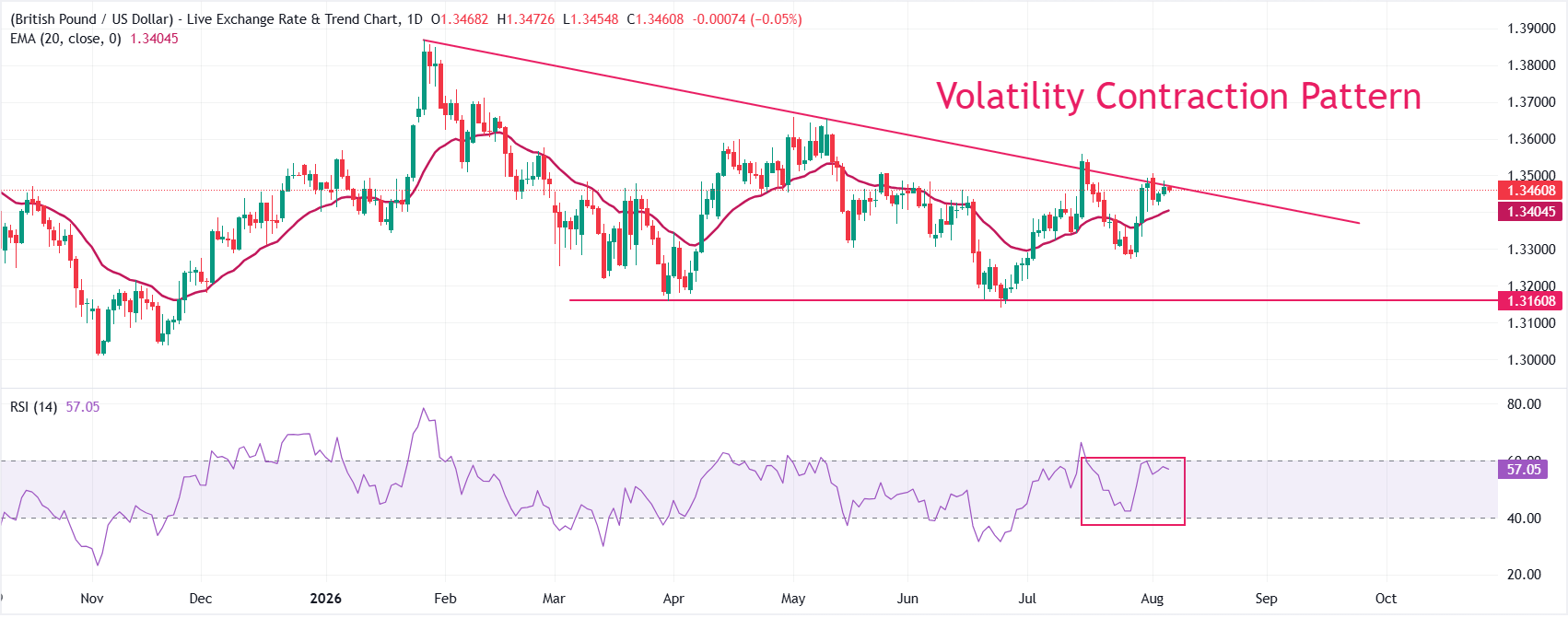
The Cable appears to be gathering strength for a decisive breakout of the VCP pattern.
The British Pound (GBP) trades marginally lower at around 1.3460 against the US Dollar (USD) during the European trading session on Thursday. The GBP/USD pair is expected to trade sideways as investors await the United States (US) Nonfarm Payrolls (NFP) data for July, which will be released on Friday.
US payrolls seen posting modest July gain as Deutsche Bank flags participation risks
Economists at Deutsche Bank expect Friday’s July payrolls report to show a further, if modest, improvement in hiring. They look for “employment growth of +65k, modestly above June’s +57k reading”.
On the labor market’s slack, Deutsche Bank forecasts that “the unemployment rate is forecast to remain at 4.2%, although risks are skewed towards a rounding up to 4.3% if labor force participation rebounds after last month’s sharp decline.” Wage and hours data are expected to be steady, with “average hourly earnings… expected to increase by +0.3% month-on-month, unchanged from June, while average hours worked are forecast to hold at 34.3 hours.”
Investors will pay close attention to the US NFP data as it will influence market expectations for the Federal Reserve’s (Fed) monetary policy outlook.
Ahead of the US NFP data for July, the ADP Employment Change data remained weaker-than-projected. On Wednesday, the ADP reported that the private sector created 44K jobs in July, fewer than estimates of 70K and the prior release of 98K.
Technical Analysis
GBP/USD trades at around 1.3460, keeping a mildly bullish near-term bias as spot holds above the 20-day exponential moving average (EMA) at 1.3404, but struggles to achieve a decisive breakout of the downward-sloping border of the Volatility Contraction Pattern (VCP) at around 1.3471.
The Relative Strength Index (RSI) around 57 shows constructive but not overextended momentum, suggesting scope for further gains as long as price stays supported on dips above the EMA.
On the topside, immediate resistance is located at the former trend line break price at 1.3471, and a decisive move above this barrier would open the way for a continuation of the recent upside. Looking up, the July 15 high at 1.3558 is the key hurdle. On the downside, initial support is seen at the 20-day EMA at 1.3404, followed by the July 28 low at 1.3274.
GBP/USD softens to around 1.3425 in Tuesday’s early Asian session.
Trump insists Iran talks are underway; Iran denies any negotiations taking place.
US ISM Manufacturing PMI rose to 55.6 in July, stronger than expected.
The GBP/USD pair loses ground to near 1.3425 during the early Asian session on Tuesday. Uncertainty surrounding US-Iran talks drives traders toward a safe-haven currency such as the US Dollar (USD) against the British Pound (GBP). All eyes will be on the US July jobs data, which is due later on Friday.
US President Donald Trump on Monday claimed talks with Iran are ongoing, saying this is Tehran’s “last chance to sign a good document”. Trump added that he expected negotiations to begin in the next day or two to reopen the Strait of Hormuz and create a pathway for Iran to address the US’s concerns about its nuclear programme.
However, Tehran denied that talks with the US were taking place. Iran’s Foreign Ministry Spokesperson, Esmaeil Baghaei, stated that the country’s current focus was on negotiations with Oman over the Strait of Hormuz.
Furthermore, the upbeat US economic data provide some support to the Greenback and create a headwind for the major pair. Data released by the Institute for Supply Management (ISM) on Monday showed that the US Manufacturing Purchasing Managers’ Index (PMI) rose to 55.6 in July, up from 53.3 in June. This figure came in stronger than the market expectation of 54.0.
Last week, the Bank of England (BoE) voted 6-3 to hold the interest rates steady at 3.75%, with three policymakers favoring a rate hike. BoE Governor Andrew Bailey pushed back against expectations of an imminent tightening cycle, saying the disinflation process remains intact. Markets are now pricing in just one rate hike by the end of the year, while renewed US-Iran hostilities continue to add uncertainty to the economic outlook.
Pound struggles for support as BoE hawkish split meets Bailey’s dovish tone
Analysts at Rabobank highlight that “GBP net shorts bounced higher last week ahead of the BoE policy meeting,” underscoring a build-up in speculative bearish positioning on the Pound. They note that, despite “a more hawkish voting split than the market had expected from the MPC,” Governor Bailey’s “dovish” tone ultimately “suggest[ed] little support for the pound from the BoE,” leaving sentiment towards the currency constrained.
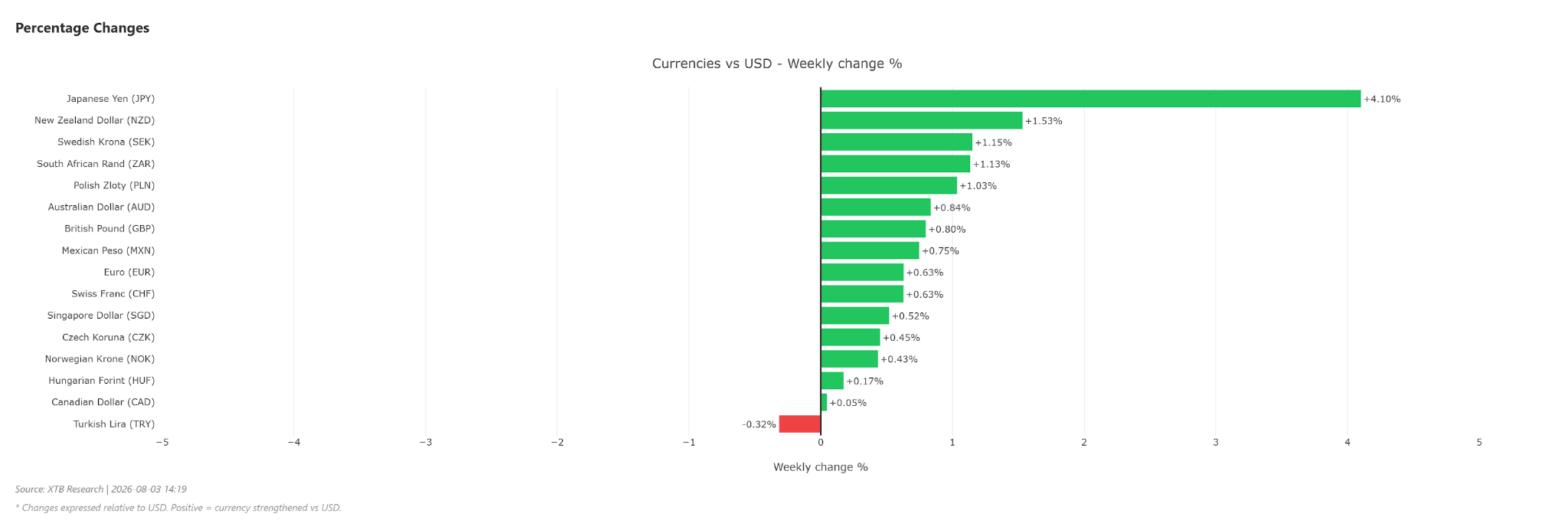
The dollar has come bottom of the G10 currency rankings for the past week.
The market does not believe that Kevin Warsh, the new Fed chairman, is a hawk.
Oil prices are falling, which is also putting pressure on the US dollar.
Higher GDP growth and inflation are fuelling expectations of interest rate rises in the eurozone.
The yen is strengthening following the first coordinated intervention by the US and Japan in 15 years.
In recent months, the market has repeatedly cast doubt on Donald Trump’s promises and announcements. This phenomenon has become so widespread that it has even been given its own name (TACO, i.e. Trump Always Chickens Out). In keeping with this motto, the US President backed down from a planned attack on Iran over the weekend, which, as he himself put it, was to be “the biggest since the Second World War”.
However, what proved more significant for the currency was investors’ scepticism regarding statements made by another US official. Kevin Warsh, the new Fed chairman, continued to emphasise his uncompromising stance on inflation, seeking to convince the markets of his supposed hawkishness. Whilst this was sufficient in June, by July investors were expecting much more.
Chart 1: Exchange rates of selected currencies [vs. USD] (27 July – 3 August)
Source: Bloomberg, 3 August 2026 The US dollar has therefore come under pressure, weakening against almost every currency we analyse on a regular basis. Currencies with a higher beta (e.g. the Swedish krona or the Polish zloty) performed particularly well, as did those whose economies could suffer most from a deepening energy crisis (e.g. the South African rand or the South Korean won). At the very top of the list was, of course, the Japanese yen, which was bolstered last Thursday by the first joint currency intervention by the United States and Japan since 2011.
US dollar (USD)
The dollar is being weighed down by both the fall in energy commodity prices (of which it is a net exporter) and a dovish revision to market expectations regarding the Fed’s interest rate path. The Federal Open Market Committee (FOMC) decided last week to hold rates steady. The vote was 9 to 3. Only three policymakers voted in favour of a rate rise, and Warsh was not among them (the others were Beth Hammack, Neel Kashkari and Lorie Logan). During the conference itself, the Fed Chair stuck to his decision not to provide forward guidance. Although he spoke for nearly 45 minutes, few of the words that came out of his mouth were of any great significance from a market perspective. He avoided answering both questions regarding the justification for the pause and those concerning the current economic situation.
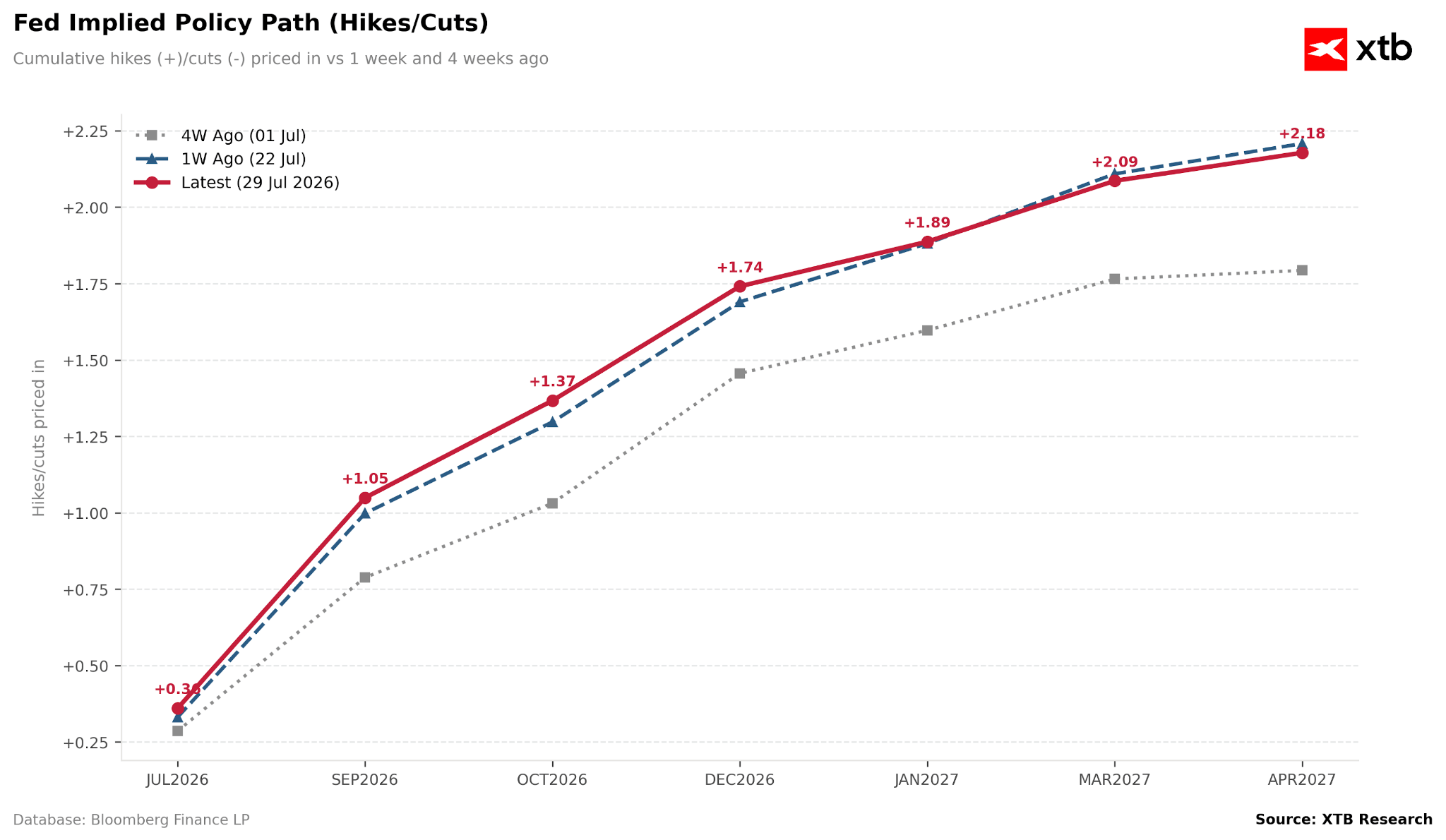
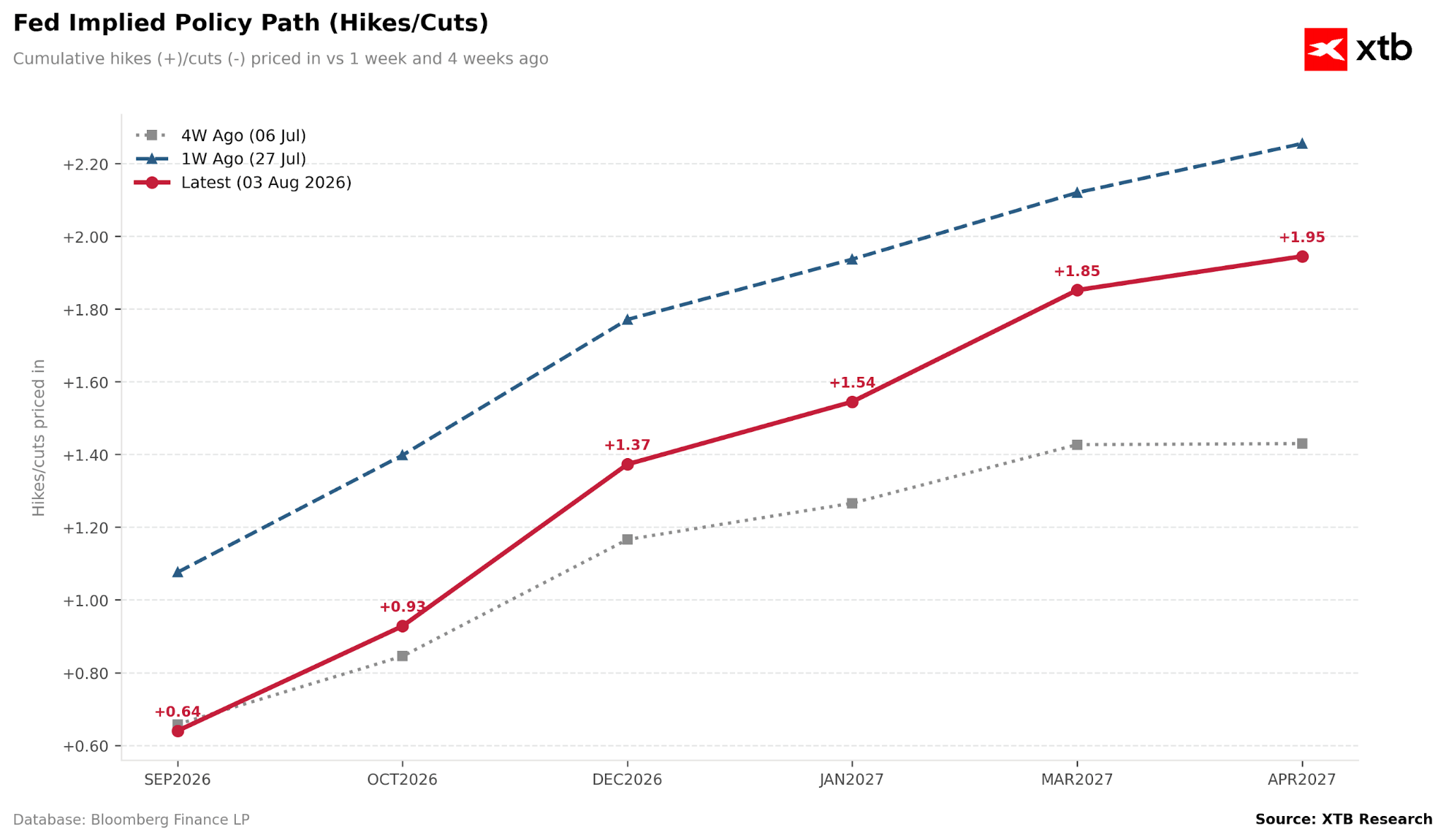
He mainly emphasised that the energy shock is hampering the committee’s work, and that the rise in CAPEX among hyperscalers should translate into future economic growth. This is largely consistent with his past comments on AI, when he argued that the productivity surge driven by artificial intelligence would, over time, have a disinflationary effect. The question is being raised once again as to whether Kevin Warsh is a dove in hawk’s clothing. The market seems increasingly sceptical that hawkish statements will be followed by concrete action, leading to a pullback in bets on interest rate rises. It currently assigns a probability of just over 60 per cent to a rate rise in September. Prior to the meeting, this was fully priced in. Chart 2: Market pricing of interest rate rises ahead of the FOMC decision (2026–2027)
Source: XTB Research, 29 July 2026 Chart 3: Market pricing of interest rate rises following the FOMC decision (2026–2027)
Source: XTB Research, 3 August 2026 It is worth recalling that almost exactly a year ago, he openly sided with the president, stating on FOX News that Donald Trump’s frustration with Powell’s conduct of monetary policy was entirely justified, and criticising the institution for being too slow to cut interest rates and for placing too much emphasis on historical economic data.
Euro (EUR)
In the eurozone, attention last week was focused not on monetary policy but on macroeconomic data. There are increasing signs that, following the pause in July, the time has come for a rate rise. The probability of a rate rise in September is estimated at almost 90 per cent. In recent days, both GDP growth (up 0.4 per cent quarter-on-quarter, compared with expectations of 0.2 per cent) and core inflation (2.5 per cent, consensus 2.4 per cent) have come in higher than expected. Both figures are consistent with further monetary tightening.
G10
Chart 4: Exchange rates of selected currencies [vs. USD]
Source: Bloomberg, 3 August 2026
Japanese yen (JPY)
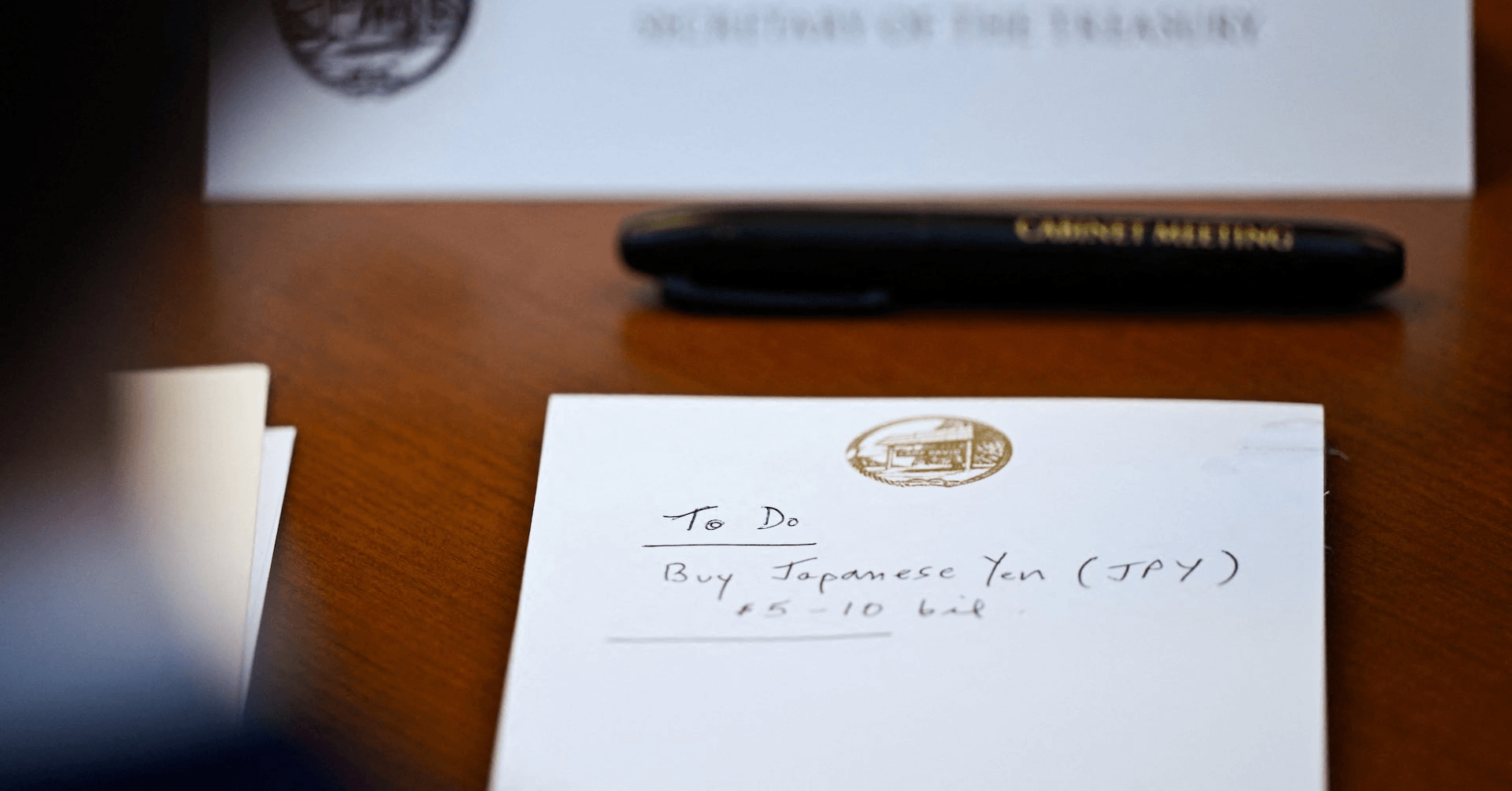
After reaching its highest level since 1986 (163.99), the USDJPY pair experienced a very sharp fall. This move was driven by the first coordinated intervention by the US and Japan since 2011. At that time, the yen had weakened following a massive earthquake. As emphasised by the US Treasury Secretary, Scott Bessent, and the Japanese Finance Minister, Satsuki Katayama, both sides remain ready to take further measures to stabilise the exchange rate. According to data provided by the Bank of Japan, the scale of the Japanese intervention may have reached as much as 59 billion dollars, which would be an unprecedented move (in terms of the scale of a single-day intervention). Although we cannot estimate the scale of US operations using official data, there are strong indications that it amounted to between 5 and 10 billion dollars. This is at least what is suggested by a note left by Scott Bessent during a meeting in Maryland.
Source: Reuters President Trump confirmed the US intervention at the weekend: “Japan has been very good to us, except, of course, for the attack on Pearl Harbour. (…) Their yen is weakening and they needed a bit of help. And we are always ready to help Japan.” Today, Minister Katayama published an official letter confirming the intervention.
To provide the best experiences, we use technologies like cookies to store and/or access device information. Consenting to these technologies will allow us to process data such as browsing behavior or unique IDs on this site. Not consenting or withdrawing consent, may adversely affect certain features and functions.
Functional
Always active
The technical storage or access is strictly necessary for the legitimate purpose of enabling the use of a specific service explicitly requested by the subscriber or user, or for the sole purpose of carrying out the transmission of a communication over an electronic communications network.
Preferences
The technical storage or access is necessary for the legitimate purpose of storing preferences that are not requested by the subscriber or user.
Statistics
The technical storage or access that is used exclusively for statistical purposes.The technical storage or access that is used exclusively for anonymous statistical purposes. Without a subpoena, voluntary compliance on the part of your Internet Service Provider, or additional records from a third party, information stored or retrieved for this purpose alone cannot usually be used to identify you.
Marketing
The technical storage or access is required to create user profiles to send advertising, or to track the user on a website or across several websites for similar marketing purposes.