Currency Hedger No Comments

Chart of The Day – GBP/USD

The political crisis surrounding Keir Starmer has become one of the key market drivers for the pound today. The situation is evolving rapidly and is having a direct impact on government bond yields and the value of the pound, with the markets closely monitoring the Prime Ministerโ€™s every word. Internal party pressure The scale of Starmerโ€™s problem is best illustrated by a single figure: 42 Labour MPs had already officially called on him to resign by Sunday evening, whilst former Deputy Prime Minister Angela Rayner described the current situation as โ€œLabourโ€™s last chanceโ€ to change course.

The emergence of potential challengers, such as Wes Streeting and Andy Burnham, means that the market now views the internal dispute within the Labour Party as a real risk, rather than mere political noise. In his speech on Monday, Starmer focused on several key themes. Firstly, a firm defence of his own position: โ€œI will fight in every internal vote.โ€ Secondly, a political agenda aimed at closer ties with the EU, the nationalisation of British Steel and a new mobility agreement for young people with Europe. The market viewed this speech primarily through the prism of one question: will the Prime Minister stabilise his position sufficiently to halt the sell-off of gilts?

You can watch the UK Prime Ministerโ€™s live address here. Source: Sky News, YouTube

Starmer, gilts in pounds

The yield on 10-year gilts rose on Monday morning to 4.954%, an increase of 3 basis points from the previous close, when it stood at 4.904% immediately after Starmer refused to resign on Friday. Economists surveyed by Bloomberg say that were it not for the political component, yields would be 10โ€“15 basis points lower. This shows just how much the market has already begun to price in the risk of political instability, rather than solely macroeconomic fundamentals. The UK currently has the highest debt servicing costs of all G7 countries, a consequence of inflation remaining above target and weak economic growth. The situation is further complicated by the economic fallout from the armed conflict in Iran, which has led to higher energy prices and a further weakening of business activity. In such an environment, any political uncertainty acts as a risk multiplier for funds holding gilts.

Implications for the GBP

The pound finds itself in a difficult position, both technically and fundamentally. On the one hand, structural factors such as the Bank of Englandโ€™s relatively high interest rates compared to the ECB and the marked inflationary divergence from the rest of Europe may continue to support it in the medium term. On the other hand, the political risk premium, which has just begun to be priced into gilt yields, is a factor that directly affects the currencyโ€™s valuation: higher bond yields against a backdrop of a weakening government is a scenario that has historically been negative for the pound, as it suggests a lack of a fiscal anchor. If Starmer survives the coming weeks politically and manages to quell the internal rebellion, the risk premium should gradually decline, and the GBP/USD pair could test higher resistance levels once again. An alternative scenario, namely a genuine battle for party leadership, would, however, mean further rises in gilt yields and pressure on the pound, particularly as global markets are now highly sensitive to any signs of political fiscal instability following the experiences of the Truss era. For sterling traders, therefore, today is a test not so much of Starmer himself as of the resilience of the political risk premium that the market has already priced in.

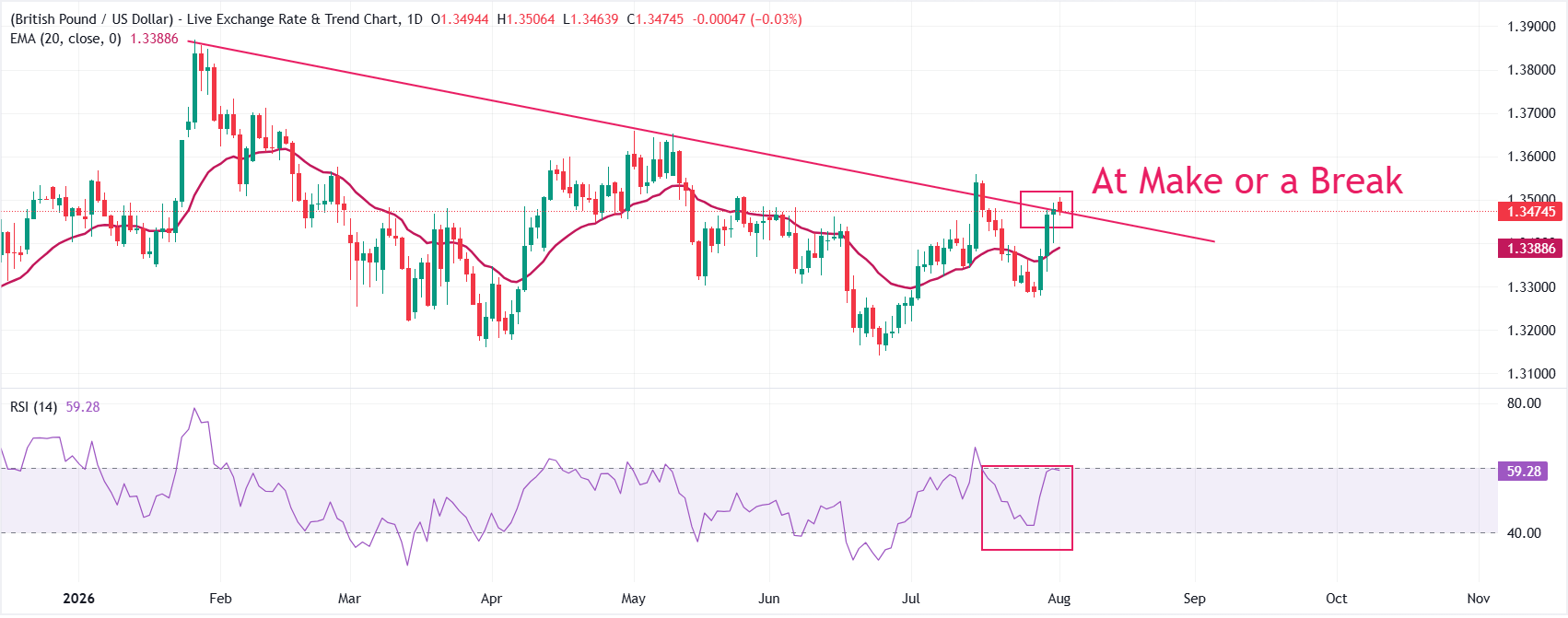
GBP/USD is trading at 1.3608 on the daily chart, within an uptrend that has been in place since the low around 1.22 at the turn of 2024/2025, and the price remains above the anchored VWAP from early 2025, which runs in the 1.31โ€“1.32 region. The volume profile indicates a Point of Control in the 1.3450โ€“1.3480 zone, where a black horizontal line marks a key support level that has been tested repeatedly on both sides. The RSI(14) at 57.17 suggests neutral-bullish momentum with no signs of overbought conditions, which technically leaves room for further gains towards the 1.3800โ€“1.3850 resistance zone, where the price reversed at the 2025 peak.

Todayโ€™s speech by Starmer and his political survival are factors that will directly determine the short-term direction: government stability paves the way upwards, whilst an escalation of the crisis and a rise in gilt yields would push the pair back towards the POC zone at 1.3450, and, in the event of a deeper sell-off, even towards the VWAP. Technically, the bulls have the upper hand as long as the price remains above 1.34, and the bears will only regain the initiative after a break below this zone with volume. Source: xStation

Currency Hedger No Comments

British Pound recovers further vs USD; GBP/USD holds near daily peak, above 1.3600

  • GBP/USD attracts fresh buyers following a modest bearish gap down opening to mid-1.3500s.
  • Easing UK political risks and the BoEโ€™s hawkish signal underpin the GBP, supporting spot prices.
  • Iran tensions and reviving Fed rate hike bets benefit the safe-haven USD and might cap the pair.

The GBP/USD pair fills a major part of its weekly bearish gap opening on Monday and is now looking to extend the momentum further beyond the 1.3600 mark. Spot prices, however, remain below the 1.3635 horizontal resistance and the highest level since February 16, touched earlier this month, warranting caution for bullish traders amid a modest US Dollar (USD) strength.

Against the backdrop of renewed hostilities in the Strait of Hormuz, disagreements over Tehran’s nuclear program dampen bets for a US-Iran peace deal. US President Donald Trump and Iran both rejected each otherโ€™s peace proposals for ending the war and the gradual reopening of the Strait of Hormuz. This keeps geopolitical risks in play, which, along with hawkish USย Federal Reserveย (Fed) expectations, turn out to be key factors underpinning the safe-haven USD.

The US-Iran standoff triggers a fresh leg up in Crude Oil prices, fueling inflationary concerns and keeping hopes alive for at least one 25-basis-point (bps) rate hike by the US central bank in 2026. In fact, the CME Group’s FedWatch Tool indicates a nearly 20% chance that the Fed will raise borrowing costs by the end of this year. That said, easing UK political uncertainty underpins theย British Poundย (GBP) and might continue to act as a tailwind for the GBP/USD pair.

In fact, UK Prime Minister Keir Starmer said he โ€‹would not resign after โ€Œlocal election results in Britain confirmed expectations of โ€Œsignificant losses for the ruling Labour Party. Furthermore, the Bank of England’s (BoE) signal last week that rate hikes could be appropriate if inflation remains persistent turns out to be another factor lending some support to the GBP and contributes to the GBP/USD pair’s goodish intraday move up from the 1.3550 horizontal support zone.

The BoE’s MPC member Megan Greene said earlier today that the central bank needs to wait to see how Middle East conflicts will flare before making any monetary policy adjustments, and that Inflation risks are skewed entirely to the upside. This, in turn, backs the case for a further appreciating move for the GBP/USD pair, though traders might opt to wait for the release of the latest US consumer inflation figures on Tuesday and the Trump-Xi summit laterย this week.

Currency Hedger No Comments

EUR/GBP holds losses near 0.8650 after weaker German Industrial Production data

  • EUR/GBP loses ground to near 0.8650 in Fridayโ€™s early European session.ย 
  • German Industrial Production falls 0.7% MoM in March, weaker than expected.ย 
  • BoEโ€™s Bailey warned of “forceful tightening” if energy price shocks from the Middle East conflict continue to drive inflation.ย 

Theย EUR/GBPย cross holds losses around 0.8650 during the early European session on Friday. The Euro (EUR) softens against the Pound Sterling (GBP) on the downbeat German economic data. Traders brace for the speeches from the European Central Bank policymakers later on Friday, includingย Christine Lagarde, ย Luis de Guindos, Piero Cipollone,ย Isabel Schnabelย , and Joachim Nagel.ย 

Data released by Destatis on Friday revealed that Germanyโ€™s industrial sector activity fell sharply in March, with Industrial Production falling by 0.7% MoM, versus a decline of 0.5% prior (revised from -0.3%). This figure came in weaker than the expectation of a 0.5% rise. 

Annually, German Industrial Production arrived at -2.8% in March, following Februaryโ€™s revised 0.2% decrease.ย The Euroย edges slightly lower against the GBP in an immediate reaction to the worse-than-expected German report.

Hawkish remarks from the ECB officials might help limit the EURโ€™s losses. ECB Executive Board member Isabel Schnabel bolstered expectations that the bank could raise interestย ratesย as soon as next month, saying companies and households were now reacting in a concerning way to surging global energy prices.

Meanwhile, ECB board member Piero Cipollone noted on Wednesday that the chance of a central bank rate hike has risen as โ€Œinflation pressures are high, even as negotiated wage data showed pay demands had yet to increase.

On the UKโ€™s front, the Bank of England (BoE) decided to hold the bank rate steady at 3.75% as widely expected at the last meeting, presenting a scenario framework that suggests rate hikes could be appropriate but avoiding any pre-commitment. BoE Governor Andrew Bailey warned of “forceful tightening” if energy price shocks from the Middle East conflict continue to drive inflation.

Currency Hedger No Comments

Pound Sterling scales higher as USD weakens amid renewed US-Iran peace deal hopes

  • GBP/USD gains positive traction for the second straight day amid a broadly weaker USD.
  • Hopes for a US-Iran peace deal and fading hawkish Fed bets exert pressure on the buck.
  • BoE rate hike expectations act as a tailwind for the GBP and further support spot prices.

The GBP/USD pair attracts buyers for the second consecutive day on Wednesday and moves away from the weekly low, around the 1.3515-1.3510 area, which was touched the previous day. The optimism over a potential US-Iran peace deal undermines the safe-haven US Dollar (USD) and lifts spot prices to the 1.3580 region during the Asian session.

US President Donald Trump said that โ€˜Project Freedomโ€™ โ€“ aimed at restoring commercial shipping traffic through the Strait of Hormuz โ€“ will be paused for a short period of time to see if the Iran peace deal can be finalised. This comes hours after US Defense Secretary Pete Hegseth said that the US-Iran ceasefire holds for now and that the US was not seeking to re-escalate tensions with Tehran. The comments lift hopes for a quick resolution of the US-Iran conflict and boost investors’ confidence, prompting some selling around the USD and providing a goodish lift to the GBP/USD pair.

Meanwhile, the latest developments trigger a fresh leg down in Crude Oil prices, which helps ease inflationary concerns and tempers market expectations for a more hawkish US Federal Reserve (Fed). The outlook turns out to be another factor weighing on the Greenback. The British Pound (GBP), on the other hand, draws support from the Bank of England’s (BoE) signal that rate hikes could be appropriate if inflation remains persistent. This further contributes to the GBP/USD pair follow-through move higher and backs the case for a further near-term appreciating move.

Moving ahead, the US ADP report on private-sector employment, along with speeches by influential FOMC members, could provide some impetus later during the early North American session. The key focus, however, will be on the closely-watched US Nonfarm Payrolls (NFP) report on Friday. Apart from this, the incoming geopolitical headlines might continue to infuse volatility across the global financial markets, which will drive the USD and the GBP/USD pair. Nevertheless, the fundamental backdrop suggests that the path of least resistance for spot prices is to the upside.

US Dollar Price Today

The table below shows the percentage change of US Dollar (USD) against listed major currencies today. US Dollar was the strongest against the Canadian Dollar.

USDEURGBPJPYCADAUDNZDCHF
USD-0.24%-0.26%-0.16%-0.14%-0.57%-0.60%-0.25%
EUR0.24%-0.03%0.09%0.10%-0.32%-0.39%-0.01%
GBP0.26%0.03%0.11%0.13%-0.29%-0.35%0.04%
JPY0.16%-0.09%-0.11%0.00%-0.43%-0.47%-0.06%
CAD0.14%-0.10%-0.13%-0.00%-0.42%-0.46%-0.08%
AUD0.57%0.32%0.29%0.43%0.42%-0.03%0.34%
NZD0.60%0.39%0.35%0.47%0.46%0.03%0.38%
CHF0.25%0.00%-0.04%0.06%0.08%-0.34%-0.38%

The heat map shows percentage changes of major currencies against each other. The base currency is picked from the left column, while the quote currency is picked from the top row. For example, if you pick the US Dollar from the left column and move along the horizontal line to the Japanese Yen, the percentage change displayed in the box will represent USD (base)/JPY (quote).

Currency Hedger No Comments

Trade of The Day – EUR/GBP

Facts: EURGBP bounced off the 1:1 structure at 0.8647 The pair is trading below the 100-period exponential moving average foram H1 interval Recommendation: Trade: Short position on EURGBP at market price Target: 0.8620, 0.8611 Stop Loss: 0.8655

Opinion: EURGBP has been trading in a downward trend recently. Taking a look at the H1 internal, we can see that the pair bounced off the key resistance, signaling a potential bearish trend resumption. The resistance at 0.8647 is marked with the upper limit of 1:1 structure. In addition the price sits below the 100- period moving average. According to the Overbalance strategy, as long as the price sits below the 0.8647 resistance, one should expect the price to continue to fall. Taking this into account, we recommend going short EURGBP at market price with two targets: 0.8620 and 0.8611. We also recommend placing a stop loss at 0.8655. Source: xStation5

Currency Hedger No Comments

Currency Talk – AUDCAD, GBPUSD, AUDUSD

Key takeaways

  • What is the technical outlook for AUD/CAD, GBP/USD and AUD/USD?

This analysis from the Overbalance series aims to identify three financial instruments, analysed primarily on the daily/four-hour timeframe (D1/H4). The analysis utilises only the Overbalance methodology, which helps to identify points where a trend may continue or where a reversal may occur. Todayโ€™s analysis covers three instruments, assessed solely in terms of 1:1 correction structures. AUDCAD After several tests, the AUDCAD exchange rate has broken through the key support level at 0.9755, which, according to the Overbalance methodology, paves the way for a deeper downward correction. A potential target for the downside is the 0.9610 level, where the lower boundary of the large 1:1 pattern is located. Currently, the 0.9755 level is acting as resistance, and only a sustained return of the price above this zone could restore the bullish scenario.

AUDCAD โ€“ H4 timeframe. Source: xStation GBPUSD Since the beginning of April, GBPUSD has been trading within a local uptrend, supported by the 1:1 bullish pattern highlighted in green. The key support level remains at 1.3488. A potential bounce at this point could lead to the generation of another upward impulse. Conversely, a break below this level would open the way for a decline towards 1.3360, where the polarity of the previously broken downward pattern lies.

GBPUSD โ€“ H4 chart. Source: xStation AUDUSD The AUDUSD pair remains in an uptrend. Recently, the pair reached a new local high, followed by a rapid correction. Should this correction deepen, the key support level is 0.7121, derived from the lower boundary of the 1:1 pattern. As long as this level holds, the base case scenario remains a continuation of the upward trend.

AUDUSD โ€“ H4 chart. Source: xStation

Currency Hedger No Comments

EUR/GBP: Political strains and BoE doubts โ€“ Commerzbank

Commerzbankโ€™s Michael Pfister argues that recent strength in the Pound (GBP) is unlikely to last, as ambitious Bank of England (BoE) rate expectations and renewed political risks weigh on the outlook. The bank forecasts EUR/GBP rising towards 0.89 in coming weeks, while GBP/USD is seen gradually appreciating over the longer term, with current Pound levels not expected to be revisited until 2027.

BoE repricing and UK politics threaten Pound

“Of the G10 currencies, the pound is one of only five to have posted a positive performance since the start of the war, alongside the four major commodity exporters. This surprising performance is based on two factors: the Bank of England (BoE) is expected to respond very decisively, and the political risk premium was priced out in early March. However, we doubt the sustainability of these factors, which is why we expect the pound to weaken in the coming months.”

“Instead of anticipating two rate cuts by the end of the year, the market has at times priced in more than three rate hikes. This massive correction naturally gave the pound a strong boost.”

“We doubt that the Bank of England will meet these expectations.”

“The BoE may raise rates once, but the focus is likely to shift back to rate cuts in the second half of the year. If the market moves in this direction as well, the GBP gains driven by ambitious rate expectations will likely be priced out again.”

“Given the ambitious BoE expectations and the ongoing political risks, we believe there is a strong possibility that the pound will come under pressure again in the coming weeks. Although EUR/GBP is now trading close to the 0.86 level again, if the local elections yield a poor result for Labour, the exchange rate is likely to trend towards 0.89.”

“Nevertheless, political risks are unlikely to persist indefinitely, so we expect a recovery to begin in the second half of the year. But the current level is unlikely to be reached again until 2027.”