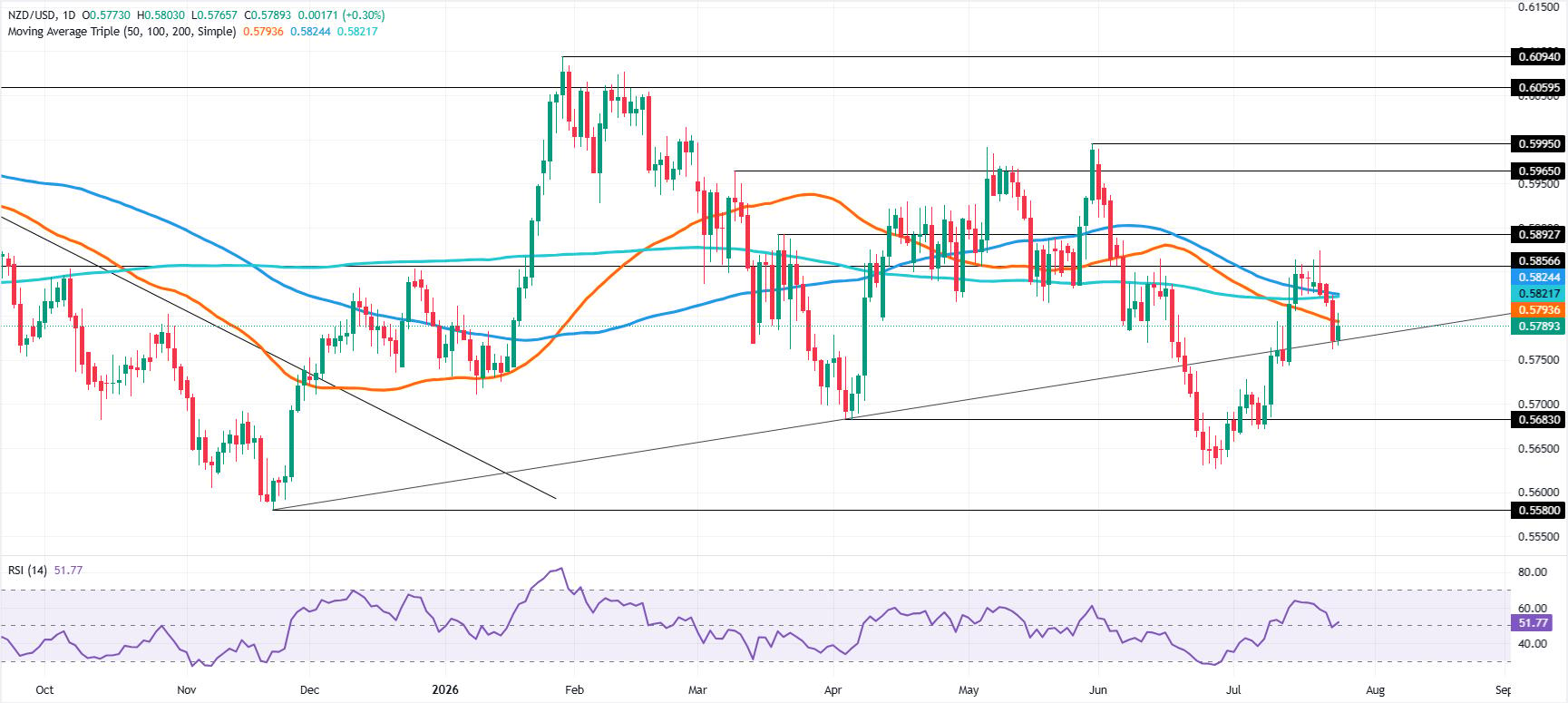
RSI turns bullish but fading slope warns of downside risk.
Break below 0.5762 exposes 0.5743 and 0.5700 supports.
The New Zealand Dollar gains over 0.30% against the US Dollar on Friday. The pair is poised to test key resistance levels with the 50-day Simple Moving Average (SMA) at 0.5793, slightly below the 0.5800 figure. At the time of writing, the NZD/USD trades at 0.5789, after bouncing off daily lows of 0.5767.
NZD/USD Price Forecast: Technical outlook
The Kiwi Dollar seems to recover during the day, but the overall trend is downwards, until the pair reclaims the May 29 high of 0.5995. Momentum turned bullish as depicted in the Relative Strength Index (RSI), but seems to be fading as the index is about to pierce bearish territory.
As of writing, the NZD/USD is testing key resistance below 0.5800. A breach of the latter will expose the confluence of the 100- day and 200-day Simple Moving Averages (SMAs) at 0.5823, followed by the July 21 high at 0.5874. Above this area, the next resistance is the 0.5900, followed by the May 29 high beneath 0.6000.
On the other hand, if NZD/USD breaches the low of the week (LOW) of 0.5762, it opens the door for further downside. The next key support is the July 13 low of 0.5743, followed by 0.5700. Beneath lies the July 7 high at 0.5672.
The New Zealand dollar steadied at 0.582, remaining near a six-week high, supported by growing expectations of further interest rate increases following a hot inflation reading. New Zealand’s annual inflation accelerated to 4.1% in Q2 from 3.1% in Q1, exceeding both market forecasts of 4% and the RBNZ’s projection of 3.9%. It marked the highest level since Q4 2023 and pushed inflation further above the central bank’s 1–3% target range. The hot print solidified wagers that the central bank will deliver another 25-basis-point rate hike in September, with swaps also implying additional increases in either October or December, followed by another move in February next year. Last week, RBNZ Chief Economist Paul Conway said that Middle East-driven inflation risks to the third quarter outlook have increased, and that some further reduction in monetary stimulus is likely to be needed.
The New Zealand dollar remained at a six-week high, hovering around $0.584, as the prospect of additional rate hikes at home helped offset a broader risk-off move amid escalating US-Iran tensions. The Reserve Bank of New Zealand is widely expected to raise interest rates again in September, with the OCR projected to reach at least 3.0% by the end of the year. Earlier this week, RBNZ Chief Economist Paul Conway warned that renewed hostilities in the Middle East could reignite inflationary pressures, potentially prompting the central bank to tighten policy further after last week’s first hike in more than three years. Meanwhile, the US dollar rebounded from a near one-month low after the latest data pointed to continued resilience in the US economy, capping further gains in the kiwi. For the week, the currency rose more than 1%, marking its third straight week of gains.
The New Zealand dollar hovered near a six-week high at around $0.583, supported by expectations that the Reserve Bank of New Zealand will continue tightening monetary policy, alongside broad weakness in the US dollar. Markets widely expect the RBNZ to deliver another rate hike in September, with the OCR seen reaching at least 3.0% by the end of the year. RBNZ Chief Economist Paul Conway said earlier this week that renewed conflict in the Middle East could fuel inflationary pressures, reinforcing the case for further policy tightening following last week’s first rate increase in more than three years. Meanwhile, the greenback hovered near a one-month low as investors scaled back bets on a near-term Federal Reserve rate hike after softer-than-expected inflation data. However, escalating geopolitical tensions remain a downside risk for the New Zealand dollar, as heightened uncertainty could weaken global risk appetite and weigh on risk-sensitive currencies such as the kiwi.
The geopolitically turbulent start of July has brought a strengthening of commodity currencies (among them, the Norwegian krone). However, the top of the G10 list is occupied by the New Zealand dollar, which may come as a surprise to some. The currency has strengthened by nearly 2.5% against the dollar over the past two weeks.
What lies behind such a significant move?
Fundamental to this, as is often the case, were the actions of the central bank. On 8 July, the Reserve Bank of New Zealand raised the main interest rate by 25 bps, lifting it to 2.5%. This was the first rate hike in New Zealand in over three years. The key, however, was not just the decision to raise rates (which was largely priced in by markets) but the communication that accompanied it.
The decision was made unanimously by the committee. At the previous meeting in May, there was a 3-3 split in votes, and the balance was only tipped by the new governor, Anna Breman.
The RBNZ Chief Economist, Paul Conway, drew clear attention to pro-inflationary risks resulting from the escalation of tensions in the Middle East.
The Bank stated in its communiqué that “while further interest rate hikes seem likely at upcoming meetings, their timing is highly uncertain.”
RBNZ research suggests that after a long period of elevated inflation, New Zealand companies are significantly more inclined to immediately pass costs on to consumers and less willing to lower prices when costs fall.
As a result, the market’s baseline scenario is another hike in September and another upward move in October or December. This would bring the main interest rate (cash rate) to 3%, which the bank currently defines as the neutral level.
What lies ahead? There is still plenty of time until September.
In the meantime, the Q2 inflation report will be published. The consensus assumes a significant increase in the headline indicator, most likely to around 4%.
After the manufacturing PMI rose to its highest level since 2021 (59.7), data on production could prove particularly interesting.
Data from China, New Zealand’s largest trading partner, which absorbs nearly 25% of the country’s total exports (mainly dairy, meat, wood, and fruit), will also be significant.
Stronger economic data from the Middle Kingdom usually means greater demand for products imported from New Zealand.
In this context, the readings published today are not particularly optimistic. GDP dynamics fell to the lowest level since 2022 (+4.3% year-on-year).
The Asian giant is burdened by a property market crisis, weak domestic demand, and a decline in investment (down 5.7% year-on-year in the first half of the year).
The strength of the dollar itself, which is awaiting further news from the geopolitical front and the September FOMC decision, could, of course, also prove key.
The market does not really expect a hike, so the focus will be on communication. Kevin Warsh remains enigmatic, so upcoming conferences may attract particular attention.
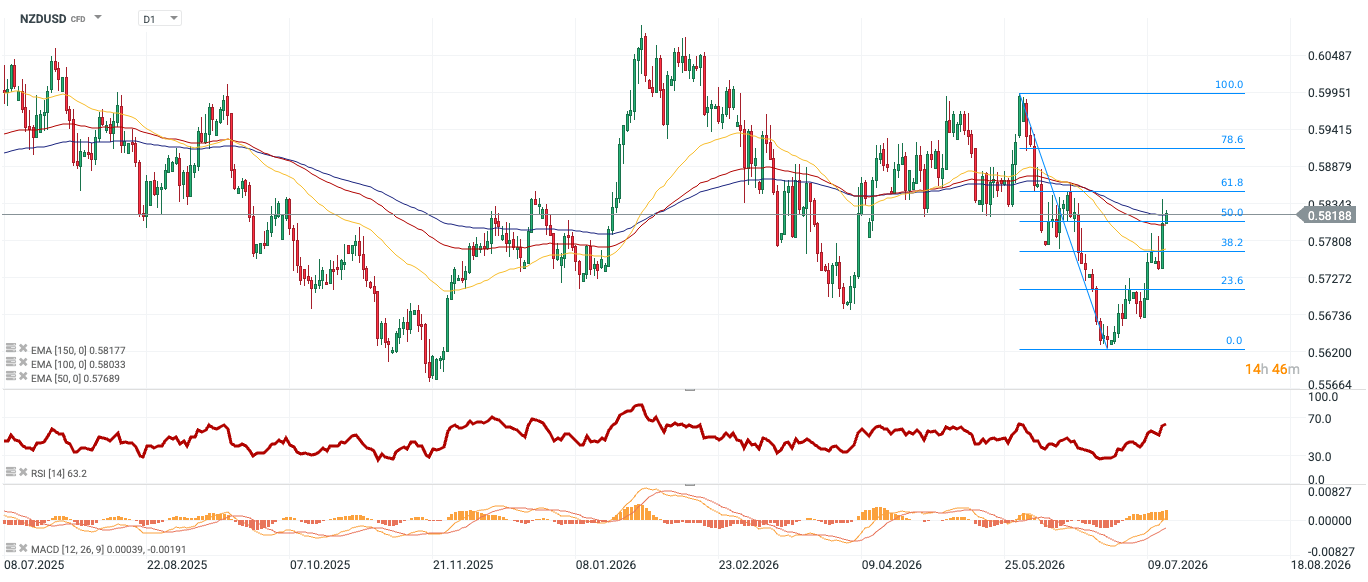
Source: xStation, 15.07.2026 The NZDUSD pair has broken out of the downtrend and is currently testing key support levels. The price has breached the 50% Fibonacci retracement and is hovering around the 150-day moving average. The upward momentum is also suggested by the MACD indicator. The Relative Strength Index (RSI) has reached 63.4, which confirms a clear advantage for market bulls, while at the same time indicating that the market is not yet in the extreme overbought zone (above 70).
The New Zealand dollar rose to around $0.577 on Tuesday, its highest level in four weeks, following remarks from RBNZ Chief Economist Paul Conway. Conway warned that inflation may not ease as quickly as the central bank expects, raising the possibility of further interest rate hikes. Last week, the RBNZ lowered its forecast for third-quarter inflation to 3.3% from 4.3%, citing lower fuel prices following the interim US-Iran agreement. However, oil prices have rebounded in recent days as renewed fighting in the Middle East fueled supply concerns. The RBNZ’s hawkish stance last week, combined with a series of upbeat domestic economic data, has led markets to price in two additional rate hikes this year. However, the kiwi’s gains were limited as the standoff between the US and Iran intensified, with President Trump reimposing a US naval blockade of Iranian ports and announcing a 20% charge on all cargo shipped through the Strait of Hormuz, dampening risk appetite.
The New Zealand dollar held around $0.576 on Monday, hovering near its highest level in more than three weeks, supported by expectations of further interest rate hikes from the Reserve Bank. Swaps traders are pricing in nearly two additional quarter-point rate hikes from the Reserve Bank of New Zealand by year-end, following the central bank’s hawkish stance and strong manufacturing data last week. Additional support came from fresh data showing that New Zealand’s services sector returned to expansion in June for the first time since January, reinforcing the view that the economy is regaining momentum. However, escalating tensions in the Middle East are weighing on risk sentiment and limiting the kiwi’s gains. The US and Iran exchanged heavy missile and drone strikes over the weekend, with Tehran targeting US facilities across the Gulf and claiming it had once again closed the Strait of Hormuz.
NZD/USD builds on the hawkish RBNZ-inspired gains for the third straight day on Friday.
The USD drops to a fresh weekly trough and provides an additional boost to spot prices.
Mixed US-Iran signals do little to impress the USD bulls or hinder the pair’s momentum.
The NZD/USD pair gains strong follow-through positive traction for the third straight day and rallies to an over three-week top during the Asian session on Friday. Spot prices currently trade around the 0.5775-0.5780 region, up nearly 0.40% for the day, and remain on track to register strong gains for the second week in a row amid a combination of supporting factors.
The New Zealand Dollar (NZD) continues to be underpinned by the Reserve Bank of New Zealand’s (RBNZ) hawkish outlook, which, along with a broadly weaker US Dollar (USD), acts as a tailwind for the NZD/USD pair. As was widely expected, the RBNZ raised the Official Cash Rate (OCR) by 25 basis points (bps) to 2.50% following the conclusion of the June monetary policy meeting on Wednesday. The central bank also indicated that some further reduction in monetary stimulus is likely to be required to curb inflationary pressures.
In contrast, the Minutes from the June 16–17 FOMC meeting revealed on Wednesday that policymakers were divided over the direction of interest rates. The minutes further stated that many participants indicated the appropriate level of the federal funds rate would be within or slightly below the current target range at the end of this year. The less hawkish outlook, in turn, drags the USD Index (DXY), which tracks the Greenback against a basket of currencies, to a fresh weekly low and contributes to the bid tone around the NZD/USD pair.
Meanwhile, the geopolitical risk premium resurfaced this week after the US military unleashed a new wave of strikes against Iran earlier this week in retaliation for Tehran’s attacks on commercial ships in the Strait of Hormuz. Iran responded by targeting American allies and bombing US military installations across Bahrain and Kuwait. The market anxiety, however, subsided after Trump on Thursday claimed that Iran had called to make a deal with the US, denting the USD’s safe-haven status and lending additional support to the NZD/USD pair.
Moving ahead, there isn’t any relevant market-moving economic data due for release from the US on Friday, leaving the USD at the mercy of comments from influential FOMC members. Apart from this, the market focus will be on further developments surrounding the Middle East crisis, which might continue to infuse volatility in global financial markets and drive the USD. Nevertheless, the fundamental backdrop backs the case for a further appreciating move for the NZD/USD pair, which remains on track to register gains for the second straight week.
New Zealand Dollar Price This week
The table below shows the percentage change of New Zealand Dollar (NZD) against listed major currencies this week. New Zealand Dollar was the strongest against the Japanese Yen.
USD
EUR
GBP
JPY
CAD
AUD
NZD
CHF
USD
-0.09%
-0.66%
0.19%
-0.30%
-0.23%
-1.29%
0.13%
EUR
0.09%
-0.60%
0.24%
-0.23%
-0.10%
-1.23%
0.18%
GBP
0.66%
0.60%
0.74%
0.36%
0.50%
-0.63%
0.77%
JPY
-0.19%
-0.24%
-0.74%
-0.49%
-0.26%
-1.42%
-0.05%
CAD
0.30%
0.23%
-0.36%
0.49%
0.20%
-0.94%
0.41%
AUD
0.23%
0.10%
-0.50%
0.26%
-0.20%
-1.13%
0.27%
NZD
1.29%
1.23%
0.63%
1.42%
0.94%
1.13%
1.41%
CHF
-0.13%
-0.18%
-0.77%
0.05%
-0.41%
-0.27%
-1.41%
The heat map shows percentage changes of major currencies against each other. The base currency is picked from the left column, while the quote currency is picked from the top row. For example, if you pick the New Zealand Dollar from the left column and move along the horizontal line to the US Dollar, the percentage change displayed in the box will represent NZD (base)/USD (quote).
To provide the best experiences, we use technologies like cookies to store and/or access device information. Consenting to these technologies will allow us to process data such as browsing behavior or unique IDs on this site. Not consenting or withdrawing consent, may adversely affect certain features and functions.
Functional
Always active
The technical storage or access is strictly necessary for the legitimate purpose of enabling the use of a specific service explicitly requested by the subscriber or user, or for the sole purpose of carrying out the transmission of a communication over an electronic communications network.
Preferences
The technical storage or access is necessary for the legitimate purpose of storing preferences that are not requested by the subscriber or user.
Statistics
The technical storage or access that is used exclusively for statistical purposes.The technical storage or access that is used exclusively for anonymous statistical purposes. Without a subpoena, voluntary compliance on the part of your Internet Service Provider, or additional records from a third party, information stored or retrieved for this purpose alone cannot usually be used to identify you.
Marketing
The technical storage or access is required to create user profiles to send advertising, or to track the user on a website or across several websites for similar marketing purposes.