
The South Korean won eased to around 1,415 per dollar, pulling back slightly from a recent over ten-month high, as renewed uncertainty over the Strait of Hormuz weighed on the currency. Iran denied holding direct talks with Washington over reopening the waterway, casting doubt on a near-term deal and keeping oil prices elevated, raising concerns over import costs and inflation in South Korea. Meanwhile, strong semiconductor exports and continued dollar selling by exporters provided support, with July exports rising nearly 63% year-on-year to $98.89 billion and semiconductor shipments surging 179%. Expectations of foreign exchange intervention by South Korean authorities are also helping limit renewed won weakness and keep the currency near its strongest level since October 2025. At the same time, investors are monitoring this week’s US inflation data for further clues on the Federal Reserve’s policy outlook and the dollar’s direction.

New Zealand Dollar drifts lower as USD recovers from post-NFP lows amid Mideast jitters
- NZD/USD meets with a fresh supply on Monday as geopolitical risks underpin the USD.
- Higher oil prices fuel inflation fears and Fed hike bets, which further benefit the buck.
- The hawkish RBNZ could support the NZD and limit losses ahead of US inflation figures.
The NZD/USD pair is seen extending Friday’s late pullback from the vicinity of the monthly peak – levels just above the 0.5900 mark – and drifting lower at the start of a new week. Spot prices, however, remain confined in a familiar range held over the past week or so and currently trade around the 0.5880 region, down 0.20% for the day, amid a modest US Dollar (USD) strength.
The immediate market reaction to the disappointing release of the US Nonfarm Payrolls (NFP) report on Friday seems to have faded as the geopolitical risk premium offers some support to the safe-haven USD. Meanwhile, the uncertainty over the Strait of Hormuz and fresh attacks by Iran-backed Houthi militants against Saudi energy infrastructure act as a tailwind for crude oil prices. This continues to fuel inflation fears and bets for at least one interest rate hike by the US Federal Reserve (Fed) in 2026.
Meanwhile, data released over the weekend showed that China’s annual consumer inflation rate slowed to a six-month low and producer price inflation eased more sharply than expected in July. This turns out to be another factor weighing on antipodean currencies, including the New Zealand Dollar (NZD), and contributing to the NZD/USD pair’s slide. However, the Reserve Bank of New Zealand’s (RBNZ) hawkish tilt could support the New Zealand Dollar (NZD) and help limit deeper losses for the pair.
Traders might also opt to wait for the latest US inflation figures, due this week, for more cues about the Fed’s future policy path. The outlook, along with further developments surrounding the Middle East crisis, will drive the USD demand and provide some impetus to the NZD/USD pair. In the meantime, the aforementioned mixed fundamental backdrop makes it prudent to wait for a breakdown through a one-week-old trading range support near the 0.5860 region before placing aggressive bearish bets.
NZD/USD 4-hour chart
Technical Analysis
With the NZD/USD pair hovers in a tight range and lacks a clear directional edge, leaving the near-term bias broadly neutral around the 0.59 handle. The 0.5865-0.5860 region should act as a short-term pivot and a sustained break below would be needed to bac the case for any further near-term depreciating move.

Dollar Index advances above 99.50 due to Middle East risks
- US Dollar gains on strong safe-haven demand amid uncertainty around the Hormuz reopening.
- July’s surprise 23,000 US payroll drop and past revision signal a cooling labor market, dampening Fed rate expectations.
- CME FedWatch Tool suggests a 46% chance of a September rate hike, down from 67%.
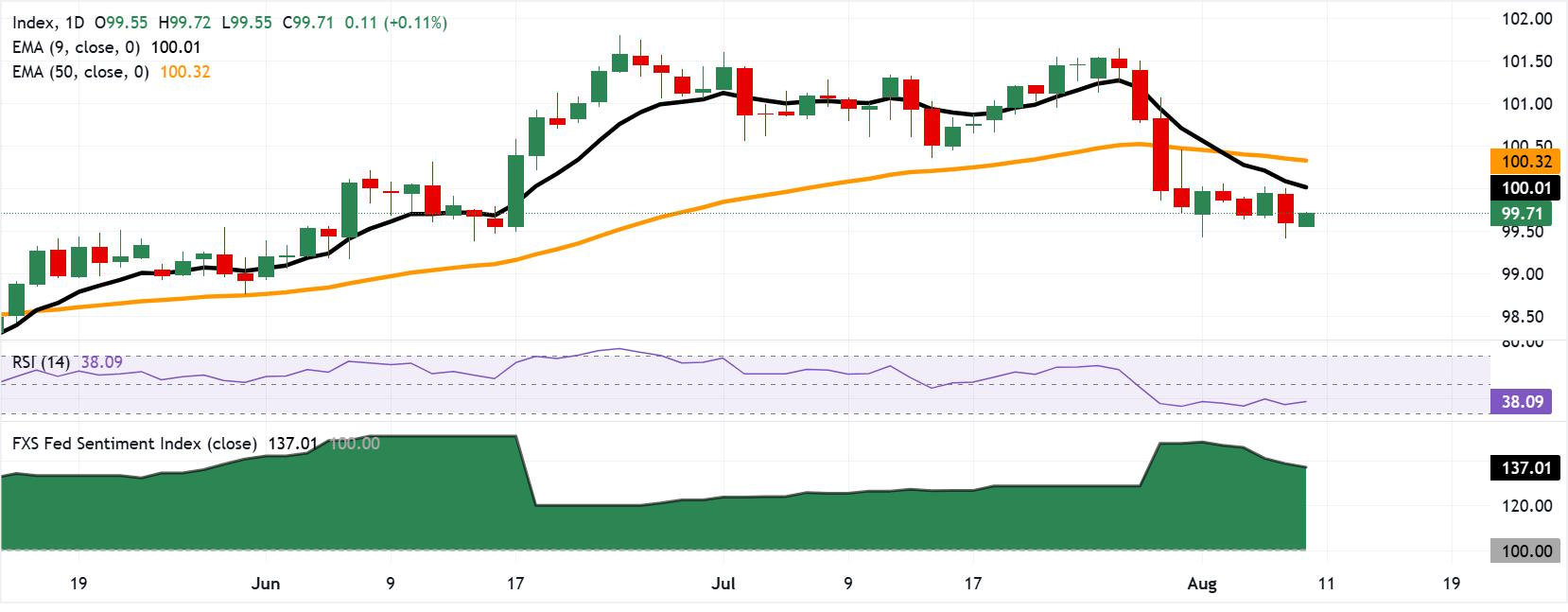
The US Dollar Index (DXY), which measures the value of the US Dollar (USD) against six major currencies, is gaining ground after registering modest losses in the previous day and trading around 99.70 during the Asian hours on Monday.
The Greenback receives support from broad risk aversion amid geopolitical tensions remaining high as the ongoing United States (US)-Iran conflict enters a critical diplomatic phase, with intense military engagements and strategic pressure surrounding the Strait of Hormuz driving market caution. Although Iranian officials noted on Sunday that Oman-mediated negotiations regarding the management of the strait are making progress, safe-haven demand for the Greenback remains firmly intact.
Weaker-than-expected US employment data has dampened expectations for a near-term Federal Reserve (Fed) rate hike. Nonfarm Payrolls (NFP) unexpectedly dropped by 23,000 in July, while sharp downward revisions to 20,000 from the previous 57,000 in June highlighted weakening labor market conditions.
CME FedWatch Tool suggests that markets now see around a 46% probability of a 25 basis point rate hike in September, down from 67% a week earlier. Investors are now focused on upcoming inflation reports for further clues on monetary policy.
Markets bull steepen as Fed hike expectations are pared back
According to TD Securities, the rates market “bull steepened on the negative headline print despite a drop in the UE rate to 4.1%.” The softer data “eased concerns over a reaccelerating labor market,” prompting investors to “price out hikes,” with the bank noting that “September’s pricing [declined] by 3bp to 12bp of hikes.”
Barkin flags weak labour balance despite solid corporate earnings
Fed’s Barkin delivered a slightly softer tone, with a 5.4/10 FXS Speechtracker score coming in below the 5.8/10 historical average, underscoring a modestly more cautious stance. The emphasis on job data being “very consistent with a sector in weak balance” and characterized by “low hire, low fire” highlights a labour market that is stagnant rather than collapsing, tempering any aggressive policy bias. At the same time, Barkin’s focus on “quite strong” and growing corporate earnings, and the explicit watch for linkages to the job market, signals that resilient profits could limit how dovish policy can become if labour softness does not spill over more broadly.
The FXS Fed Sentiment Index fell by 1.68 points to 137.01, indicating a pullback in perceived hawkishness even as the index remains firmly above the neutral 100 mark. This configuration suggests that, despite a softer tone in the latest remarks captured by the FXS Speechtracker, overall Fed communication is still anchored in hawkish territory, with markets expecting policy to stay relatively restrictive.

Euro consolidates below its highest level since June 17 as Mideast tensions support USD
- EUR/USD consolidates below its highest level since June 17 amid a modest USD uptick.
- The USD looks to build on its recovery from the post-NFP swing low amid Iran tensions.
- Market attention now shifts to this week’s release of the latest US inflation figures.
The EUR/USD pair kicks off the new week on a subdued note and trades just above 1.1550 during the Asian session, well within striking distance of a fresh high since June 17, touched in reaction to the disappointing US jobs data on Friday.
The closely watched US Nonfarm Payrolls (NFP) showed that the economy lost 23K jobs in July, missing consensus estimates of 80K by a wide margin. Adding to this, the previous month’s reading was revised lower to show an addition of 20K jobs, compared to the 57K reported originally. Further details revealed that annual wage inflation, as measured by the change in the Average Hourly Earnings, eased to 3.2% from 3.4%. This offsets a dip in the Unemployment Rate to 4.1%, from 4.2% in June, and undermines the case for the US Federal Reserve (Fed) to raise interest rates.
The immediate market reaction, however, turns out to be short-lived as persistent uncertainties over efforts to reopen the critical Strait of Hormuz lend some support to the safe-haven US Dollar (USD). The USD Index (DXY), which tracks the Greenback against a basket of currencies, is now looking to build on Friday’s late rebound from its lowest level since June 17 and is turning out to be a key factor acting as a headwind for the EUR/USD pair. Traders, however, seem reluctant to place directional bets and opt to wait for further developments surrounding the Middle East crisis.
Over the weekend, Iran stated that talks with Oman to establish a safe shipping route through the strategic waterway are nearing an agreement. Tehran, however, cautioned that any deal would not result in an immediate reopening. Furthermore, Iran-backed Houthi militants in Yemen claimed a recent attack on Saudi Arabia’s Jazan refinery, while a tanker operated by the Abu Dhabi National Oil Co. came under attack in the Strait. This keeps the geopolitical risk premium in play and supports oil prices, fueling inflation fears and bets for at least one interest rate hike by the Fed in 2026.
The mixed fundamental backdrop, in turn, warrants some caution before positioning for an extension of the EUR/USD pair’s recent strong move up from the vicinity of mid-1.1300s, touched on July 28. Market attention now shifts to the latest US consumer inflation figures, due on Wednesday, which will be looked for more cues about the Fed’s policy path. Apart from this, the incoming geopolitical headlines will play a key role in influencing the USD price dynamics and producing some short-term trading opportunities around the EUR/USD pair.

British Pound moves away from multi-week top as Hormuz risks support USD
- GBP/USD kicks off the new week on a softer note as geopolitical uncertainties support the USD.
- The disappointing US NFP further tempers Fed hike bets, which might cap the upside for the buck.
- Market focus now shifts to this week’s release of US inflation figures and the prelim UK Q2 report.
The GBP/USD pair edges lower at the start of a new week and moves further away from an over three-week high, or levels just above the 1.3500 psychological mark touched on Friday.
The US Dollar (USD) is looking to build on its recovery from the post-NFP swing low amid persistent uncertainties surrounding the Middle East crisis and efforts to reopen the Strait of Hormuz. This, in turn, acts as a headwind for the GBP/USD pair, though the downside seems limited as receding US Federal Reserve (Fed) rate hike bets could limit any meaningful USD appreciation.
The closely-watched US monthly jobs data showed that the economy lost 23Kjobs in July, while the previous month’s reading was revised lower to 20K from 57K, pointing to signs of a cooling labor market. Traders were quick to react and are now pricing in a less than 45% chance that the US central bank will raise borrowing costs in September, down from 67% a week ago.
However, investors are still assigning a greater probability of at least one 25-basis-point (bps) rate increase before the end of this year amid concerns that recovering oil prices will rekindle inflationary pressures. Hence, the focus shifts to the latest US inflation figures, due this week. Apart from this, the incoming geopolitical headlines will drive the USD and influence the GBP/USD pair.
Investors will further confront the release of the prelim UK Q2 GDP report on Thursday, which will play a key role in providing a fresh impetus to the British Pound (GBP). Nevertheless, the aforementioned fundamental backdrop warrants some caution before placing fresh bullish bets on the GBP/USD pair and positioning for an extension of a nearly two-week-old uptrend.

Japanese Yen comes under pressure as BoJ division, unexpected current account deficit
- USD/JPY rises as split BoJ board views on future rate hikes keep the Yen on the defensive.
- Japan logged an unexpected June current account deficit of JPY 92.3 billion, its first in 17 months, on large foreign dividend payouts.
- Escalating US-Iran tensions boost the Dollar, driving the USD/JPY pair higher.
USD/JPY gains ground after registering modest losses in the previous day, trading around 158.20 during the Asian hours on Monday. The pair remains stronger as the Japanese Yen (JPY) holds losses following the release of the Bank of Japan’s (BoJ) Summary of Opinions from its July 30–31 monetary policy meeting.
The summary suggested a clear division among board members; while some advocated for holding interest rates steady to evaluate the lagged impact of previous rate hikes, others pushed to maintain or even accelerate the tightening cycle, citing rising upside risks to prices. Despite members noting that Middle East tensions are weighing on economic activity, they highlighted that robust AI-related demand and a moderately recovering domestic economy continue to provide an offset.
Japan recorded its first current account deficit in 17 months in June, driven by high dividend payouts to overseas investors who have been pouring capital into domestic markets. According to Finance Ministry data released Monday, the deficit hit JPY 92.3 billion ($584.51 million), wildly missing economists’ median forecast of a JPY 1.51 trillion surplus in a Reuters poll, and down sharply from a JPY 1.28 trillion surplus a year earlier.
The USD/JPY pair rises as the US Dollar (USD) continues to draw support from broad risk aversion. Geopolitical tensions remain high as the ongoing US-Iran conflict enters a critical diplomatic phase, with intense military engagements and strategic pressure surrounding the Strait of Hormuz driving market caution. Although Iranian officials noted on Sunday that Oman-mediated negotiations regarding the management of the strait are making progress, safe-haven demand for the Greenback remains firmly intact.
Fed expectations seen driving scope for lower yields
According to TD Securities, the risk of another Fed hike “lingers,” but the bank argues that upcoming inflation data could be pivotal for rate expectations. The team notes that their projections for this week’s CPI — “core and headline CPI this week (0.20% m/m and 0.15% m/m, respectively)” — would “likely lead to further pricing out of hikes.” With “the majority of the recent move higher in rates driven by Fed expectations,” TD Securities adds that “rates could move lower as hikes are priced out.”
Musalem flags persistent inflation risks as Fed bias stays hawkish
Fed’s Musalem delivered a modestly more hawkish tone, with the FXS Speechtracker score at 7.4 versus a 7.0 historical baseline, underscoring concern that inflation expectations could risk losing their anchor even as they are currently described as stable and aligned with the 2% target. Emphasis on core inflation amid energy volatility, a preference for incremental rate hikes, and an assessment that core inflation likely sits between 2.5% and 3%—alongside a stated willingness to surprise markets when needed—reinforce a bias toward tighter policy and a higher-for-longer stance. The assertion that the Dollar’s reserve status is not under threat and that the United States remains the fastest-growing, most innovative economy with strong rule of law further supports a constructive backdrop for the Dollar, especially as financial conditions are still seen as highly accommodative and many asset prices remain elevated.
The FXS Fed Sentiment Index was unchanged, moving 0.00 points to hold at a hawkish 138.69, signaling that despite the slightly above-baseline speech score, the broader policy tone remains consistently restrictive rather than newly escalated. With the index firmly above the neutral 100 mark and aligned with the elevated FXS Speechtracker reading, markets are likely to interpret Musalem’s remarks as reinforcing existing expectations for a cautious, data-dependent path that leans toward additional tightening if inflation fails to move sustainably closer to the 2% target.

The CAD pulls back from two-month top as rebounding USD counters higher oil prices
- USD/CAD kicks off the new week on a slightly positive note, though it lacks follow-through.
- Geopolitical uncertainties and bets for at least one Fed rate hike this year support the USD.
- Friday’s upbeat Canadian jobs data and oil prices underpin the Loonie, capping spot prices.
The USD/CAD pair attracts some dip-buyers at the start of a new week and recovers a part of Friday’s heavy losses to the 1.3925 area, or a nearly two-month low. Spot prices climb back above mid-1.3900s during the Asian session, though the upside potential seems limited amid a combination of diverging forces.
As investors look past Friday’s disappointing US Nonfarm Payrolls (NFP) report, the US-Iran standoff keeps the geopolitical risk premium in play and acts as a tailwind for the safe-haven US Dollar (USD). Furthermore, bets that the US Federal Reserve (Fed) will raise borrowing costs by the end of this year amid inflation risks stemming from recovering crude oil prices lend support to the Greenback and the USD/CAD pair.
Meanwhile, uncertainties surrounding the reopening of the Strait of Hormuz remain supportive of a bid tone surrounding crude oil prices, which is seen underpinning the commodity-linked Loonie. The Canadian Dollar (USD) could further benefit from the upbeat domestic jobs report, released on Friday. This, in turn, might hold back traders from placing aggressive bullish bets on the USD/CAD pair and cap any meaningful gains.
Hence, it will be prudent to wait for strong follow-through buying before confirming that the recent pullback from the vicinity of mid-1.4200s, or the year-to-date high touched in June, has run its course and positioning for further upside. Traders might also opt to wait for this week’s release of US inflation figures. Moreover, further developments surrounding the Middle East crisis will be looked upon for some impetus.
USD/CAD daily chart
Technical Analysis:
The USD/CAD pair’s ability to stay above the 100-day Simple Moving Average (SMA) at 1.3917 suggests underlying demand is still cushioning pullbacks, even as upside momentum appears measured. A break would expose a deeper correction. On the flip side, traders may look to psychological round figures and recent swing highs to define the next topside hurdles as long as spot prices hold above the 100-day SMA.

Australian Dollar weakens as safe-haven demand lifts US Dollar
- AUD/USD holds losses as US Dollar safe-haven demand rises amid heightened US-Iran tensions and Strait of Hormuz risks.
- A surprising decline of 23,000 Nonfarm Payrolls in July curbed hopes for an immediate interest rate increase by the Fed.
- RBA is widely expected to keep its cash rate unchanged at 4.35% on Tuesday.
AUD/USD inches lower after registering modest gains in the previous day, trading around 0.7060 during the Asian hours on Monday. The pair holds losses as the US Dollar (USD) receives support from broad risk aversion.
Geopolitical tensions remain high as the ongoing United States (US)-Iran conflict enters a critical diplomatic phase, with intense military engagements and strategic pressure surrounding the Strait of Hormuz driving market caution. Although Iranian officials noted on Sunday that Oman-mediated negotiations regarding the management of the strait are making progress, safe-haven demand for the Greenback remains firmly intact.
Weaker-than-expected US employment data has dampened expectations for a near-term Federal Reserve (Fed) rate hike. Nonfarm Payrolls (NFP) unexpectedly dropped by 23,000 in July, while sharp downward revisions to the previous two months highlighted weakening labor market conditions. Investors are now focused on upcoming inflation reports for further clues on monetary policy.
Traders look ahead to the Reserve Bank of Australia’s (RBA) monetary policy decision on Tuesday. The central bank is widely expected to keep its cash rate unchanged at 4.35% for a second straight meeting. Traders will closely watch the RBA’s updated forecasts and Governor Michele Bullock’s comments for clues on the future policy path.
Rabo sees November RBA risk keeping modest upside bias in AUD/USD
Strategists at Rabobank note that, in their view, there is still “risk of one more rate hike this year in November,” with markets likely to look to the RBA’s 11 August policy meeting for “more clarity on rate hike risks.” Against this backdrop, the bank says it continues to “forecast a modest upside bias in AUD/USD out to 12 months,” a view it anchors “mostly on the back of a moderately softer tone in the USD and the view that Fed rate hike expectations are overdone.”