

The Philippine peso weakened to around 61.84 per US dollar in late July, moving closer to a fresh record low as surging oil prices and broad US dollar strength weighed on the currency. Crude prices have jumped more than 30% this month as the escalating US-Iran conflict spilled over into key other shipping routes, heightening concerns over deeper disruptions to global energy supplies. This has intensified pressure on oil-importing economies, including the Philippines, raising concerns over imported inflation and the country’s trade balance. The Bangko Sentral ng Pilipinas intervened in the foreign exchange market this week to support the peso, while the Marcos administration expressed confidence that the central bank would act decisively if needed. Fitch Group’s BMI Research forecasts the peso to trade within the 61–63 per US dollar range this year, making it one of Asia’s weakest-performing currencies. The peso has fallen nearly 5% against the US dollar so far this year.

United States Dollar Index holds gains near 101.50 on revival of hawkish Fed bets
- The US Dollar Index holds gains near 101.50 on the resurgence of Fed’s interest rate hike prospects.
- Surging oil prices have revived hawkish Fed bets.
- US President Trump warns of major military punishment to Iran and Houthis.
The US Dollar (USD) clings to the previous day’s gains in the Asian session on Friday, as surging oil prices due to intensified Middle East energy supply risks have revived Federal Reserve (Fed) interest rate hike expectations.
At press time, the US Dollar Index (DXY), which tracks the Greenback’s value against six major currencies, trades firmly near an over three-week high at 101.50.
US Dollar Price This week
The table below shows the percentage change of US Dollar (USD) against listed major currencies this week. US Dollar was the strongest against the Swiss Franc.
| USD | EUR | GBP | JPY | CAD | AUD | NZD | CHF | |
|---|---|---|---|---|---|---|---|---|
| USD | 0.43% | 1.05% | 0.92% | 0.45% | -0.13% | 0.98% | 1.08% | |
| EUR | -0.43% | 0.63% | 0.43% | 0.02% | -0.53% | 0.57% | 0.64% | |
| GBP | -1.05% | -0.63% | -0.22% | -0.62% | -1.17% | -0.06% | 0.05% | |
| JPY | -0.92% | -0.43% | 0.22% | -0.38% | -0.99% | 0.00% | 0.25% | |
| CAD | -0.45% | -0.02% | 0.62% | 0.38% | -0.54% | 0.39% | 0.66% | |
| AUD | 0.13% | 0.53% | 1.17% | 0.99% | 0.54% | 1.10% | 1.23% | |
| NZD | -0.98% | -0.57% | 0.06% | -0.01% | -0.39% | -1.10% | 0.13% | |
| CHF | -1.08% | -0.64% | -0.05% | -0.25% | -0.66% | -1.23% | -0.13% |
The heat map shows percentage changes of major currencies against each other. The base currency is picked from the left column, while the quote currency is picked from the top row. For example, if you pick the US Dollar from the left column and move along the horizontal line to the Japanese Yen, the percentage change displayed in the box will represent USD (base)/JPY (quote).
In the Asian trade, the WTI Oil price trades 0.5% lower to near $90.60, but is close to its over six-week high of $92.25 posted on Thursday. Higher oil prices boost inflation expectations, a scenario that discourages Fed officials from considering loose monetary conditions.
The closure of the Bab el-Mandeb Strait, along with the Strait of Hormuz, has disrupted 27% of global energy supply.
Meanwhile, no signs of a diplomatic breakthrough between the US and Iran indicate that supply shocks could last long. On Thursday, US President Donald Trump said that Washington would hold Iran responsible for the Yemen-based Houthis’ actions and warned that Iran and its Houthi allies would both soon receive a “major military punishment”.
According to the CME FedWatch tool, the odds of the Fed delivering an interest rate hike in the policy meeting next week stand at 35.8%, significantly higher from 11.8% recorded last week. Fed’s interest rate hike prospects were similar to the current state a month ago, but they eased later after the release of the soft US Consumer Price Index (CPI) data for June.
British Pound rebounds above 1.3300
- GBP/USD rebounds to around 1.3325 in Friday’s Asian session.
- The US launched the 13th consecutive night of strikes against Iran.
- Traders await the UK June Retail Sales report on Friday for fresh impetus.
The GBP/USD pair recovers some lost ground to near 1.3325, snapping the five-day losing streak during the Asian trading hours on Friday. However, the potential upside might be limited amid heightened military tensions in the Middle East. Traders brace for the release of the UK Retail Sales data, which will be published later on Friday.
Renewed geopolitical tensions in the Middle East could underpin the US Dollar (USD) as a safe-haven currency. The US Central Command (CENTCOM) said it launched its 13th consecutive night against Iranian targets. US President Donald Trump said on Thursday that the US would hold Iran responsible for the Houthis’ actions and warned Iran and its Houthi allies would both soon receive a “major military punishment,” per the Guardian.
Traders expect the Bank of England (BoE) to keep its benchmark interest rate steady at 3.75% next week as it continues to assess the impact of the Middle East conflict. Financial markets were pricing in one or possibly two quarter-point interest rate hikes by the end of 2026, little changed from Tuesday, according to Reuters.
The UK Retail Sales data could offer more clues about the UK interest rate path. Retail Sales are expected to show a decline of 0.3% MoM in June, compared to a rise of 1.2% in May. In case of a surprise upside reading, this could reinforce the Bank of England (BoE) to maintain an aggressive tightening stance, supporting the Cable.
Pound steadies as markets look for BoE to hold Bank Rate at 3.75%
Analysts at Scotiabank note that policy expectations remain firmly anchored ahead of next week’s BoE decision, with “markets … expecting no policy change at the next MPC rate decision, where the Bank Rate is expected to be held at 3.75%.” This steady policy outlook, they suggest, continues to frame near-term trading conditions for the Pound against the US Dollar as investors look toward upcoming UK data for further direction.
Japanese Yen flatlines near multi-decade low after CPI inflation data
- USD/JPY steadies around 163.90 in Friday’s early Asian session.
- Japanese CPI inflation rose to 1.7% YoY in June from 1.5% in May.
- Trump vowed to punish Iran for Houthi attacks in the Red Sea.
The USD/JPY pair holds steady near 163.90 during the early Asian session on Friday. However, the Japanese Yen (JPY) remains near a multi-decade low against the US Dollar (USD). The preliminary readings of the US S&P Global Purchasing Managers Index (PMI) will be published later on Friday.
Data released by the Japan Statistics Bureau on Friday showed that Japan’s National Consumer Price Index (CPI) inflation rose to 1.7% YoY in June, up from 1.5% in May. Meanwhile, the core CPI came in at 1.6% YoY in June, versus 1.4% prior. The figure came in line with the market consensus. This is the first rise in core inflation since March.
The so-called “core-core” inflation rate, which strips out prices of fresh food and energy, fell to 1.7% YoY in June, compared to the previous reading of 1.8%. This figure registered the lowest since August 2022.
This reading came just days before the Bank of Japan (BoJ) policy meeting, where the central bank is widely expected to leave interest rates unchanged. Japan’s National CPI inflation report has little to no impact on the JPY as traders are on high alert for possible intervention from Japanese authorities.
Finance Minister Satsuki Katayama on Wednesday warned markets that authorities stood ready to take “appropriate and bold action.” Katayama added that Japan’s policy on potential intervention remained unchanged and that it would take action if necessary.
Escalating tensions in the Middle East could boost the Greenback against the JPY in the near term. Reuters reported on Thursday that US President Donald Trump said the US would hold Iran responsible for the Houthis’ actions and warned Iran and its Houthi allies would both soon receive a “major military punishment.”

Australian Dollar rebounds vs USD; Trump’s tariffs and US-Iran tensions cap gains
- AUD/USD edges higher as Australia’s flash PMIs reaffirm RBA rate hike bets and lift the Aussie.
- Energy-driven inflation fears fuel hawkish Fed expectations and benefit the USD amid Iran risks.
- Traders look to the US PMIs for some impetus as the focus shifts to the FOMC meeting next week.
The AUD/USD pair attracts some buyers during the Asian session on Friday and reverses a part of the previous day’s slide back to the weekly trough. The mixed fundamental backdrop, however, warrants caution before confirming that the corrective slide from a nearly five-week high, around the 0.7025 area, touched on Tuesday has run its course and positioning for the resumption of the uptrend from the June low.
The US Dollar (USD) preserves its strong weekly gains to the highest level since June 26 and turns out to be a key factor acting as a headwind for the AUD/USD pair. A further escalation of tensions between the US and Iran remains supportive of the recent rise in crude oil prices to the highest level since June 11, which has been fueling inflationary concerns and bolstering US Federal Reserve (Fed) rate hike bets.
Moreover, US President Donald Trump’s new trade tariffs temper investors’ appetite for riskier assets and further underpin the safe-haven Greenback. According to a notice released by the office of US Trade Representative Jamieson Greer, the Trump administration is set to impose sweeping new tariffs of between 10% and 12.5% on 60 of the top trading partners, covering nearly all of the country’s imports.
The Australian Dollar (AUD), however, draws support from the better-than-expected release of domestic flash PMIs, signaling a second consecutive month of expansion for the broader private sector. This follows Thursday’s upbeat Australian employment details and reaffirms bets for more interest rate hikes by the Reserve Bank of Australia (RBA), which helps limit the downside for the AUD/USD pair.
Traders now look forward to flash US PMIs, due later during the early North American session. Apart from this, incoming geopolitical headlines will play a key role in influencing the USD price dynamics. Meanwhile, the focus will remain glued to the highly-anticipated two-day FOMC monetary policy meeting next week, which should determine the near-term trajectory for the buck and the AUD/USD pair.

Canadian Dollar edges higher vs soft USD; bulls seem hesitant amid mixed cues
- USD/CAD meets with a fresh supply amid a softer USD, though the downside seems limited.
- Retreating oil prices, the divergent BoC-Fed expectations, and Trump’s tariffs favor USD bulls.
- Traders look to flash US PMIs for some impetus as the focus remains on the FOMC next week.
The USD/CAD pair attracts fresh sellers during the Asian session on Friday and currently trades around the 1.4070 zone, down 0.10% for the day amid a softer US Dollar (USD). Spot prices, however, hold above the previous day’s swing low and remain on track to register modest gains for the first time in three weeks.
Crude oil prices retreat from the highest level since June 11 amid some profit-taking heading into the week. Adding to this, divergent Bank of Canada (BoC) and US Federal Reserve (Fed) policy expectations, along with US President Donald Trump’s new tariffs, contribute to keeping a lid on the commodity-linked Loonie. Moreover, the underlying USD bullish tone warrants some caution before placing aggressive bearish bets on the USD/CAD pair.
This week’s soft Canadian consumer inflation figures reaffirmed bets that the BoC will keep interest rates unchanged through the remainder of 2026. In contrast, traders have been pricing in a greater chance that the US central bank will raise borrowing costs by the end of this year amid concerns about energy-driven inflation. Apart from this, a further escalation of tensions between the US and Iran should help limit deeper losses for the safe-haven buck.
Meanwhile, the Trump administration is set to impose sweeping new tariffs of 10% to 12.5% on 60 of the top trading partners, covering nearly all of the country’s imports. This further tempers investors’ appetite for riskier assets amid persistent geopolitical uncertainties and favors USD bulls, making it prudent to wait for some follow-through selling before confirming that the USD/CAD pair’s recovery from over a one-month low has run out of steam.
Traders now look forward to the release of the flash US PMIs, which might influence the USD. Furthermore, fresh developments surrounding the Middle East crisis will drive oil price dynamics and provide some impetus to the USD/CAD pair amid a broadly constructive setup. The focus will then shift to the highly-anticipated two-day FOMC meeting next week, which will help in determining the near-term trajectory for the Greenback and the currency pair.

Euro rises as US Dollar weakens despite rising Middle East tensions
- EUR/USD may fall as escalating Middle East tensions drive up oil prices and fuel Fed rate hike expectations.
- President Trump threatens massive military strikes against Iran and plans new 10% to 12.5% global import tariffs.
- The ECB held key interest rates steady while warning that persistent energy shocks present ongoing inflation risks.
EUR/USD gains ground after posting modest losses in the previous day, trading around 1.1380 during the Asian hours on Friday. However, the potential upside for the pair could be limited as the US Dollar (USD) may regain strength, largely driven by escalating conflicts in the Middle East that threaten to push crude oil prices higher. An oil-driven inflation spike has fueled expectations that the US Federal Reserve (Fed) might resume raising interest rates.
According to the CME FedWatch tool, money markets are currently pricing in roughly a 35.8% chance of a Fed rate hike this month, alongside an 82.1% probability of at least a quarter-point hike in September.
Geopolitical tension continues to surge following reports that Yemen’s Iran-backed Houthi militant group attacked two Saudi oil tankers in the Red Sea for allegedly violating a blockade. In response, the US conducted its 13th consecutive night of military strikes on Iran. Tensions escalated further after US President Donald Trump warned of “major military punishment” for both the Houthis and Iran if attacks continue, stating he is close to deciding on a massive, unprecedented military operation against Iran.
Simultaneously, trade concerns are mounting after Bloomberg reported that the United States plans to impose new tariffs ranging between 10% and 12.5% on imports from major trading partners. This marks a major effort to rebuild the Trump administration’s trade barrier following a recent Supreme Court ruling. Under this plan, imports from the European Union will face tariffs of at least 10%, structured to remain compliant with existing US-EU trade agreements.
Market participants process the European Central Bank’s (ECB) latest monetary policy decisions. While the ECB Governing Council reaffirmed its commitment to bringing inflation down to its 2% medium-term target, it cautioned that high uncertainty persists and the full inflationary impact of the energy shock has yet to materialize. Following a 25-basis-point rate hike in June, the ECB opted to hold its key interest rates steady, keeping the deposit facility, main refinancing, and marginal lending rates at 2.25%, 2.40%, and 2.65%, respectively.
Chart of The Day – No changes in the Far East, USD/JPY Hits New Highs
USD/JPY is breaking out to new 40-year highs above 163.30 , and the market is signalling that the acceleration in the pace of the BOJ’s rate rises is already largely priced in.
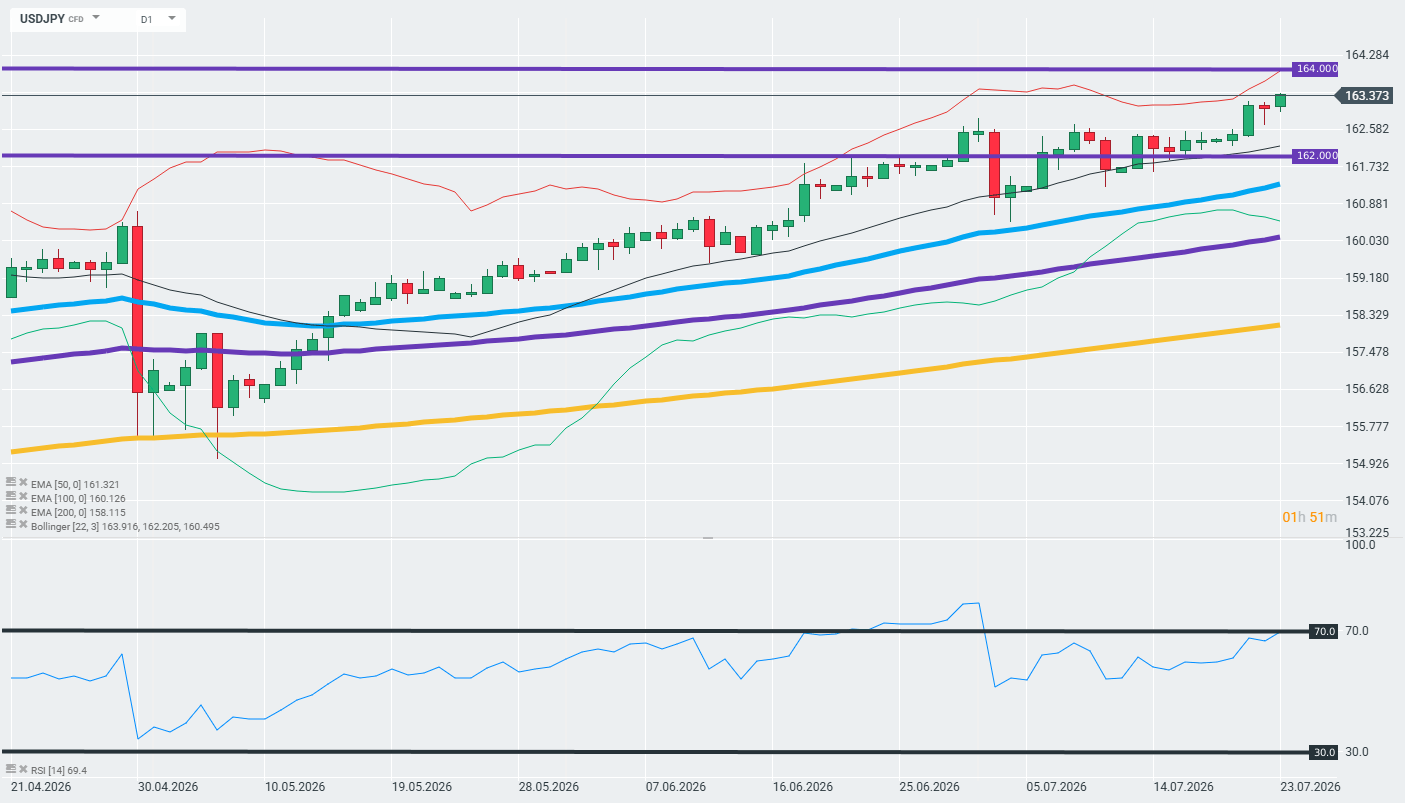
Traffic conditions on the D1
The price has broken through the previous resistance level of 163.00 (purple line) and is reaching new highs in the 163.30–163.40 range, whilst the RSI (14) remains in a strong uptrend at around 69.4, close to the overbought zone. The candlesticks are holding above the EMA50 (161.32), EMA100 (160.13) and EMA200 (158.12), and the EMA configuration (rising, in the order 50 > 100 > 200) confirms a strong bullish trend. The price is close to the upper Bollinger Band (163.92), which signals strong momentum but also the risk of a short-term correction before the next attempt to break through the resistance at 164.00.
Why do the markets already price in faster BOJ rate rises?
The OIS (overnight index swap) market for 22 July 2026 implies a rate of 0.981 per cent, compared with an effective rate of 0.977 per cent, whilst contracts up to the 18 December meeting are already pricing in a rise to 1.277 per cent – effectively discounting approximately 1.2 rate rises in full. This means that reports of the BOJ’s readiness to accelerate the pace of rate rises come as no surprise to the market – investors began pricing in a more aggressive cycle well ahead of the consensus among economists.
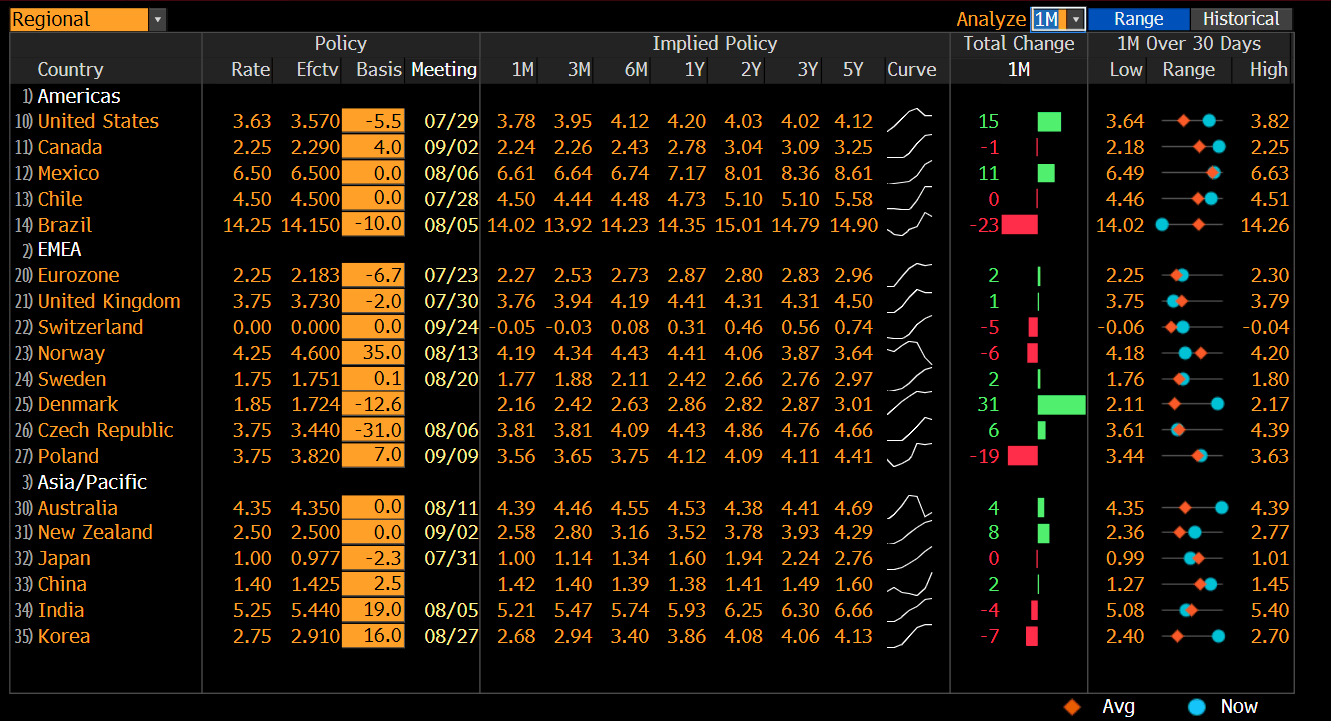
This is also confirmed by the table of 1-month price changes: the cumulative change (“Total Change 1M”) for Japan is zero, which indicates that the market is no longer revising its forecasts upwards, but is instead stabilising following the earlier movement – the “faster pace” is, to a large extent, already behind us in terms of prices. Source: Bloomberg Financial LP
Carry trade remains dominant despite rate rises
The interest rate differential between Japan (1.00%, following a rise to a 31-year high) and the effective US rate (3.63%) remains huge, and the two-year US-Japan yield spread has widened to 285 basis points – its widest level since August last year. Even a potential further 25 bp rate rise would do little to reduce the appeal of this spread, which is fuelling carry trades based on the low cost of yen-denominated financing relative to high-yielding currencies such as the BRL, MXN and AUD.
The fundamental ‘loop’ driving the yen’s weakness
Apart from monetary policy, the yen is suffering from a ‘doom loop’ – Prime Minister Sanae Takaichi’s loose fiscal policy (debt-to-GDP ratio over 200 per cent) combined with the BOJ’s insufficiently tight monetary policy, which is pushing the yield on 10-year JGBs up to 2.90 per cent, the highest level in 30 years. Finance Minister Satsuki Katayama has once again signalled her readiness to take “decisive action” in the foreign exchange market, however, interventions to date (totalling around US$215 billion since 2022) have failed to reverse the trend of yen weakness on a sustained basis, which undermines the credibility of such announcements in the eyes of investors.
The options market confirms that there are no fears of a shock
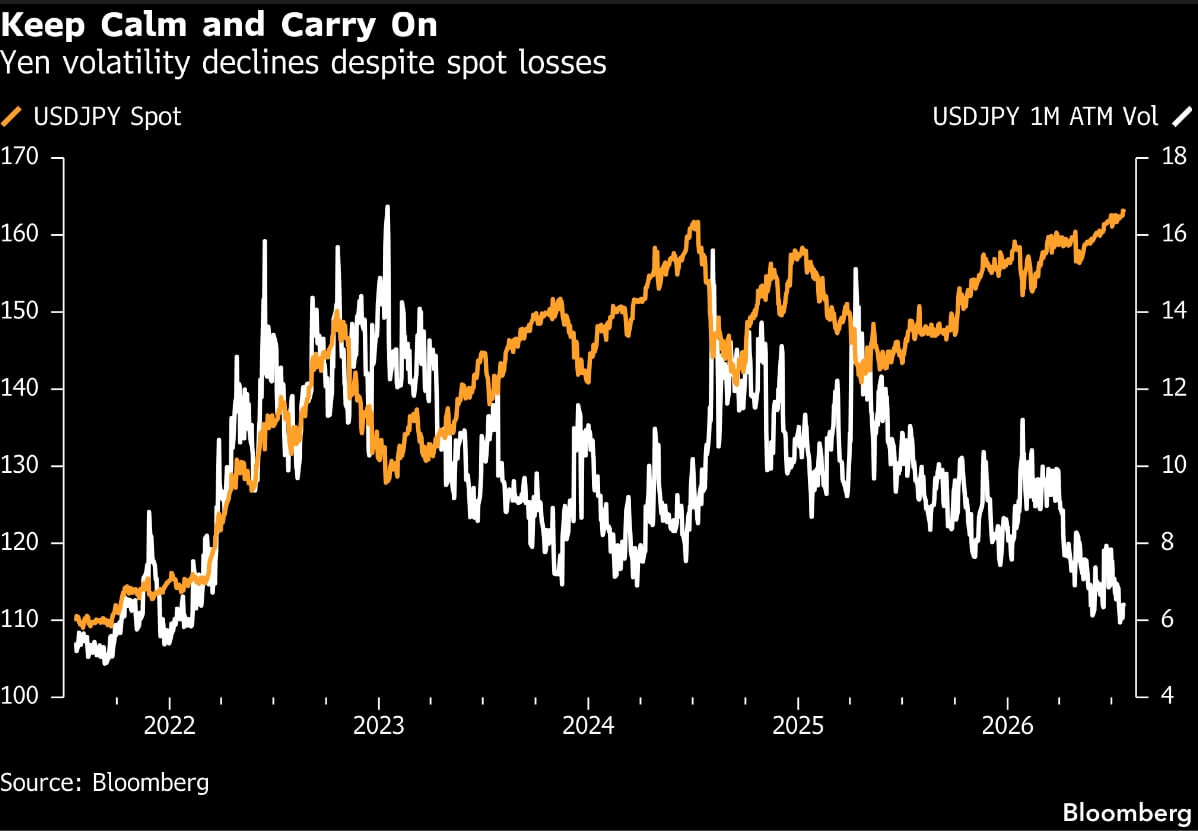
The falling 1-month ATM implied volatility for USD/JPY since 2022, despite the deepening weakness in the spot market, suggests that options are not pricing in any significant risk of a sudden reversal – such as a sharp intervention or an unexpected rate hike – but rather a continuation of the current narrative regarding the currency. Source: Bloomberg Financial Lp