


Japan Signals Readiness to Act on Yen Weakness
Japan’s Finance Minister Satsuki Katayama said on Wednesday that the government remains prepared to intervene in currency markets if excessive exchange-rate moves threaten financial stability, after the yen weakened beyond JPY 163 per U.S. dollar to its lowest level in about 40 years. Speaking to reporters, Katayama declined to comment on specific exchange-rate levels but reiterated that authorities stand ready to act if necessary. The remarks reinforce the government’s long-standing position of closely monitoring currency movements and signal that policymakers remain willing to step into the foreign-exchange market should volatility become excessive, even as they avoid specifying a level that could trigger intervention.

Canadian Dollar edges higher amid bullish oil prices; upside potential seems limited
- USD/CAD edges lower during the Asian session, though the downside remains limited.
- Bullish oil prices underpin the Loonie and cap spot prices amid subdued USD demand.
- The divergent Fed-BoC policy bets back the case for the emergence of some dip-buying.
The USD/CAD pair struggles to capitalize on its strong weekly gains registered over the past two days and edges lower during the Asian session on Wednesday. Spot prices currently trade around the 1.4100 round figure, though the fundamental backdrop warrants caution for aggressive bearish traders.
Crude Oil prices climb to a fresh high since June 16 amid escalating US-Iran military conflicts, the closure of the Strait of Hormuz and Houthi threats of a naval blockade on Saudi Arabia. This, in turn, is seen lending some support to the commodity-linked Loonie. The US Dollar (USD), on the other hand, pauses for a breather following a four-day move higher and turns out to be another factor acting as a headwind for the USD/CAD pair.
Meanwhile, the ongoing fighting in the Middle East, along with fresh trade war fears, might continue to underpin the safe-haven Greenback. In fact, US President Donald Trump announced a new tariff plan on imported generic drugs, with duties set to rise sharply to 100% from 2028 and then increase further to 200% the next year. This follows a new tariff of 50% on most Canadian products, which should cap the upside for the Canadian Dollar (CAD).
Furthermore, hawkish US Federal Reserve (Fed) expectations, bolstered by concerns about energy-driven inflation, favor the USD bulls. In contrast, this week’s soft Canadian consumer inflation figures reaffirmed bets that the Bank of Canada (BoC) will keep rates unchanged through the remainder of 2026. This, in turn, suggests that the path of least resistance for the USD/CAD pair is to the downside and backs the case for the emergence of dip-buyers.
UK CPI set to show receding inflation in June as GBP/USD fails at May highs
- The UK’s ONR Office publishes the June CPI data on Wednesday.
- The UK headline CPI is expected to ease toward 2.7% from a year earlier.
- Core inflation is also seen easing toward 2.5% over the last 12 months.
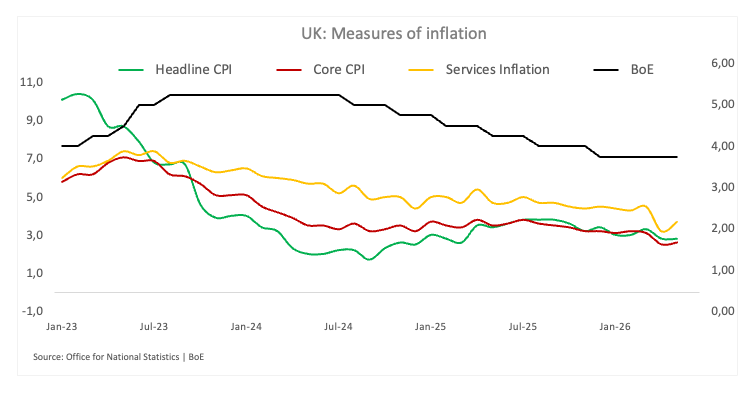
The UK Office for National Statistics (ONS) will release the June Consumer Price Index (CPI) figures on Wednesday at 06:00 GMT, a print that will matter for markets. Consensus expectations point to inflation pressures still above the Bank of England’s (BoE) target, although losing further momentum.
UK consumer inflation remains one of the most important inputs for the BoE and typically carries real weight for the British Pound (GBP). Following the latest cautious hold by the BoE on June 18, investors now favour a steady hand by the ‘Old Lady’ at its meeting on July 30.
What to expect from the next UK inflation report?
Headline UK CPI is expected to clock 2.7% in the year to June, a tad lower than the May reading. On a monthly basis, inflation is seen gaining 0.1%, adding to the 0.2% increase recorded the previous month.
Core inflation, which strips out the more volatile food and energy components and is therefore more closely watched by the BoE, is forecast at 2.5% on an annual basis, down a tenth of percent from May.
How will the UK CPI data affect GBP/USD?
The BoE met expectations and kept the bank rate unchanged at 3.75% on June 18. However, the 7–2 vote split carried a slightly more hawkish tone, with Megan Greene joining Huw Pill in supporting a 25-basis-point increase. But the larger message is patience, with policy still firmly in wait-and-see mode and market pricing that reflects that stance.
In his latest comments last week, Governor Andrew Bailey said the renewed hostilities in the Gulf highlighted the instability facing the global economy. Turning to the UK, he argued that the country was supported by both its fiscal framework and monetary policy, while stressing that the central challenge remained economic growth.
Bailey added that the UK’s core banking system was resilient and that debt levels were not overstretched. However, he warned that sustainable economic growth would not be possible without financial stability.
Implied rates currently suggest nearly 43 basis points of tightening by year-end, while consensus sees the central bank keeping its policy rate unchanged at its next gathering on July 30.
Back to technicals, Senior Analyst at FXStreet, Pablo Piovano, notes that the recent multi-week recovery in GBP/USD appears to have encountered some initial hurdle in the 1.3550-1.3560 band near the July tops. “In case bulls regain the upper hand, the next barrier emerges at the May top at 1.3653 (May 11), followed by the YTD ceiling at 1.3868 (January 27),” he adds.
On the downside, Piovano sees initial contention at current yearly lows near 1.3140 (June 24). “Further weakness from here could expose a move toward the November 2025 base at 1.3010 (November 5),” Piovano adds.
Piovano also points out that momentum indicators remain somewhat bullish for now as the Relative Strength Index (RSI) hovers just below 54, while the Average Directional Index (ADX) near 18 suggests the current trend lacks muscle.

New Zealand Dollar Holds Near 6-Week High
The New Zealand dollar steadied at 0.582, remaining near a six-week high, supported by growing expectations of further interest rate increases following a hot inflation reading. New Zealand’s annual inflation accelerated to 4.1% in Q2 from 3.1% in Q1, exceeding both market forecasts of 4% and the RBNZ’s projection of 3.9%. It marked the highest level since Q4 2023 and pushed inflation further above the central bank’s 1–3% target range. The hot print solidified wagers that the central bank will deliver another 25-basis-point rate hike in September, with swaps also implying additional increases in either October or December, followed by another move in February next year. Last week, RBNZ Chief Economist Paul Conway said that Middle East-driven inflation risks to the third quarter outlook have increased, and that some further reduction in monetary stimulus is likely to be needed.

Offshore Yuan Hits 1-Month High
The offshore yuan traded around 6.76 per dollar on Tuesday, reaching its strongest level in a month, supported by firmer official guidance from the People’s Bank of China. The central bank set the daily midpoint rate at 6.7917 per dollar, 31 pips stronger than the previous fixing of 6.7948. The latest move signaled continued support for the currency, even as geopolitical tensions in the Middle East boosted demand for the US dollar as a safe-haven asset. Providing additional support, the State Council emphasized accelerating policy implementation and improving the efficiency of fiscal spending, underscoring its commitment to bolstering growth after Q2 GDP slowed to 4.3%, the weakest pace in more than three years and well below Beijing’s annual target range of 4.5% to 5%. Investor focus is now turning to the Communist Party of China’s upcoming Politburo meeting later this month for signals on the economic policy agenda for the second half of the year.
Japanese Yen consolidates against US Dollar amid uncertainty over future of Middle East
- The Japanese Yen trades calmly around 162.50 against the US Dollar amid uncertainty over the future of the Middle East.
- US President Trump will either accept a 10-day ceasefire or call for a joint full-scale military campaign against Iran.
- Investors await the Japan National CPI data for June.
The Japanese Yen (JPY) trades flat against the US Dollar (USD) at around 162.50 during the Asian trading session on Tuesday, closer to its multi-decade high of 162.84. The USD/JPY pair will likely remain sideways as investors seek fresh cues regarding whether the United States (US) and Iran will announce a ceasefire or will continue exchanging attacks.
In the Asian trade, the US Dollar Index (DXY), which gauges the Greenback’s value against six major currencies, trades flat around 101.00.
According to a report from Axios, US President Donald Trump will either accept the 10-day ceasefire with Iran and resume negotiations towards an interim deal or call for a joint full-scale military campaign with Israel against Iran.
On Monday, a senior Iranian official confirmed receiving a proposal for a 10-day ceasefire from mediators to resume talks on an interim deal.
On the domestic front, investors await Japan’s National Consumer Price Index (CPI) data for June, which will be released on Friday. Investors will pay close attention to the inflation data to get cues regarding the Bank of Japan’s (BoJ) monetary policy outlook. The National CPI ex. Fresh Food is expected to arrive at 1.6% Year-on-Year (YoY), higher than 1.4% in May.
Meanwhile, the next key trigger for the US Dollar will be the preliminary S&P Global PMI data for July, which will be released on Thursday.

EUR/USD Price Forecast: Bears retain control below 200-SMA on H4; break of 1.1400 awaited
- EUR/USD struggles to gain any meaningful traction as traders keenly await the crucial ECB meeting.
- Reviving inflation fears bolster Fed hike bets and underpin the USD, capping the upside for the pair.
- Last week’s failure near the 200- SMA on H4 favors bears and backs the case for further depreciation.
The EUR/USD pair is seen consolidating during the Asian session on Tuesday and trading just above the 1.1400 mark, or a four-day low touched the previous day. Market participants seem hesitant and keenly await the highly-anticipated European Central Bank (ECB) meeting on Thursday before positioning for the next leg of a directional move.
In the meantime, energy-driven inflation fears bolster US Federal Reserve (Fed) rate hike bets and support the US Dollar (USD) amid escalating US-Iran tensions. This could act as a headwind for the EUR/USD pair, warranting caution before confirming that the recent pullback from a four-week high, touched last Wednesday, has run its course.
Spot prices keep a bearish tone following last week’s failure near the 1.1480-1.1485 region, which coincides with the 200-period Simple Moving Average (SMA). Moreover, the Moving Average Convergence Divergence (MACD) indicator remains below zero with a negative reading, while the Relative Strength Index (RSI) at 40.95 stays under the midline.
Momentum indicators together suggest waning bullish momentum and reinforce the downside bias while the EUR/USD pair remains capped beneath the 200-period SMA. This, in turn, backs the case for an eventual break below the 1.1400 round figure and a further decline towards retesting the year-to-date low, around the 1.1325 region, touched on June 24.
On the topside, initial resistance is located at the 200-period SMA around 1.1480. A sustained move above this level is needed to ease the current bearish pressure and open the way for a more constructive outlook. Nevertheless, the sub-50 RSI and negative MACD suggest that the path of least resistance for the EUR/USD pair remains to the downside.