

The offshore yuan traded around 6.81 per dollar on Wednesday, approaching its strongest level since March 2023, as demand for safe-haven assets such as the greenback weakened amid diplomatic progress between the US and Iran. Market sentiment improved after President Donald Trump pointed to what he described as โgreat progressโ toward a โcomplete and final agreement with representatives of Iran,โ while stating that the US would temporarily pause efforts to assist stranded vessels leaving the Strait of Hormuz. In parallel, Trump indicated he would discuss the Iran conflict with Chinese President Xi Jinping during their upcoming summit on May 14โ15, while seeking to temper tensions surrounding the issue. On the domestic front, a private survey showed that the composite PMI rose to 53.1 in April from 51.5 in March, as both manufacturing output (52.2 vs. 50.8) and services activity (52.6 vs. 52.1) expanded at a faster pace.
Pound Sterling scales higher as USD weakens amid renewed US-Iran peace deal hopes
- GBP/USD gains positive traction for the second straight day amid a broadly weaker USD.
- Hopes for a US-Iran peace deal and fading hawkish Fed bets exert pressure on the buck.
- BoE rate hike expectations act as a tailwind for the GBP and further support spot prices.
The GBP/USD pair attracts buyers for the second consecutive day on Wednesday and moves away from the weekly low, around the 1.3515-1.3510 area, which was touched the previous day. The optimism over a potential US-Iran peace deal undermines the safe-haven US Dollar (USD) and lifts spot prices to the 1.3580 region during the Asian session.
US President Donald Trump said that โProject Freedomโ โ aimed at restoring commercial shipping traffic through the Strait of Hormuz โ will be paused for a short period of time to see if the Iran peace deal can be finalised. This comes hours after US Defense Secretary Pete Hegseth said that the US-Iran ceasefire holds for now and that the US was not seeking to re-escalate tensions with Tehran. The comments lift hopes for a quick resolution of the US-Iran conflict and boost investors’ confidence, prompting some selling around the USD and providing a goodish lift to the GBP/USD pair.
Meanwhile, the latest developments trigger a fresh leg down in Crude Oil prices, which helps ease inflationary concerns and tempers market expectations for a more hawkish US Federal Reserve (Fed). The outlook turns out to be another factor weighing on the Greenback. The British Pound (GBP), on the other hand, draws support from the Bank of England’s (BoE) signal that rate hikes could be appropriate if inflation remains persistent. This further contributes to the GBP/USD pair follow-through move higher and backs the case for a further near-term appreciating move.
Moving ahead, the US ADP report on private-sector employment, along with speeches by influential FOMC members, could provide some impetus later during the early North American session. The key focus, however, will be on the closely-watched US Nonfarm Payrolls (NFP) report on Friday. Apart from this, the incoming geopolitical headlines might continue to infuse volatility across the global financial markets, which will drive the USD and the GBP/USD pair. Nevertheless, the fundamental backdrop suggests that the path of least resistance for spot prices is to the upside.
US Dollar Price Today
The table below shows the percentage change of US Dollar (USD) against listed major currencies today. US Dollar was the strongest against the Canadian Dollar.
| USD | EUR | GBP | JPY | CAD | AUD | NZD | CHF | |
|---|---|---|---|---|---|---|---|---|
| USD | -0.24% | -0.26% | -0.16% | -0.14% | -0.57% | -0.60% | -0.25% | |
| EUR | 0.24% | -0.03% | 0.09% | 0.10% | -0.32% | -0.39% | -0.01% | |
| GBP | 0.26% | 0.03% | 0.11% | 0.13% | -0.29% | -0.35% | 0.04% | |
| JPY | 0.16% | -0.09% | -0.11% | 0.00% | -0.43% | -0.47% | -0.06% | |
| CAD | 0.14% | -0.10% | -0.13% | -0.00% | -0.42% | -0.46% | -0.08% | |
| AUD | 0.57% | 0.32% | 0.29% | 0.43% | 0.42% | -0.03% | 0.34% | |
| NZD | 0.60% | 0.39% | 0.35% | 0.47% | 0.46% | 0.03% | 0.38% | |
| CHF | 0.25% | 0.00% | -0.04% | 0.06% | 0.08% | -0.34% | -0.38% |
The heat map shows percentage changes of major currencies against each other. The base currency is picked from the left column, while the quote currency is picked from the top row. For example, if you pick the US Dollar from the left column and move along the horizontal line to the Japanese Yen, the percentage change displayed in the box will represent USD (base)/JPY (quote).
Canadian Dollar gains ground as easing safe-haven demand weighs on US Dollar
- USD/CAD weakens as the US Dollar softens amid optimism over a potential Tehran deal.
- Defense Secretary Pete Hegseth said the US-Iran ceasefire holds despite Gulf clashes over the Strait of Hormuz.
- The commodity-linked CAD may weaken as oil prices fall amid easing supply concerns on fading Middle East tensions.
USD/CAD extends its losses for the second successive day, trading around 1.3600 during the Asian hours on Wednesday. The pair retreats as the US Dollar (USD) softens on reduced safe-haven demand, driven by rising optimism over a potential deal with Tehran.
Washington announced an end to offensive operations against Iran and reaffirmed the ceasefire, with US Secretary of State Marco Rubio stating that โOperation Epic Fury is concluded,โ adding that its objectives had been achieved.
However, US Defense Secretary Pete Hegseth said on Tuesday that the ceasefire with Iran was not fully settled, as both sides continued exchanging fire in the Gulf amid tensions over control of the Strait of Hormuz.
Losses in the USD/CAD pair may be capped, as the commodity-linked Canadian Dollar (CAD) may face pressure from weaker oil prices. West Texas Intermediate continues to decline, trading near $97.90 per troy ounce at the time of writing.
Oil prices are falling as supply concerns ease alongside fading Middle East tensions. US President Donald Trump stated that the US would temporarily pause efforts to help stranded vessels exit the Strait of Hormuz, allowing time to evaluate prospects for a deal with Iran to end the conflict.
Japanese Yen gains ground on Trumpโs Hormuz pause, intervention caution
- USD/JPY softens to near 157.65 in Wednesdayโs Asian session.
- Trump said he is pausing the operation that helps ships leave the Strait of Hormuz.
- Traders remain cautious after suspected intervention.
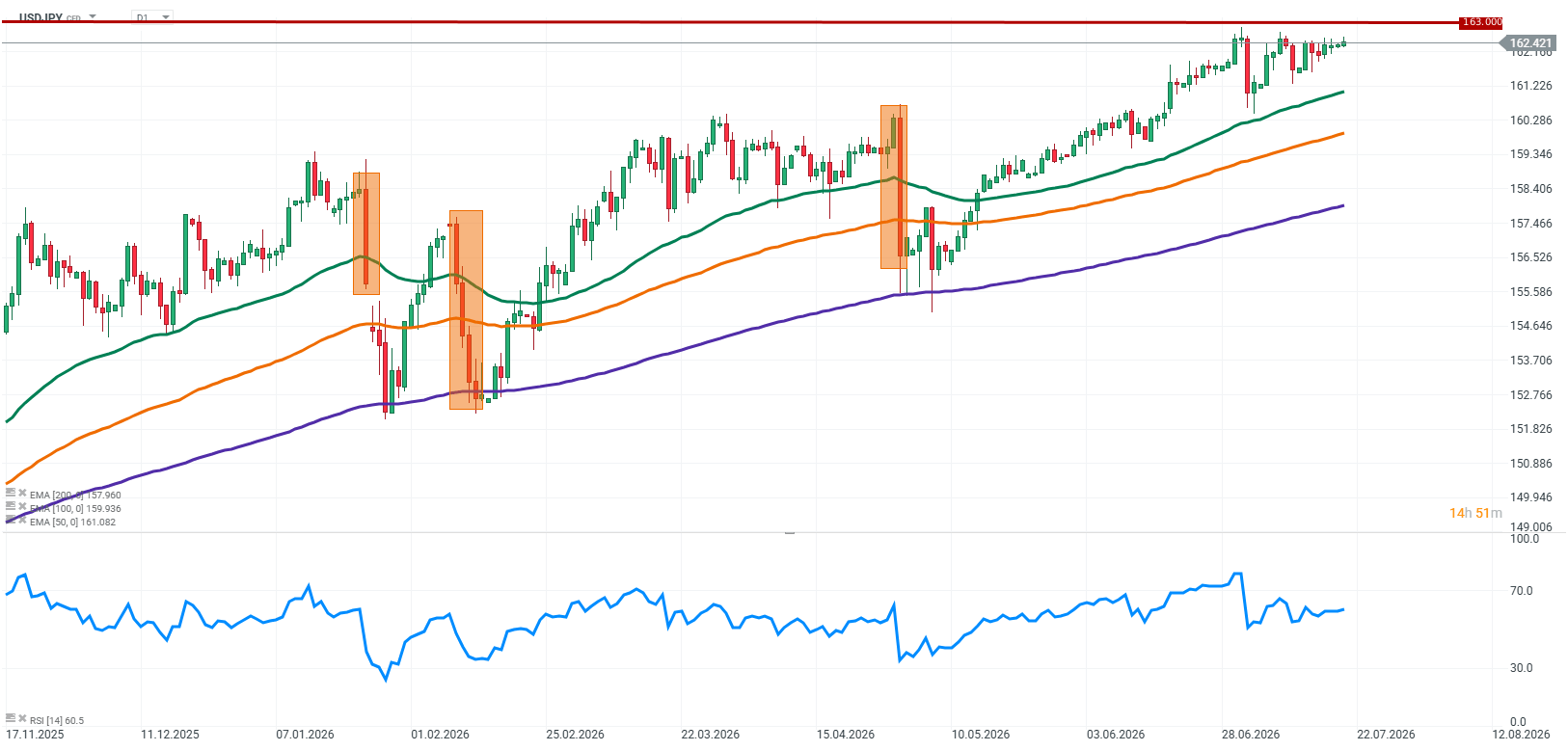
The USD/JPY pair loses ground to around 157.65 during the Asian trading hours on Wednesday. The US Dollar (USD) weakens against the Japanese Yen (JPY) after US President Donald Trump announces a pause on ‘Project Freedom’ in the Strait of Hormuz. The US April ADP Employment Change report will be released later on Wednesday.
Trump said on Tuesday that Iran and the US have mutually agreed that while the US blockade โwill remain in full force and effect,” Project Freedom will be paused. Trump further stated that this was to see if an agreement between the two countries can be finalized and signed. US President noted the decision was made at the request of Pakistan and other countries and follows what he called โtremendous military successโ during a US campaign against Iran.
Markets remain on high alert following suspected interventions by Japanese authorities. Japanese Finance Minister Satsuki Katayama said Japan can take action against speculative foreign-exchange movements. “It’s probably going to take another round of significant intervention to push the dollar more significantly lower,” said Shaun Osborne, chief currency strategist at Scotiabank.
The US employment data for April will be in the spotlight on Friday. This report could influence interest rate expectations and the pairโs next move. Economists expect the US economy to have added 60,000 jobs in April, while the Unemployment Rate is estimated to hold steady at 4.3 during the same period. Any signs of improvement in the US labor market could lift the Greenback against the JPY in the near term.
AUD/USD Price Forecast: Rallies to June 2022 high, closer to mid-0.7200s on weaker USD
- AUD/USD attracts strong follow-through buyers amid a combination of supporting factors.
- US-Iran peace deal hopes and receding hawkish Fed expectations weigh heavily on the USD.
- The RBAโs hawkish outlook benefits the Aussie and contributes to the positive momentum.
Theย AUD/USDย pair is seen building on the previous day’s bounce from the 0.7135 region, or the weekly low, and gaining strong follow-through positive traction for the second straight day on Wednesday. The momentum lifts spot prices to a fresh high since June 2022, closer to mid-0.7200s, during the Asian session, and is sponsored by a broadly weaker US Dollar (USD).
The incoming headlines fuel optimism over a potential US-Iran peace deal and boost investors’ confidence, undermining the safe-haven buck and benefiting the risk-sensitive Aussie. Furthermore, sliding Crude Oil prices ease inflationary concerns and temper bets for a rate hike by the USย Federal Reserveย (Fed). This exerts additional pressure on the USD, which, along with the Reserve Bank of Australia’s (RBA) hawkishย outlook, contributes to the bid tone surrounding the AUD/USD pair.
From a technical perspective, spot prices hold a bullish near-term bias following the recent resilience below the 100-period Exponential Moving Average (EMA) on the 4-hour chart. The said support is pegged at 0.7145, which now underpins the broader upturn from recent lows. Moreover, a firm Relative Strength Index (RSI) around 65 suggests strong but maturing upside momentum, while the positive Moving Average Convergence Divergence (MACD) reading hints that buyers still retain control.
This, in turn, suggests that any corrective pullback might still be seen as a buying opportunity near the 100-period EMA on H4, at 0.7145, as the broader structure remains constructive above this zone. A sustained break beneath this moving average would weaken the current bullish tone and open the door to a deeper corrective phase on the four-hour timeframe.
(The technical analysis of this story was written with the help of an AI tool.)
AUD/USD 4-hour chart
US Dollar Price Today
The table below shows the percentage change of US Dollar (USD) against listed major currencies today. US Dollar was the strongest against the Japanese Yen.
| USD | EUR | GBP | JPY | CAD | AUD | NZD | CHF | |
|---|---|---|---|---|---|---|---|---|
| USD | -0.20% | -0.18% | -0.06% | -0.14% | -0.69% | -0.75% | -0.20% | |
| EUR | 0.20% | 0.02% | 0.15% | 0.07% | -0.48% | -0.57% | 0.00% | |
| GBP | 0.18% | -0.02% | 0.13% | 0.06% | -0.50% | -0.57% | 0.00% | |
| JPY | 0.06% | -0.15% | -0.13% | -0.09% | -0.64% | -0.72% | -0.12% | |
| CAD | 0.14% | -0.07% | -0.06% | 0.09% | -0.55% | -0.62% | -0.04% | |
| AUD | 0.69% | 0.48% | 0.50% | 0.64% | 0.55% | -0.07% | 0.50% | |
| NZD | 0.75% | 0.57% | 0.57% | 0.72% | 0.62% | 0.07% | 0.57% | |
| CHF | 0.20% | -0.00% | -0.00% | 0.12% | 0.04% | -0.50% | -0.57% |
The heat map shows percentage changes of major currencies against each other. The base currency is picked from the left column, while the quote currency is picked from the top row. For example, if you pick the US Dollar from the left column and move along the horizontal line to the Japanese Yen, the percentage change displayed in the box will represent USD (base)/JPY (quote).
Currency Talk – AUDCAD, GBPUSD, AUDUSD
Key takeaways
- What is the technical outlook for AUD/CAD, GBP/USD and AUD/USD?
This analysis from the Overbalance series aims to identify three financial instruments, analysed primarily on the daily/four-hour timeframe (D1/H4). The analysis utilises only the Overbalance methodology, which helps to identify points where a trend may continue or where a reversal may occur. Todayโs analysis covers three instruments, assessed solely in terms of 1:1 correction structures. AUDCAD After several tests, the AUDCAD exchange rate has broken through the key support level at 0.9755, which, according to the Overbalance methodology, paves the way for a deeper downward correction. A potential target for the downside is the 0.9610 level, where the lower boundary of the large 1:1 pattern is located. Currently, the 0.9755 level is acting as resistance, and only a sustained return of the price above this zone could restore the bullish scenario.

AUDCAD โ H4 timeframe. Source: xStation GBPUSD Since the beginning of April, GBPUSD has been trading within a local uptrend, supported by the 1:1 bullish pattern highlighted in green. The key support level remains at 1.3488. A potential bounce at this point could lead to the generation of another upward impulse. Conversely, a break below this level would open the way for a decline towards 1.3360, where the polarity of the previously broken downward pattern lies.

GBPUSD โ H4 chart. Source: xStation AUDUSD The AUDUSD pair remains in an uptrend. Recently, the pair reached a new local high, followed by a rapid correction. Should this correction deepen, the key support level is 0.7121, derived from the lower boundary of the 1:1 pattern. As long as this level holds, the base case scenario remains a continuation of the upward trend.

AUDUSD โ H4 chart. Source: xStation
USD/INR stays near fresh record highs as risk aversion prevails
- USD/INR appreciates as the US Dollar gains on increased risk aversion amid Middle East concerns.
- Modiโs BJP won a third term in Assam and captured opposition stronghold West Bengal in a key election.
- Indiaโs forex reserves fell from $728.5 billion, while equity outflows hit $19 billion in March and April.
USD/INR extends gains for the third successive day, trading around the fresh record high of 95.40, during the Asian hours on Tuesday. Traders will likely observe Indiaโs HSBC Composite and Services Purchasing Managers’ Index (PMI) data to be released on Wednesday.
The USD/INR pair appreciates as the US Dollar (USD) strengthens on safe-haven demand following Iranโs attack on the United Arab Emirates (UAE). CNBC reported Monday that the UAE was targeted by Iranian drones and missiles, while the US said it destroyed Iranian boats in the Strait of Hormuz. US President Donald Trump warned that Iran would be โblown off the face of the earthโ if it targets US ships protecting commercial vessels passing through the Strait of Hormuz.
The Indian Rupee (INR) faced challenges as an overnight surge in crude oil prices dampened investor sentiment. Oil prices, however, have since declined as concerns over immediate supply disruptions eased, with the United States (US) Navy taking steps to reopen the crucial Strait after Iran attempted to close it. Maersk, a Danish shipping and logistics company, later confirmed that its Alliance Fairfax, a US-flagged vehicle carrier, exited the strait under US military escort.
Indian Prime Minister Narendra Modiโs Bharatiya Janata Party (BJP) clinched a third straight term in Assam and captured opposition stronghold West Bengal in a key election.
On Monday, HSBC Manufacturing Purchasing Managers’ Index (PMI) in India came in at 54.7 for April, revised down from the preliminary 55.9 but higher than 53.9 in the prior month. Both output and new orders continued to expand, though growth remained subdued relative to levels seen over the past three and a half years.
Foreign institutional investors (FII) turned net buyers of Indian equities on Monday after nine consecutive days of selling, with inflows totaling 28.36 billion rupees ($298 million). Domestic institutional investors (DII) bought local shares worth 47.64 billion rupees, marking their seventh straight session of purchases, per Reuters.
Stock-specific moves linked to earnings are also expected to remain in focus. Nifty 50 constituents Larsen & Toubro, Mahindra and Mahindra, and Hero MotoCorp are scheduled to announce their quarterly results later in the day.
Indiaโs foreign exchange reserves have declined from a peak of $728.5 billion, while equity outflows reached $19 billion across March and April. Nevertheless, the Reserve Bank of India (RBI) has stated that it remains comfortable with reserve levels sufficient to cover 11 months of imports, though recent policy discussions highlight renewed urgency to strengthen buffers amid ongoing capital outflows.
Technical Analysis: USD/INR nears rectangular channel top, all-time highs near 95.50
USD/INR trades around 95.40 at the time of writing on Tuesday. The technical analysis of the daily chart indicates a potential for a bullish emergence as the pair is testing the upper boundary of the rectangular channel.
However, the USD/INR pair retains a bullish near-term bias as price holds above the nine-day and 50-day Exponential Moving Averages (EMAs). The 14-day Relative Strength Index (RSI) at 66.7 points to firm positive momentum edging toward overbought territory, suggesting upside pressure persists while leaving the pair vulnerable to bouts of consolidation if buyers lose traction.
The USD/INR pair is testing the upper boundary of the rectangle, followed by the all-time high of 95.40, which was recorded on May 4. On the downside, the initial support lies at the nine-day EMA of 94.71. A break below the short-term average would lead the pair to test the 50-day EMA at 93.20, followed by the lower rectangle boundary around 92.50 and a seven-week low of 92.14.
(The story was corrected on May 5 at 6:10 GMT to say in the first paragraph to say that the HSBC PMI data will be released on Wednesday, not Tuesday.)

US Dollar Price Today
The table below shows the percentage change of US Dollar (USD) against listed major currencies today. US Dollar was the strongest against the Australian Dollar.
| USD | EUR | GBP | JPY | CAD | AUD | NZD | INR | |
|---|---|---|---|---|---|---|---|---|
| USD | 0.04% | 0.06% | 0.00% | -0.02% | 0.16% | 0.10% | 0.14% | |
| EUR | -0.04% | 0.00% | -0.02% | -0.03% | 0.12% | 0.06% | 0.25% | |
| GBP | -0.06% | -0.00% | -0.04% | -0.08% | 0.10% | 0.07% | 0.09% | |
| JPY | 0.00% | 0.02% | 0.04% | -0.01% | 0.15% | 0.11% | 0.30% | |
| CAD | 0.02% | 0.03% | 0.08% | 0.00% | 0.16% | 0.11% | 0.32% | |
| AUD | -0.16% | -0.12% | -0.10% | -0.15% | -0.16% | -0.04% | 0.15% | |
| NZD | -0.10% | -0.06% | -0.07% | -0.11% | -0.11% | 0.04% | -0.01% | |
| INR | -0.14% | -0.25% | -0.09% | -0.30% | -0.32% | -0.15% | 0.01% |
The heat map shows percentage changes of major currencies against each other. The base currency is picked from the left column, while the quote currency is picked from the top row. For example, if you pick the US Dollar from the left column and move along the horizontal line to the Japanese Yen, the percentage change displayed in the box will represent USD (base)/JPY (quote).
AUD/USD: Consolidation risk after RBA pause โ Societe Generale
Societe Generale strategists noteย AUD/USDย has pulled back after the Reserve Bank of Australia (RBA) delivered a third 25bp hike to 4.35% while signalling a pause. The pair is drifting below 0.7150 despite earlier reclaiming its 50โDMA, with risk sentiment and the RBAโs dataโdependent stance expected to guide direction around key 0.7060 and 0.7225 levels.
Key supports and RBA-driven outlook
“Three hikes and done, receive the front end in Australia? Not so fast. The third rate increase today by the RBA puts the CRT at 4.35% but this is below the new higher projection of 4.7% for Dec-26 (raised from 4.2% in February). In other words, the central bank is holding powder in reserve to tighten at least once more. The rate then stays at 4.7% through 2027 and 1H-28. Core inflation peaks at 3.8% in 2Q and then drifts down to 3.1% by the end of this year, to 2.6% in 2027 and 2.5% in 1H-28. Headline CPI falls back from 4.0% in Dec-26 to 2.4% by mid-2027. “
“Governor Bullock sounded more neutral this time in her comments, prompting the receiving interest in the front end and bull steepening in 2s/10s. The further crystallisation of upside risks to inflation and inflation expectations will determine ifย ratesย are hoisted again to 4.6%, probably in August or September. A pause in June looks a done deal. The statement highlighted the risk of second-round effects across goods and services.ย Governor Bullockย reiterated that the Board has no predetermined path and will remain data-dependent, ruling nothing in or out.”
“AUD/USD reclaimed its 50โDMA in April and subsequently staged a strong rebound. However, the pair has struggled to establish itself beyond the March peak, carving out an interim high near 0.7225; this points to a lack of steady upward momentum.”
“A period of consolidation cannot be ruled out. Defence of the 50โDMA around 0.7060 is crucial for continuation of the up move. A break above 0.7225 may lead to a larger uptrend.”