Societe Generale analysts observe USD/CNY trading below 6.80, with the Chinese Yuan at its strongest level since February 2023 ahead of the US/China summit. They attribute Yuan outperformance to safe-haven demand and solid trade data, while expecting only incremental outcomes from Trump’s visit, focused on trade discipline and limited confidence-building steps.
Safe-haven flows and trade surplus
“The Chinese yuan trades at the strongest level since February 2023, returning below 6.80/USD ahead of this week’s US/China summit. The outperformance of the Yuan in EM Asia this year has been more about China’s rising status as a safe-haven amid the geopolitical and energy storm.”
“Foreign trade data also continue to support the currency. Exports climbed 14.1% yoy, lifting the surplus to $84.82bn in April.”
“The visit of Trump is relatively low on expectations, underscored by a scaled‑down CEO delegation compared to 2017 and late invites that reflect internal policy divisions. The agenda will prioritize trade discipline and a possible short extension of the October trade truce, rather than headline‑grabbing deal announcements.”
“China will likely press for relief from US technology export controls and greater policy certainty, while Washington is set to hold the line, keeping outcomes incremental
US April CPI on Tuesday is forecast at 0.6% MoM and 3.7% YoY, with a hotter print likely to weigh on Sterling.
Thursday’s UK Q1 GDP, consensus 0.6% QoQ, is the only domestic release with real potential to drive Sterling this week.
Iran-US clashes flared again over the weekend, with the Strait of Hormuz shut and global energy supply risk elevated.
Sterling pulled back from a fresh peak near 1.3650 on Monday, easing close to 1.3610 through European trade after the Asian session squeezed the Pound to a new local high. The rejection from the 1.3650 area produced a sharp intraday reversal, with a string of red candles unwinding most of the overnight push and pointing to fading upside momentum ahead of a heavy data week.
The week ahead is a US-heavy affair: Tuesday’s April Consumer Price Index (CPI) is the centerpiece, with consensus penciling in 0.6% MoM and 3.7% YoY headline alongside a 0.4% MoM, 2.7% YoY core read, in part reflecting the first full month of Iran-conflict energy pass-through. Wednesday’s Producer Price Index (PPI) print is forecast hotter again at 0.5% MoM and 4.9% YoY, with Thursday’s Retail Sales penciled at 0.5% MoM. A heavier Federal Reserve speaking calendar bookends each release, with Williams, Goolsbee, Kashkari, Schmid, Hammack, and Barr all scheduled, leaving the US Dollar exposed to two-way risk on every print and every headline. A hotter-than-expected CPI in particular would underline how Strait of Hormuz disruption is feeding through to US prices and tend to weigh on Sterling.
On the UK side, the calendar is thin. Thursday’s release block, headlined by the Q1 Gross Domestic Product (GDP) preliminary print at 0.6% QoQ and 0.8% YoY consensus alongside the March monthly read forecast at minus 0.2% MoM, is the only domestic catalyst with real potential to move Sterling. An upside surprise would help the Pound break free of its consolidation, while a softer set would deepen the stagflation narrative that has built since UK March CPI ran at 3.3% YoY. Bank of England (BoE) commentary from Greene on Monday and Mann on Wednesday will fill the gaps but is unlikely to drive direction. Fresh Iran-US clashes over the weekend, with the Strait of Hormuz still shut and Washington’s reopening proposal awaiting an Iranian response, continue to set the macro tone, while reported internal Labour pressure on Prime Minister Keir Starmer adds a modest political risk premium on the Pound that a soft GDP print would only widen.
GBP/USD 15-minute chart
Technical Analysis
In the fifteen-minute chart, GBP/USD trades at 1.3609. The pair holds a mild intraday bullish bias as it sits above the daily open at 1.3584, keeping the latest rebound intact despite the lack of nearby moving average references. However, the Stochastic RSI has recently shifted from overbought extremes toward the lower end of its range, hinting that upside momentum is cooling after the earlier advance.
On the downside, immediate support is seen at the daily open level around 1.3584, where buyers may look to defend the broader intraday up-move. A sustained break below this floor would weaken the constructive tone and expose deeper pullbacks, while holding above it would keep the short-term bias tilted to the upside even as momentum indicators stay in a corrective phase.
In the daily chart, GBP/USD trades at 1.3611 with a bullish near-term bias, as spot holds above both the 50-day and 200-day exponential moving averages (EMAs). The pair has extended its advance away from these reclaimed trend filters, suggesting underlying demand remains in control, while the Stochastic RSI around 61 indicates positive but not overstretched momentum, leaving room for further gains if buyers stay in charge.
On the topside, immediate support-turned-reference now comes from the 50-day EMA at 1.3480, followed by the 200-day EMA near 1.3399, which together mark a broader demand band on any corrective pullback. As long as daily closes remain above these EMAs, the technical backdrop would continue to favor dip-buying strategies over a deeper reversal.
The Bank of Japan (BoJ) published the Summary of Opinions from the April monetary policy meeting, with the key findings noted below.
Key quotes
One member states real interest rates low enough to support further policy rate hikes.
BOJ member says bank may need to tackle risk of rising price deviations.
One member said impact of Middle East situation hard to predict, bank to take wait-and-see stance at meeting.
One member said a policy rate increase focused on controlling inflation is likely to harm economic progress at this stage.
Rate hike likely from next meeting despite uncertain Middle East outlook.
One BoJ member signals no rush to act now but favors rate hike soon barring clear economic slowdown.
One member says Japan’s real policy interest rate is by far the lowest globally, BoJ must continue adjusting negative real rate ahead of second-round effects. One member said BoJ must prevent significant risk of inflation rising sharply in conducting monetary policy.
One member said policy rate remains below neutral, so BOJ must keep raising rates every few months.
One member said if upside risks to prices rise, BoJ must speed up rate hikes without delay.
One member said prolonged Middle East tensions could prompt earlier policy rate increase to neutral level.
One member said Middle East situation remains uncertain, all scenarios indicate greater upside risks to price .
One member warns supply-side constraints could cause sharp price surges.
Market reaction
Following the BoJ’s Summary of Opinions, the USD/JPY pair is up 0.36% on the day to trade at 157.25 as of writing.
EUR/USD weakens to around 1.1775 in Tuesday’s early Asian session.
Trump said the US-Iran ceasefire was on ‘massive life support.’
Hawkish expectations for the ECB might help limit the Euro’s losses.
The EUR/USD pair loses ground to near 1.1775 during the early Asian session on Tuesday. The Euro (EUR) softens against the US Dollar (USD) as traders turn cautious ahead of the US April inflation report and ongoing geopolitical tensions in the Middle East.
Reuters reported on Monday that Iranian Parliament speaker Mohammad Bagher Ghalibaf warned that Iran’s military was fully prepared to retaliate against any future attacks after rising tensions threatened the fragile ceasefire in the Middle East.
Earlier Monday, US President Donald Trump said the ceasefire between the US and Iran is on “massive life support” after he rejected Tehran’s latest peace offer, which he called “simply unacceptable.” Signs of a prolonged conflict between the US and Iran could boost a safe-haven currency such as the Greenback and act as a headwind for the major pair in the near term.
On the other hand, a hawkish stance from the European Central Bank (ECB) could provide some support to the shared currency. ECB Governing Council member Martin Kocher said on Monday that there’s no need to delay the interest rate hikes if energy prices don’t improve swiftly.
Financial markets are now pricing in a 92% chance of a 25 basis point (bps) hike at the June meeting, with a total of three hikes anticipated by the end of 2026, according to Reuters.
The political crisis surrounding Keir Starmer has become one of the key market drivers for the pound today. The situation is evolving rapidly and is having a direct impact on government bond yields and the value of the pound, with the markets closely monitoring the Prime Minister’s every word. Internal party pressure The scale of Starmer’s problem is best illustrated by a single figure: 42 Labour MPs had already officially called on him to resign by Sunday evening, whilst former Deputy Prime Minister Angela Rayner described the current situation as “Labour’s last chance” to change course.
The emergence of potential challengers, such as Wes Streeting and Andy Burnham, means that the market now views the internal dispute within the Labour Party as a real risk, rather than mere political noise. In his speech on Monday, Starmer focused on several key themes. Firstly, a firm defence of his own position: “I will fight in every internal vote.” Secondly, a political agenda aimed at closer ties with the EU, the nationalisation of British Steel and a new mobility agreement for young people with Europe. The market viewed this speech primarily through the prism of one question: will the Prime Minister stabilise his position sufficiently to halt the sell-off of gilts?
You can watch the UK Prime Minister’s live address here. Source: Sky News, YouTube
Starmer, gilts in pounds
The yield on 10-year gilts rose on Monday morning to 4.954%, an increase of 3 basis points from the previous close, when it stood at 4.904% immediately after Starmer refused to resign on Friday. Economists surveyed by Bloomberg say that were it not for the political component, yields would be 10–15 basis points lower. This shows just how much the market has already begun to price in the risk of political instability, rather than solely macroeconomic fundamentals. The UK currently has the highest debt servicing costs of all G7 countries, a consequence of inflation remaining above target and weak economic growth. The situation is further complicated by the economic fallout from the armed conflict in Iran, which has led to higher energy prices and a further weakening of business activity. In such an environment, any political uncertainty acts as a risk multiplier for funds holding gilts.
Implications for the GBP
The pound finds itself in a difficult position, both technically and fundamentally. On the one hand, structural factors such as the Bank of England’s relatively high interest rates compared to the ECB and the marked inflationary divergence from the rest of Europe may continue to support it in the medium term. On the other hand, the political risk premium, which has just begun to be priced into gilt yields, is a factor that directly affects the currency’s valuation: higher bond yields against a backdrop of a weakening government is a scenario that has historically been negative for the pound, as it suggests a lack of a fiscal anchor. If Starmer survives the coming weeks politically and manages to quell the internal rebellion, the risk premium should gradually decline, and the GBP/USD pair could test higher resistance levels once again. An alternative scenario, namely a genuine battle for party leadership, would, however, mean further rises in gilt yields and pressure on the pound, particularly as global markets are now highly sensitive to any signs of political fiscal instability following the experiences of the Truss era. For sterling traders, therefore, today is a test not so much of Starmer himself as of the resilience of the political risk premium that the market has already priced in.
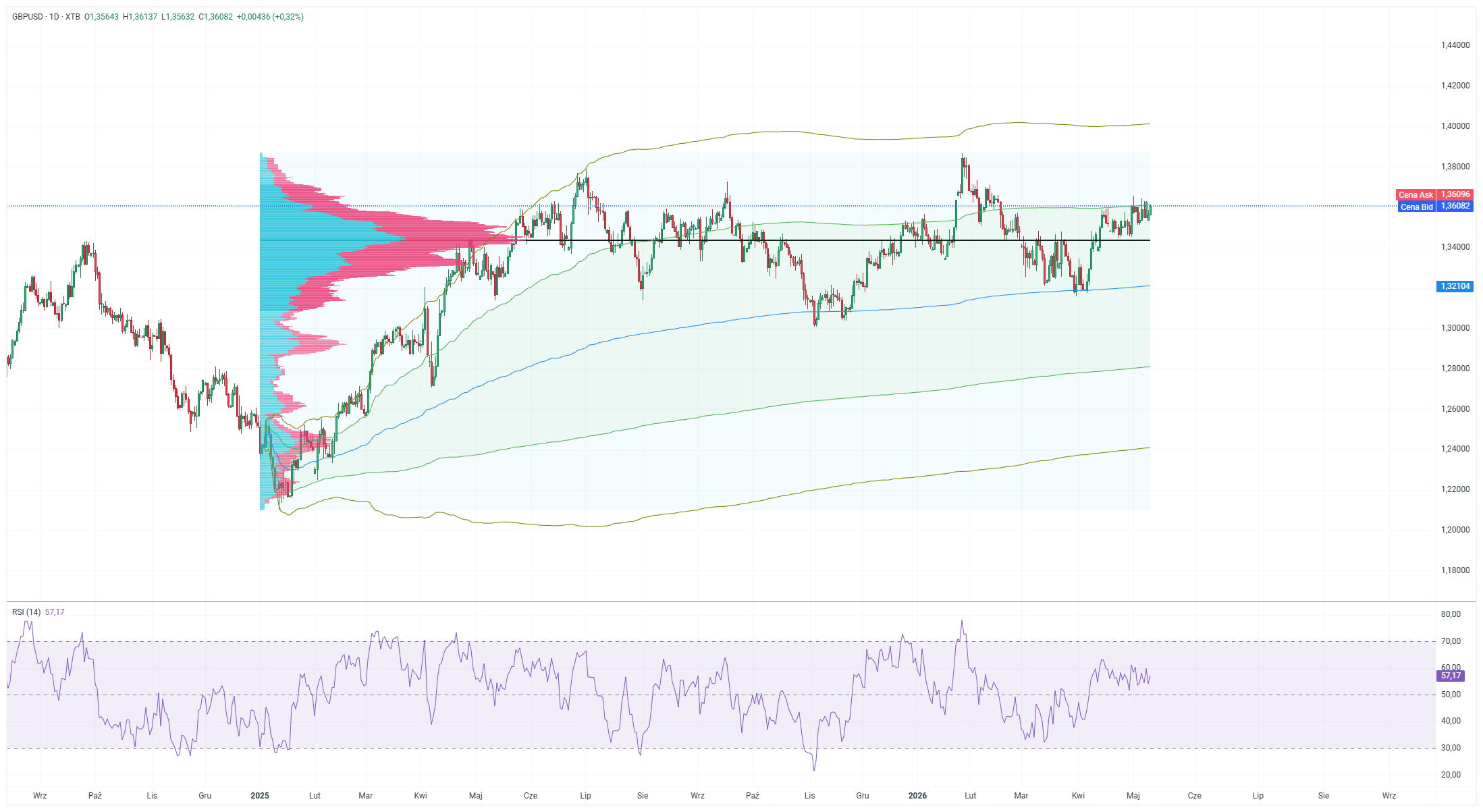
GBP/USD is trading at 1.3608 on the daily chart, within an uptrend that has been in place since the low around 1.22 at the turn of 2024/2025, and the price remains above the anchored VWAP from early 2025, which runs in the 1.31–1.32 region. The volume profile indicates a Point of Control in the 1.3450–1.3480 zone, where a black horizontal line marks a key support level that has been tested repeatedly on both sides. The RSI(14) at 57.17 suggests neutral-bullish momentum with no signs of overbought conditions, which technically leaves room for further gains towards the 1.3800–1.3850 resistance zone, where the price reversed at the 2025 peak.
Today’s speech by Starmer and his political survival are factors that will directly determine the short-term direction: government stability paves the way upwards, whilst an escalation of the crisis and a rise in gilt yields would push the pair back towards the POC zone at 1.3450, and, in the event of a deeper sell-off, even towards the VWAP. Technically, the bulls have the upper hand as long as the price remains above 1.34, and the bears will only regain the initiative after a break below this zone with volume. Source: xStation
What is the technical outlook for USDCAD, AUDUSD and EURNZD?
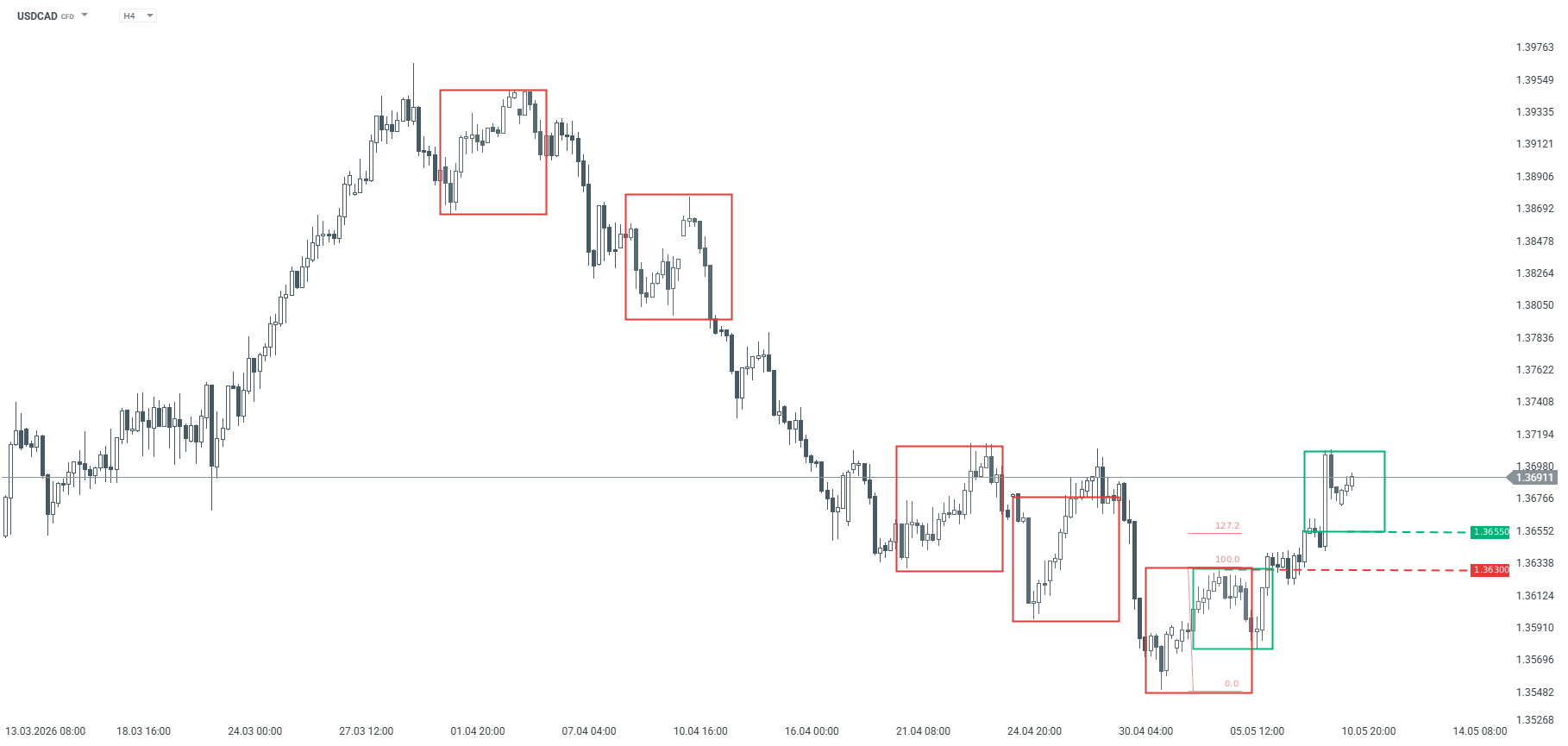
This analysis from the Overbalance series aims to identify three financial instruments, analysed primarily on the daily/four-hour (D1/H4) timeframe. The analysis utilises only the Overbalance methodology, which helps to identify points where a trend may continue or where a reversal may occur. Today’s analysis covers three instruments, assessed solely in terms of 1:1 correction structures. USDCAD USDCAD prices remained in a downtrend throughout April, but in recent days the 1:1 downtrend pattern has been negated at the 1.3630 level, which, according to the Overbalance methodology, may signal a significant upward correction or even a trend reversal. Currently, the key support level remains at 1.3655, where the lower boundary of the local 1:1 pattern is located. As long as the price remains above this level, the bullish scenario remains in place. Conversely, a return below 1.3630, i.e. below the polarity of the previously negated pattern, could once again open the way for further declines.
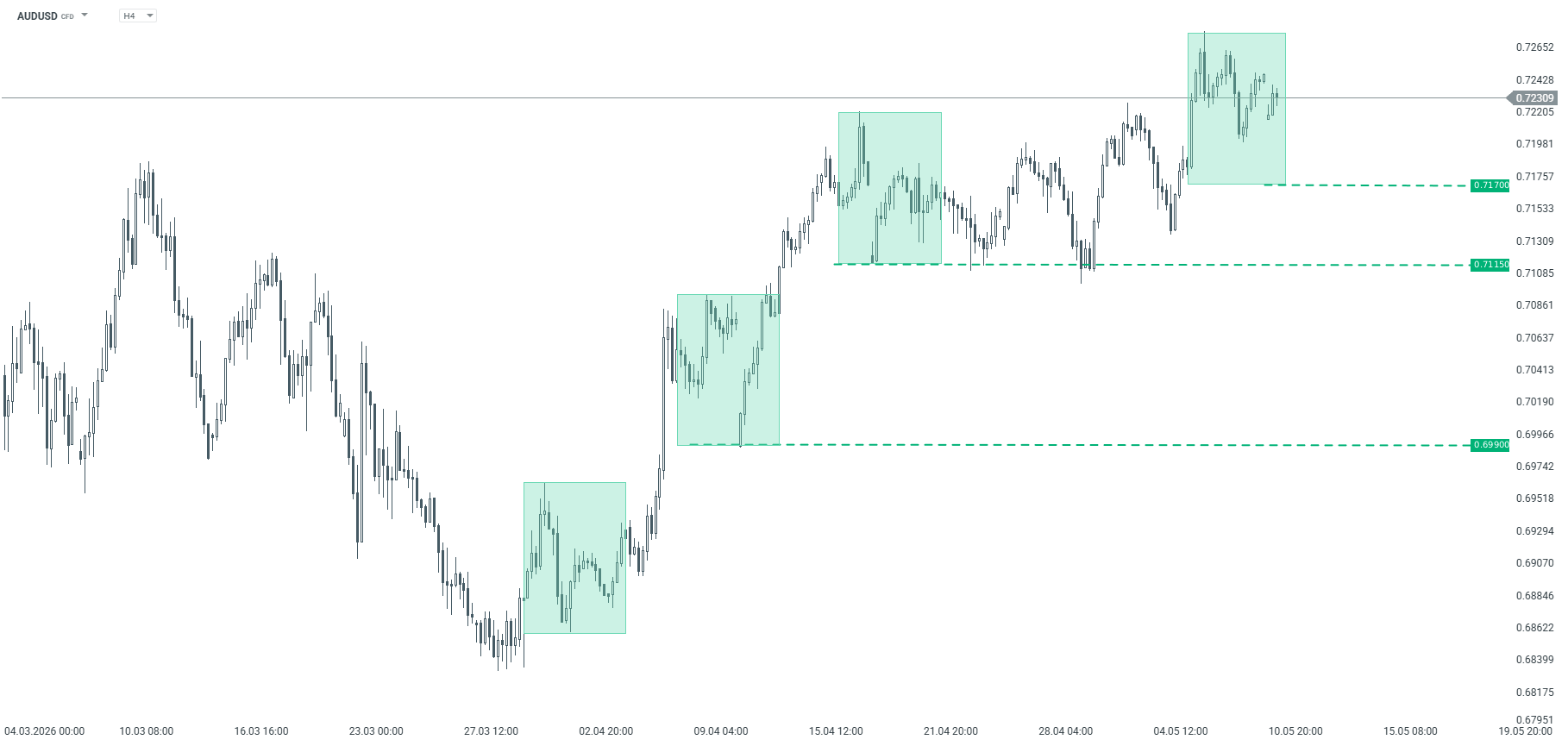
USDCAD – H4 timeframe. Source: xStation AUDUSD The AUDUSD exchange rate has been on an upward trend since the beginning of April. The key support level for the exchange rate is currently 0.7170. According to the Overbalance methodology, as long as the price remains above this level, the upward trend remains in place.
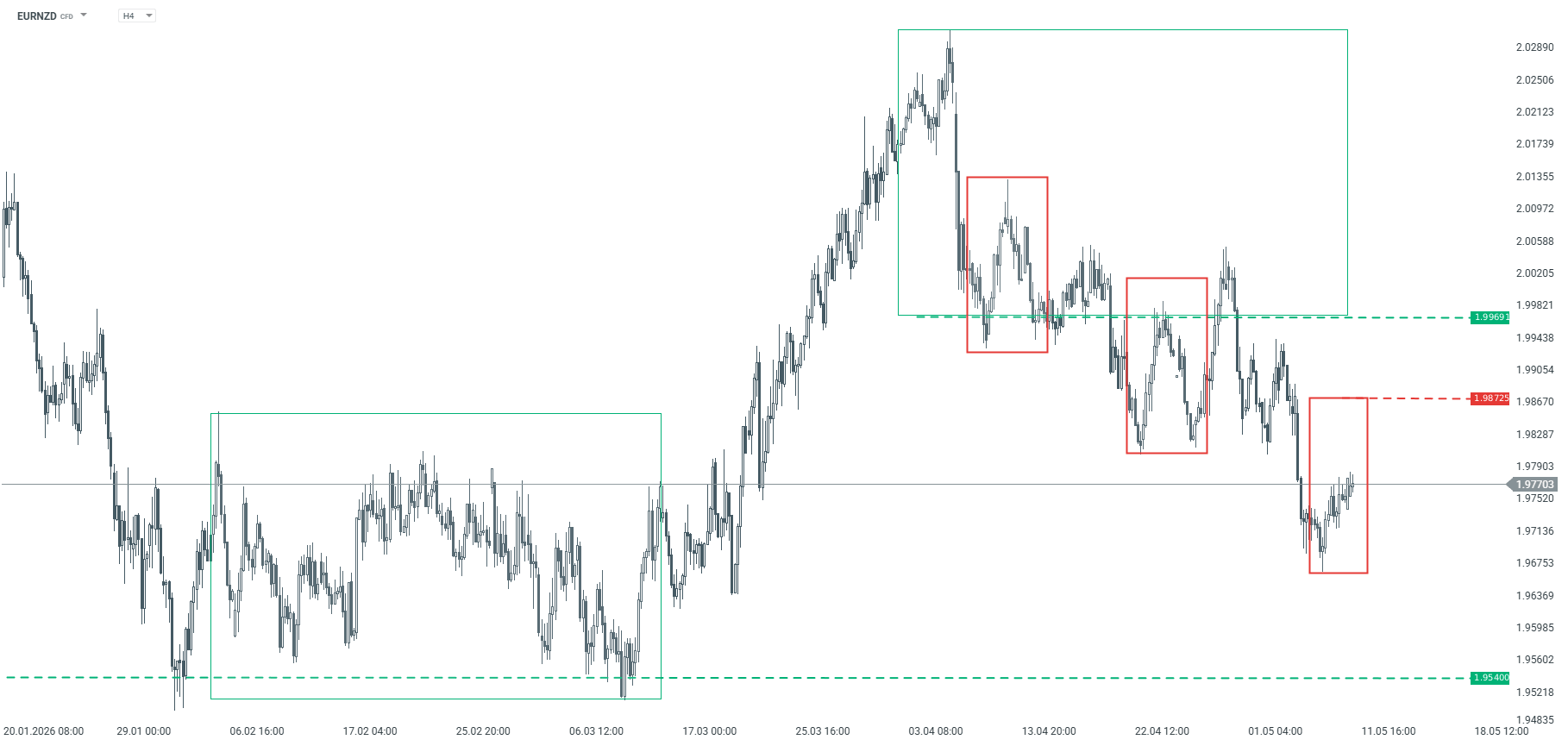
AUDUSD – H4 chart. Source: xStation EURNZD Since 7 April, the EURNZD has been trading in a downtrend. Should the upward correction extend, the key resistance level remains at 1.9872. As long as the price stays below this level, the bearish scenario remains in place. Conversely, for a return to the uptrend to be considered, the price would need to rise above the 1.9969 level, where the polarity of the previously negated 1:1 upward geometry is located.
Deutsche Bank’s Jim Reid and team say markets are digesting a firm US payrolls report that reinforced views of a resilient labour market and persistent inflation risks. They highlight a dense United States (US) data calendar, led by April Consumer Price Index (CPI), Producer Price Index (PPI), retail sales and industrial production, which will shape expectations for the US Dollar (USD) and US yields over coming days.
US data and inflation in focus
“Before that, the new week arrives with markets still processing last Friday’s US payrolls report, which came in broadly firm and reinforced the view that labour market conditions remain resilient.”
“While not strong enough to decisively alter the policy outlook, the release did little to ease concerns that underlying inflation pressures could persist, especially given still-solid wage dynamics.”
“Against this backdrop, outside of the Iran War developments which will of course take centre stage, the coming week will remain centred on the US, with a dense run of data and policy developments.”
“The focal point will be tomorrow’s April CPI report.”
“Our economists expect headline inflation to rise by +0.58% month-on-month, moderating from March’s +0.9%, but still relatively firm.”
“In contrast, the core measure is projected to accelerate to +0.39% MoM from +0.2%, suggesting underlying price pressures remain sticky even as energy-related effects fade.”
“The YoY rates would move from 3.3% to 3.8% for the former and from 2.6% to 2.8% for the latter.”
“Producer price data follows on Wednesday and then the remainder of the week shifts towards activity indicators.”
“Our economists expect retail sales to decline by -0.3% MoM after March’s strong +1.7% increase, pointing to some payback in consumer spending.”
“Meanwhile, industrial production is forecast to rise modestly by +0.2% MoM following a -0.5% drop previously, suggesting a tentative stabilisation in manufacturing output.”
AUD/JPY trades with mild gains around 113.60 in Monday’s early European session.
Market pricing indicates the OCR could reach 4.7% by the end of 2026, with no cuts expected until 2028.
Japan’s officials intervened in the FX market during the holidays in early May.
The AUD/JPY cross posts modest gains near 113.60 during the early European trading hours on Monday. The Australian Dollar (AUD) edges higher against the Japanese Yen (JPY) on a hawkish tone from the Reserve Bank of Australia (RBA). Nonetheless, traders remain cautious of potential further interventions from the Japanese authorities.
The Australian central bank raised its Official Cash Rate (OCR) to 4.35% last week, matching its December 2024 peak, as inflation remains elevated. This marks the third consecutive rate hike this year. According to the statement, the RBA said inflation had picked up materially in the second half of 2025, with conflict in the Middle East pushing up fuel and commodity prices.
The RBA signaled that more rate hikes were on the horizon, with its economic forecasts pencilling in a 4.70% policy rate by the end of 2026, with no cuts expected until 2028, according to CNBC.
However, the potential upside for the cross might be limited amid intervention fears. Japanese officials reportedly intervened in the currency market again during the Golden week.
Markets estimated the cost of these additional moves at approximately ¥4 trillion to ¥5 trillion ($32 billion). Japan’s top foreign exchange official, Atsushi Mimura, said last week that continued intervention was possible.
To provide the best experiences, we use technologies like cookies to store and/or access device information. Consenting to these technologies will allow us to process data such as browsing behavior or unique IDs on this site. Not consenting or withdrawing consent, may adversely affect certain features and functions.
Functional
Always active
The technical storage or access is strictly necessary for the legitimate purpose of enabling the use of a specific service explicitly requested by the subscriber or user, or for the sole purpose of carrying out the transmission of a communication over an electronic communications network.
Preferences
The technical storage or access is necessary for the legitimate purpose of storing preferences that are not requested by the subscriber or user.
Statistics
The technical storage or access that is used exclusively for statistical purposes.The technical storage or access that is used exclusively for anonymous statistical purposes. Without a subpoena, voluntary compliance on the part of your Internet Service Provider, or additional records from a third party, information stored or retrieved for this purpose alone cannot usually be used to identify you.
Marketing
The technical storage or access is required to create user profiles to send advertising, or to track the user on a website or across several websites for similar marketing purposes.