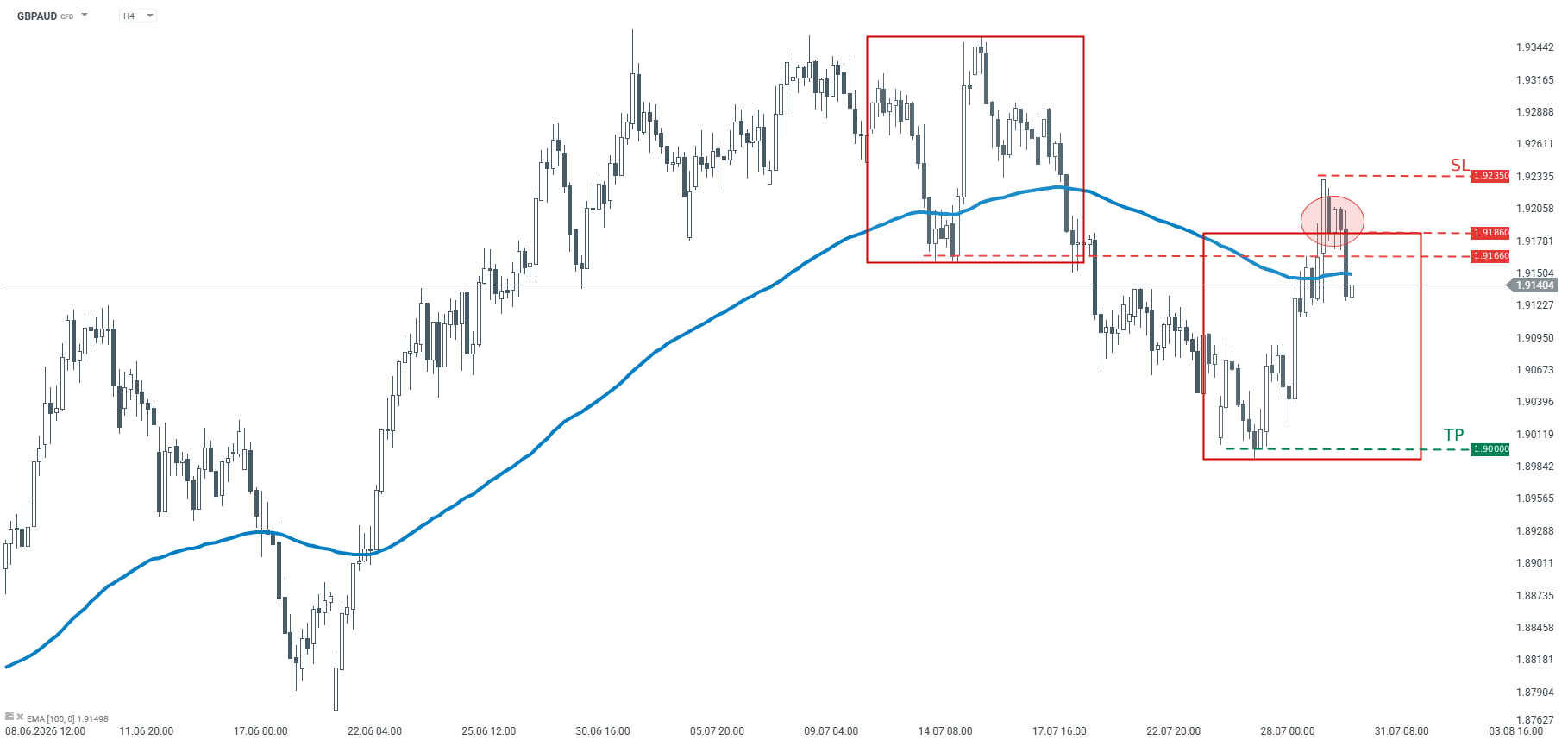
Facts: GBPAUD is trading below the 100-period moving average from H4 interval The pair failed to break above the 1:1 structure Recommendation: Trade: Short position on GBPAUD at market price Target: 1.9000 Stop: 1.9235
Opinion: GBPAUD has been trading in a upward trend recently, but the pair may be experiencing a trend reversal. Looking at the pair at the H4 interval, one can see that the price failed to break above the upper limit of the 1:1 structure which, according to the Overbalance strategy, may herald a resumption of a downward trend. As long as the price sits below the 1.9186 the further downward move is the base case scenario. We recommend going short GBPAUD at market price with a target of 1.9000. We also recommend placing a stop loss at 1.9235. Source: xStation5
The bearish technical setup backs the case for a further near-term depreciating move.
The AUD/USD pair turns lower following a modest Asian session uptick to the 0.6965 region on Thursday amid the emergence of some US Dollar (USD) dip-buying. Spot prices, however, hold above an over two-week low, touched on Wednesday, and currently trade around mid-0.6900s, down less than 0.10% for the day.
The growing acceptance that the US Federal Reserve (Fed) will hike interest rates in 2026 amid inflation risks stemming from volatile oil prices, along with escalating US-Iran tensions, helps revive demand for the safe-haven Greenback. Furthermore, soft Australian consumer inflation figures on Wednesday led to some unwinding of near-term Reserve Bank of Australia (RBA) rate hike bets, which undermines the Australian Dollar (AUD) and contributes to capping the AUD/USD pair.
From a technical perspective, the recent repeated failures near the 0.7020 horizontal resistance and the overnight close below the 100-period Exponential Moving Average (EMA) on the 4-hour chart favor bearish traders. Furthermore, the Relative Strength Index (RSI) drifts below the neutral 50 line and Moving Average Convergence Divergence (MACD) stays marginally below zero. Momentum indicators together hint at subdued bullish momentum and a corrective tone after recent losses.
However, it will still be prudent to wait for some follow-through weakness below the overnight swing low, around the 0.6925 region, and a technically significant 200-day Simple Moving Average (SMA) near 0.6900 before positioning for further losses. The AUD/USD pair might then aim to challenge the June monthly swing low, around the 0.6865 zone, and extend the downfall further to the 0.6835 area, or the year-to-date low touched in March, and the 0.6800 round-figure mark.
On the topside, initial resistance is defined by the 100-period EMA at 0.6974. A sustained move above this barrier would be needed to ease immediate downside pressure and open the way for a more constructive recovery. Until then, the AUD/USD pair remains vulnerable to further slippage, with traders likely to fade upticks while spot prices remain capped below the said EMA.
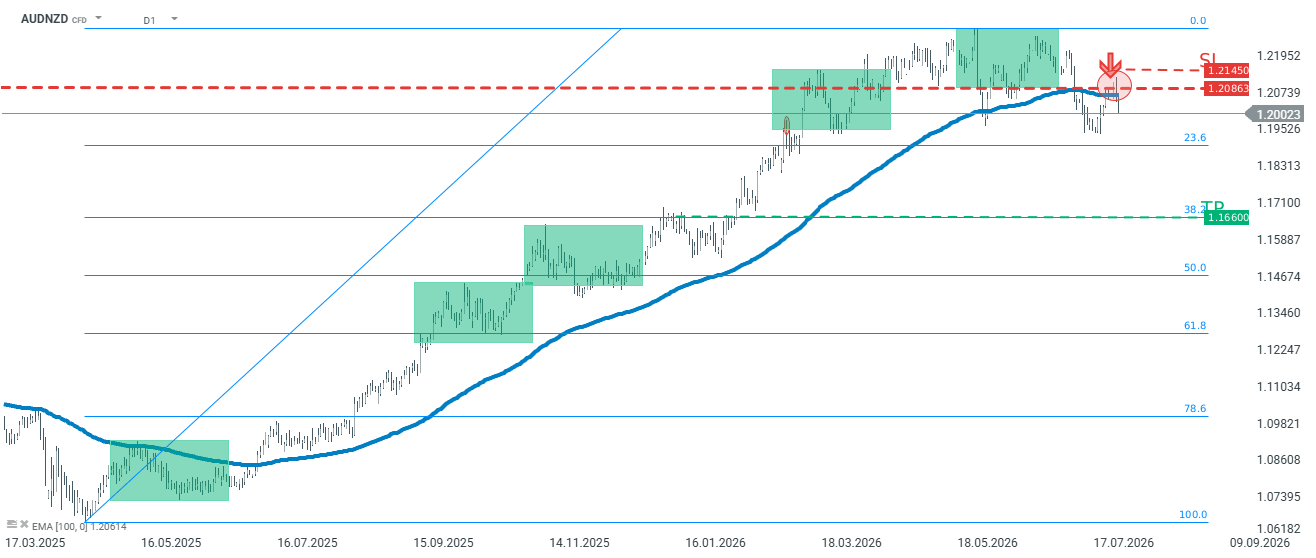
Facts: The pair is trading below a key resistance at 1.2086 AUDNZD sits below 100-period moving average
Recommendation: Trade: Short position on AUDNZD at market price Target: 1.1660 Stop: 1.2145
Opinion:
AUDNZD has been trading in an upward trend recently. However looking at the D1 interval, we can see that a potential trend reversal took place. The pair broke below the lower limit of 1:1 structure, which according to the Overbalance strategy heralds a bigger downward move. It seems that as long as the price sits below the 1.2086 resistance, one should expect the price to continue to fall. In addition the price sits below the 100-period moving average form D1 interval. We recommend going short AUDNZD at market price with a target of 1.1660. We also recommend placing a stop loss order at 1.2145.
The Australian dollar is sliding today against all G10 currencies in response to lower-than-expected CPI inflation data in Australia (AUD/USD, AUD/NZD: -0.3%). Both the latest reading for June and the full Q2 report came in below 4%, delivering the Reserve Bank of Australia (RBA) the first fruits of months of aggressive interest rate hikes.
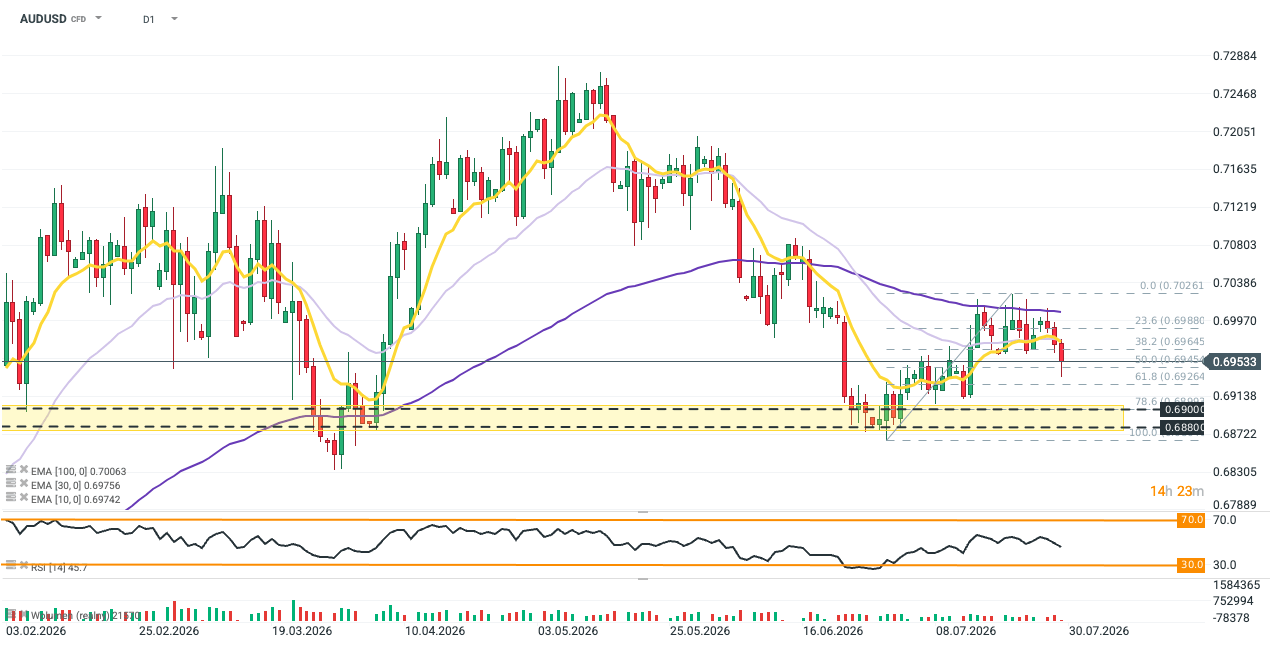
Technical Analysis: AUDUSD (D1)
AUDUSD is testing key levels amidst intensifying selling pressure. Defending the 50.0% and 61.8% Fibonacci retracements is essential to prevent a deeper decline toward the 0.6900 area. A move below the yellow buffer zone (0.68800–0.69000) would signal a decisive return of the downtrend, potentially exacerbated by further disinflation in Australia. The RSI remains near the neutral 50 level, leaving room for further bearish pressure. The only hope for the bulls remains a very dovish signal from the Fed and a return above the 100-day EMA (dark purple). However, this scenario seems unlikely given the strong US labor market (stable unemployment, record-low jobless claims), rising PMI readings, and Warsh’s uncompromising stance on above-target inflation.
Source: xStation5
What is driving the AUDUSD decline today?
Inflation drops below 4% : Australia’s annual CPI inflation rate fell to 3.8% YoY in June from 4.0% in May, dropping 0.1% month-on-month. In the second quarter, inflation slowed to 0.6% QoQ (4.0% YoY) compared to 1.4% QoQ in Q1. Crucially for the RBA, trimmed mean inflation came in at 3.6% YoY (0.8% QoQ), falling below the central bank’s forecast (3.8%).
Cheaper fuel saves the reading: The main dampening factor was a nearly 11% drop in fuel prices in June, translating into disinflation in transport and goods. On the other hand, the housing sector weighed heavily (+6.8% YoY), where new home construction costs jumped 5.8% YoY due to higher material and labor costs. Furthermore, services inflation accelerated to 4.0% YoY, pointing to ongoing domestic price pressures in the economy.
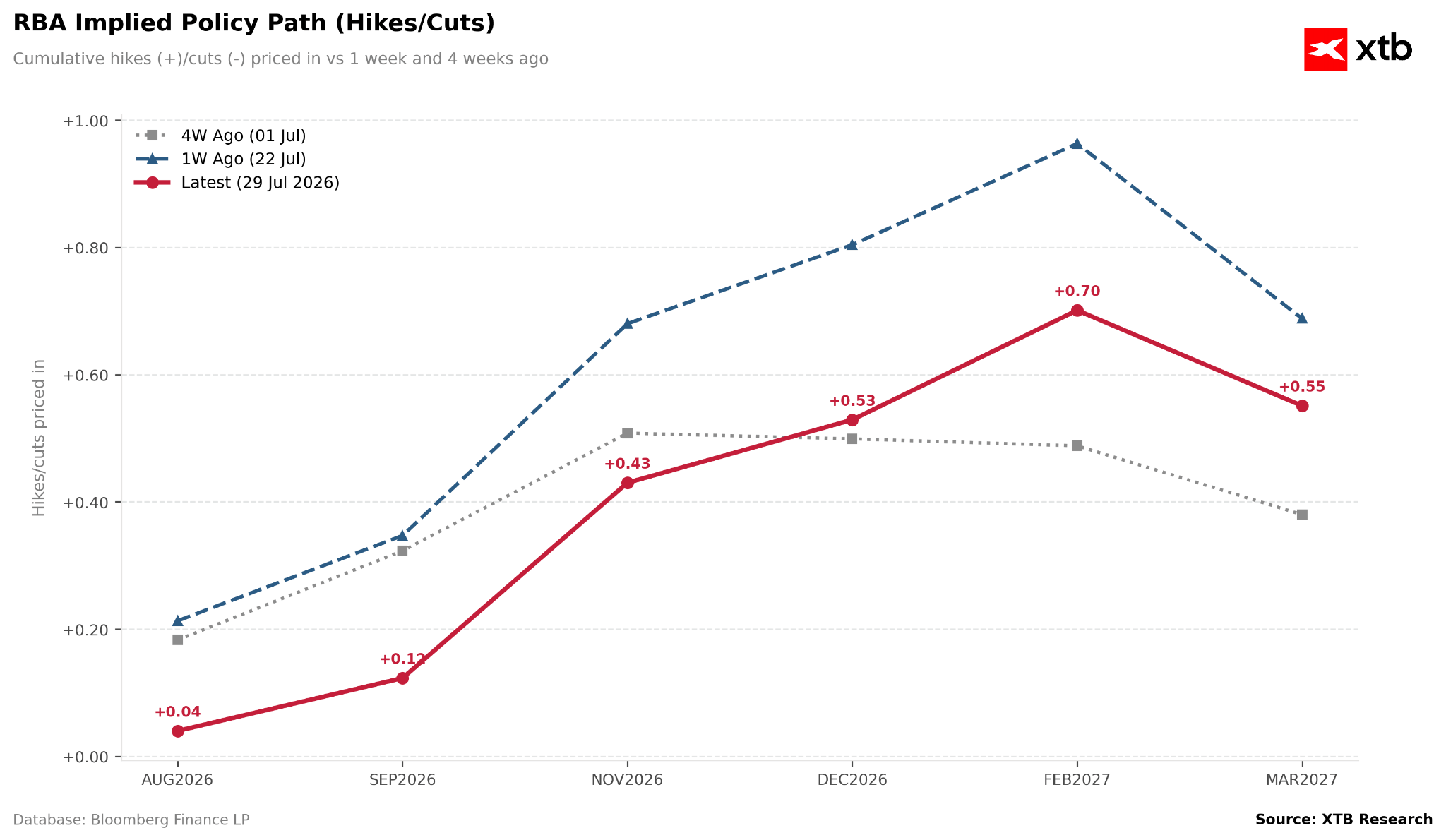
Market wipes out rate hike expectations: The swap-market-implied probability of an August rate hike in Australia dropped to zero. In fact, expectations fell across all time horizons. Interest rates in Australia are currently the highest among all G10 economies (4.35%). The last rate hike occurred in May, while subsequent months brought dovish signals from the RBA governor, who indicated that the current rate level is a good place to take a breather.
The market no longer pricing in a full interest rate hike in Australia until March 2027. Pricing from last week indicated a move in February with near certainty (blue line), whereas currently, we are approaching the flat curve from a month ago, which signaled a pause alongside hopes at the time for an end to the Middle East conflict. Source: XTB Research.
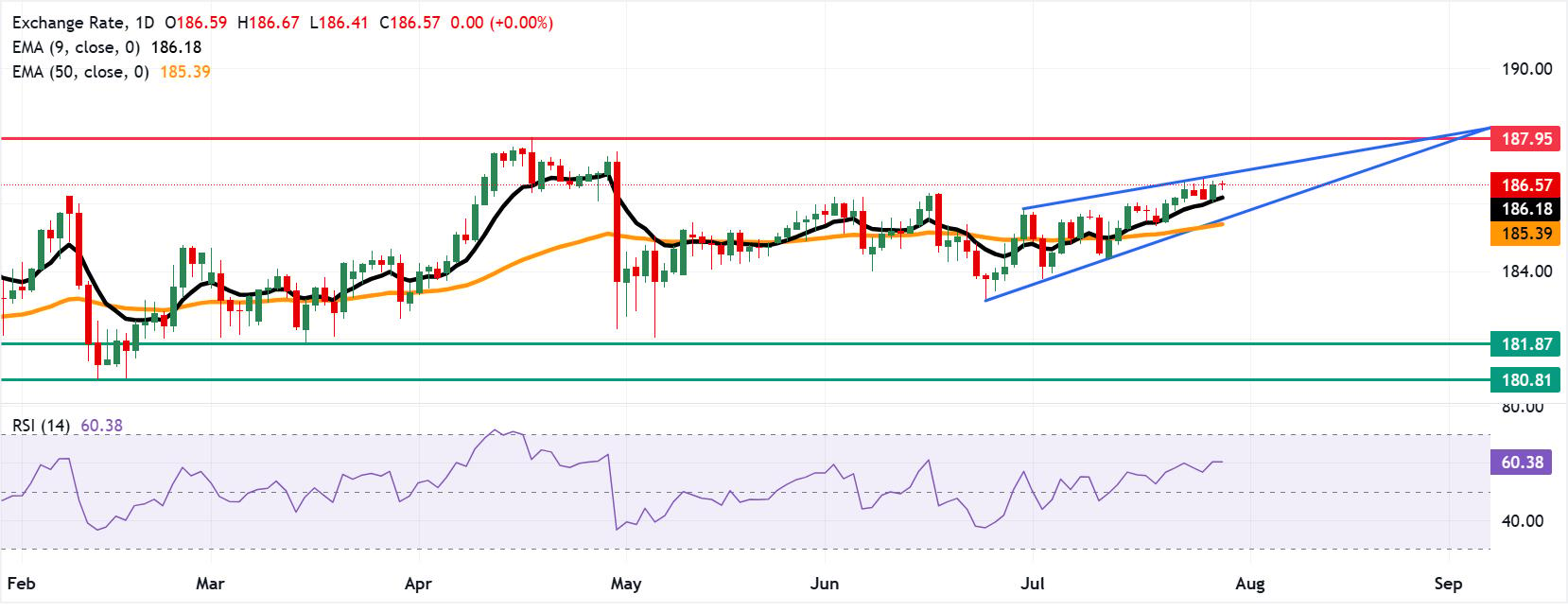
EUR/JPY could find primary resistance around the rising wedge top at 187.00.
The 14-day Relative Strength Index around 60 maintains a bullish bias.
The primary support lies at the nine-day EMA of 186.18.
EUR/JPY moves little after registering modest gains in the previous day, trading around 186.60 during the Asian hours on Wednesday. The currency cross is maintaining a bullish near-term tone as it holds above both the nine-period and 50-period Exponential Moving Averages (EMAs). The alignment of short- and medium-term EMAs below price suggests ongoing upside pressure.
Additionally, the 14-day Relative Strength Index (RSI) around 60 keeps a constructive bias without yet signaling overbought conditions. However, the daily chart technical analysis shows that the EUR/JPY cross is remaining within a rising wedge, indicating a strong bearish reversal risk.
The EUR/JPY cross may test the initial resistance at the upper boundary of the rising wedge around 187.00. A successful break above the wedge could support the currency cross to target the all-time high of 187.95, which was recorded on April 17.
On the downside, the primary support lies at the nine-day EMA of 186.18, followed by the lower boundary of the rising wedge around 185.60 and the 50-day EMA at 185.39. A break below this confluence support zone could cause a bearish emergence and put downward pressure on the EUR/JPY cross to navigate the region around the five-month low of 181.87, recorded on March 16, and the seven-month low of 180.81.
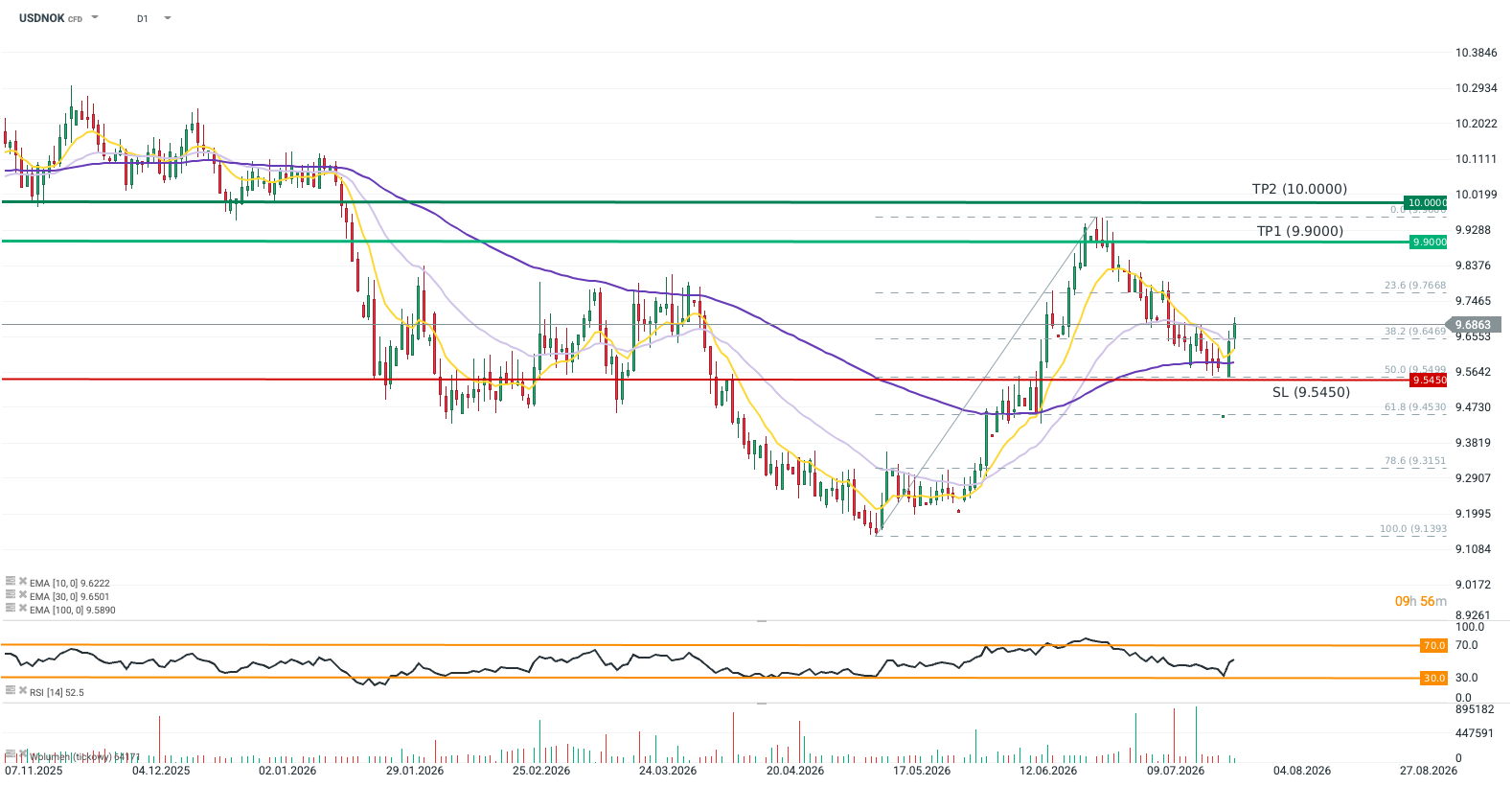
USDNOK returned today above the 10- and 30-day exponential moving averages (EMA10 and EMA30).
The yield spread between US and Norwegian 10-year government bonds (US-NOR) has widened by approximately 8 basis points over the past month (today vs. June 26).
The swap market is fully pricing in a September interest rate hike in the US.
After breaking out to a 5-month high in late June, USDNOK entered a local downtrend driven by the resurgence of military actions in the Persian Gulf and rising oil prices. The ~4% correction ended on Monday, and the exchange rate is currently attempting to break out of this downtrend, aided by falling oil prices that are weakening the Norwegian krone. A rebound in USDNOK should be supported by the Federal Reserve’s increasingly hawkish stance. During the central banking forum in Sintra, Kevin Warsh explicitly identified inflation as enemy number one, emphasizing that the Fed will not tolerate inflation above target and suggesting it will not take AI-driven productivity gains for granted. A hawkish Fed is also backed by the recent series of US economic data (jobless claims at their lowest since 1969, a stable unemployment rate, and better-than-expected PMI readings indicating expansion in the private sector). The gathering economic momentum, accompanied by sticky inflation above 3%, is driving interest rate expectations across all time horizons (e.g., the year-end rate implied by the swap market rose from 4.00% to 4.05% over the past month). Expectations for Norges Bank are also hawkish (the swap market is pricing in a 25 bps hike by the end of the year), but they are gaining momentum more slowly than those for the US, as evidenced by the upward trend in the 10-year yield spread between the two economies. A renewal of upward pressure on oil prices could naturally strengthen the NOK; however, geopolitical risk simultaneously supports the dollar, which should limit any non-monetary-policy-driven declines in USDNOK.
Methodology
This recommendation was prepared based on a technical analysis of the USDNOK chart and a fundamental analysis of the respective economies (monetary policy in Norway and the United States). The directional bias was determined using moving averages and market expectations regarding central bank policies. Take Profit and Stop Loss levels were established using Fibonacci retracements and price action:
TP1 is set at the recent peak.
TP2 is set at the next key resistance level.
SL is placed at the 61.8% Fibonacci retracement level of the April–May 2026 downward wave.
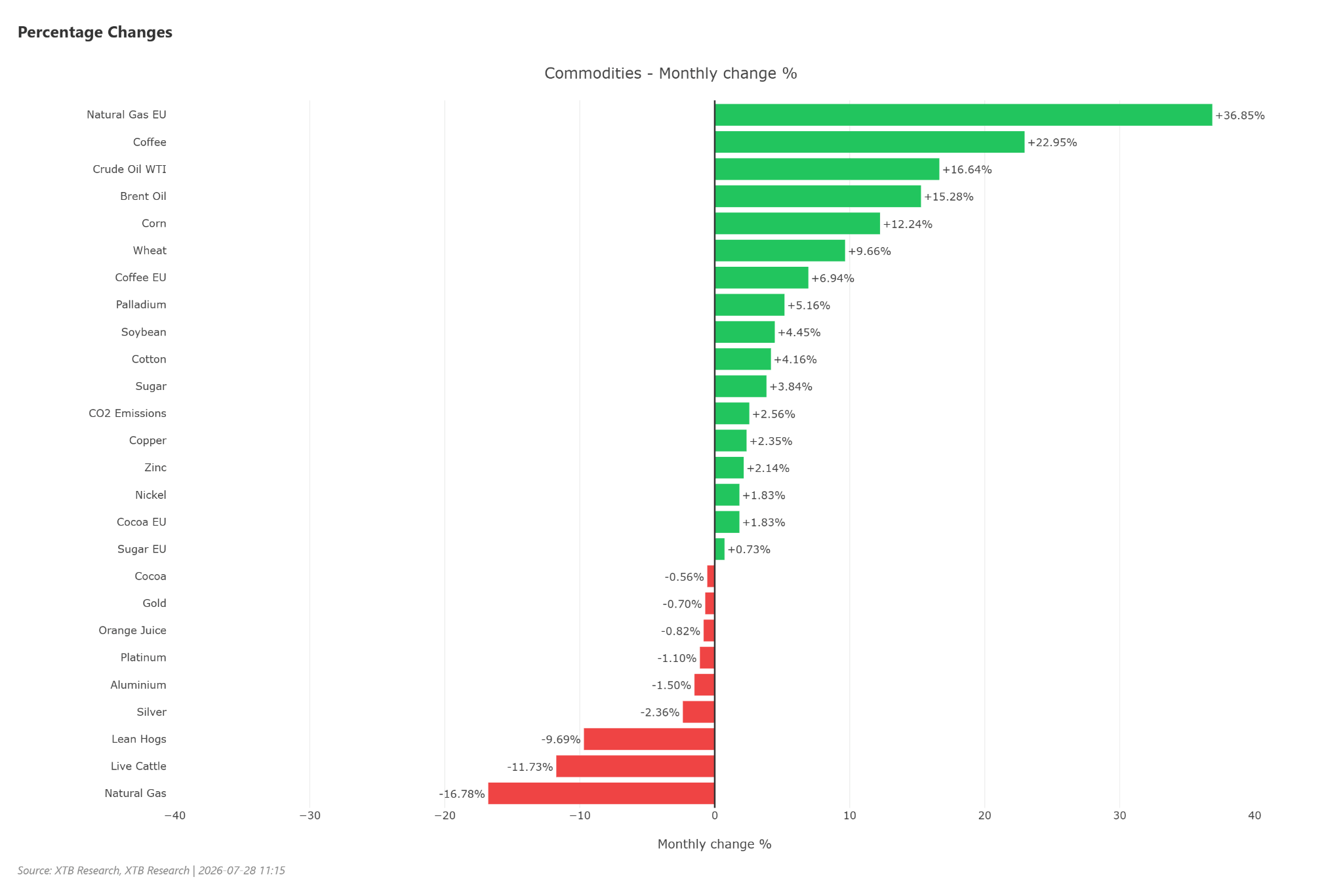
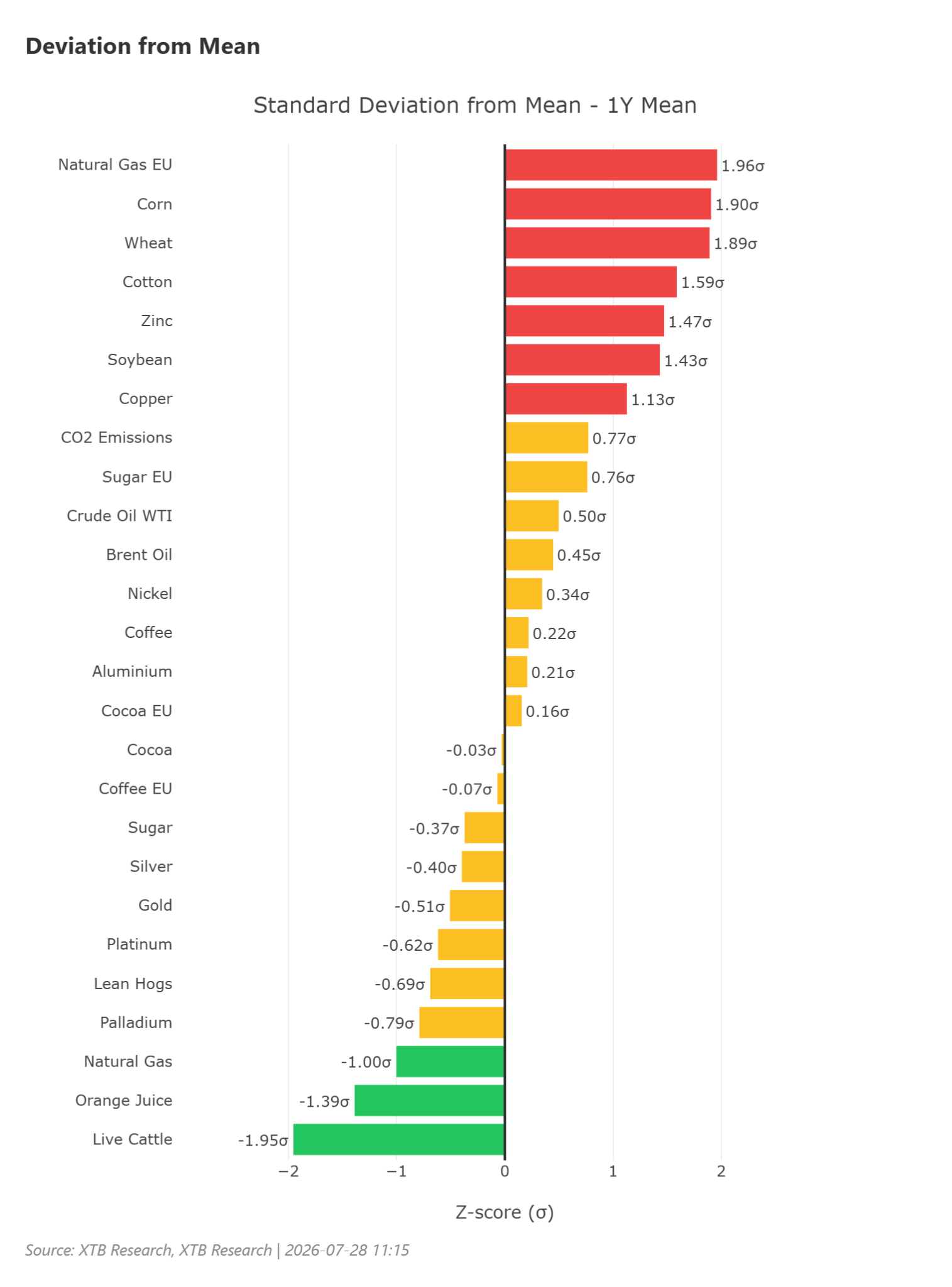
Bearish sentiment dominates the commodity market today, reflected by a negative average daily change of -0.41% with only six assets rising. The energy sector is seeing the sharpest decline—Brent crude is down 2.24% today (over 8.4% weekly), and WTI has fallen by 1.96%, driven by increasing hopes for a US-Iran diplomatic agreement. On the opposite pole are agricultural commodities, where coffee is the leader of growth, appreciating by 5.73%, which pushes its valuation to an extreme level of +2.18 standard deviations (Z-score) above the 5-year average. Despite current corrections, industrial and precious metals still maintain historically high valuations, indicated by extreme deviations for copper (+3.06σ), gold (+2.76σ), and aluminum (+2.12σ). In the global context, it is worth noting reports of an expected economic slowdown in India due to the oil shock and stock market turmoil in Asia, which may affect future industrial demand. In the coming days, investor attention should focus on the upcoming Fed meeting and central bank decisions, which will define the further direction of the market. Commodity Price Changes in the Last Month
Over the last month, TTF natural gas, coffee, and crude oil gained the most. On the other hand, we have American natural gas and livestock. Source: XTB Oversold and Overbought Commodities
From a short-term perspective, cattle is very strongly oversold, reaching nearly 2 standard deviations from the 1-year average. In contrast, TTF natural gas, corn, wheat, and cotton can be treated as slightly overbought. Source: XTB
🛢️ Crude Oil
Crude oil prices continue strong declines in response to reports of a halt in mutual attacks and attempts to engage in diplomatic talks between the US and Iran.
Iran is set to discuss with Oman the resumption of ship traffic in the Strait of Hormuz. During the last session, only one tanker passed through Hormuz, while through Bab el-Mandab, there is a rebound to 7 tankers (compared to an average of 10 tankers in recent months).
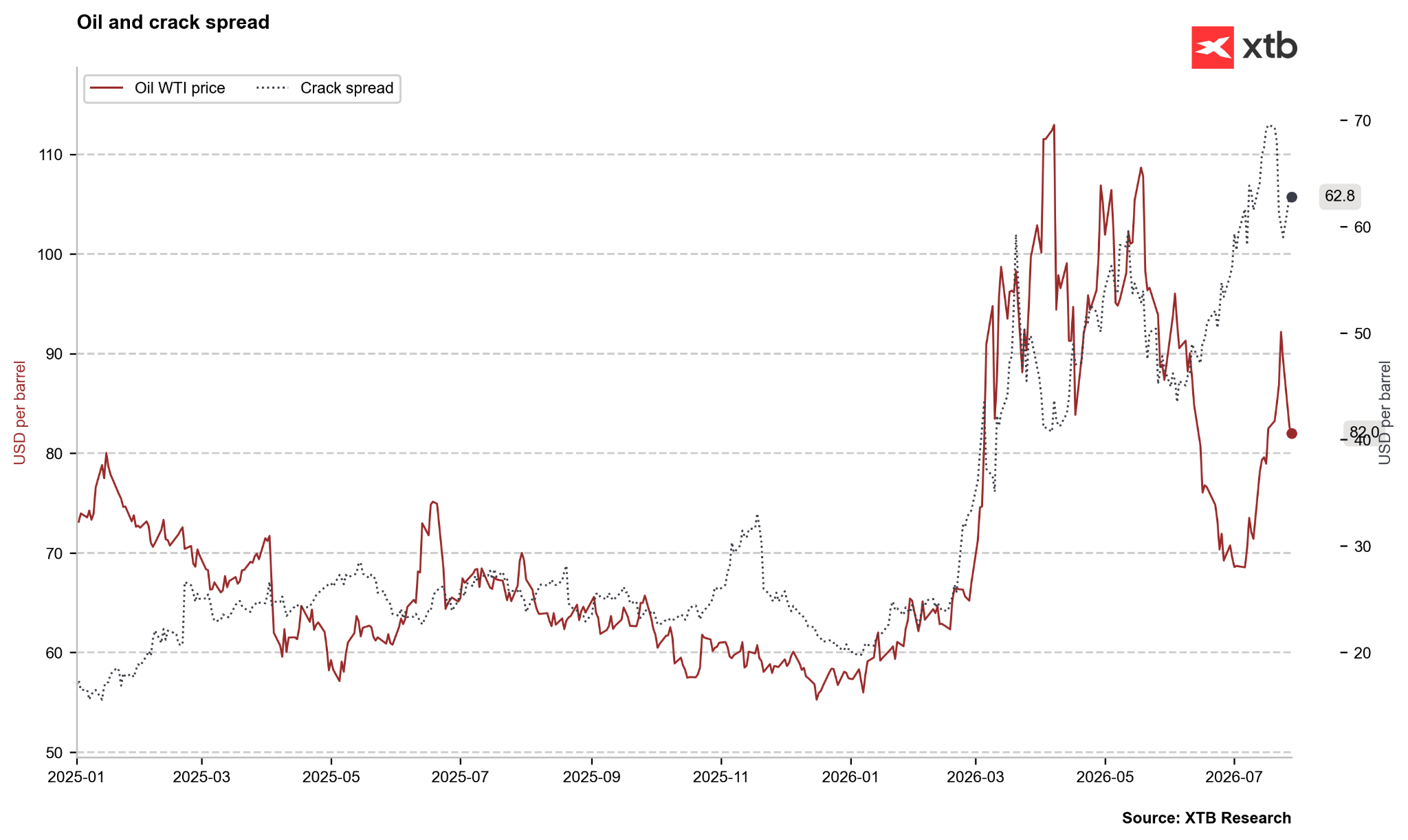
The price of Brent crude fell to around $87 for the September contract, while the October contract is trading below $84. WTI crude, in turn, dropped below $81 per barrel.
If an agreement with Iran is reached, a significant oversupply, estimated at up to 2 million barrels per day in Q4 2026, will quickly appear on the oil market. Nevertheless, it is worth remembering that earlier IEA forecasts changed virtually from report to report, so everything will depend on the navigability of key straits in the Middle East.
Reloading is resuming at the CPC terminal in Kazakhstan after disruptions caused by drone attacks. It is worth noting that the oil and fuel market is also disrupted by Ukrainian attacks on Russian oil infrastructure. It is estimated that up to 50% of fuel production capacity in Russia is shut down due to the attacks, leading to domestic supply problems.
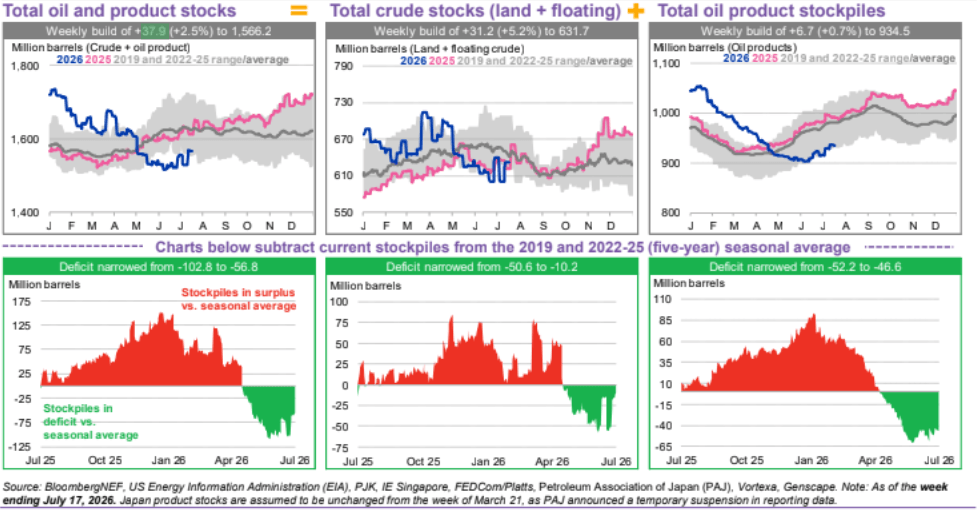
Global stocks of crude oil and petroleum products increased by 2.5% (by 37.9 million barrels) in the week ended July 17, narrowing the deficit relative to the 5-year average.
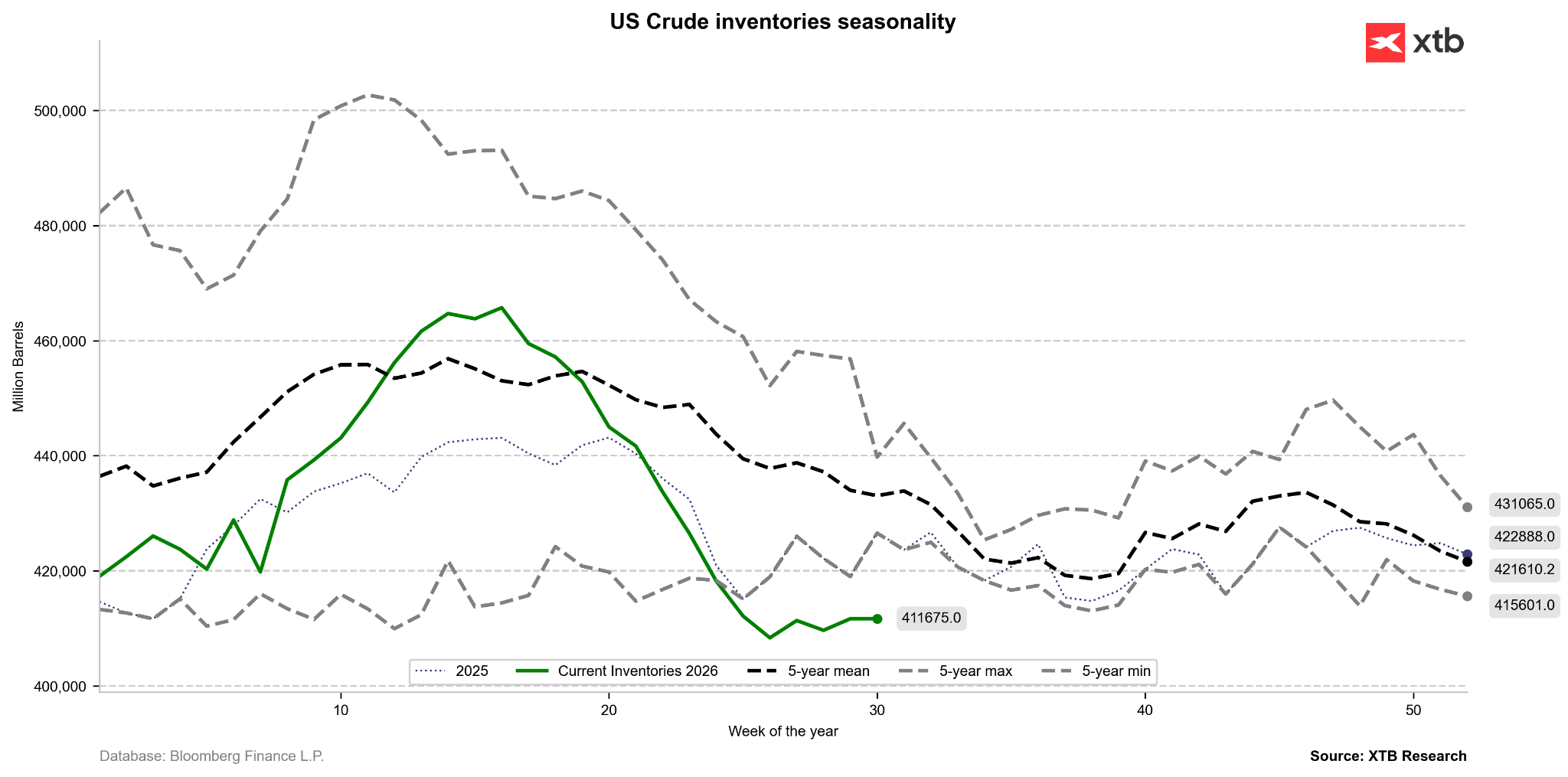
US crude oil stocks also rose, although the latest reports indicate a further decline in reserves, close to 300 million barrels.
According to Citi, the IEA may coordinate further releases of reserves and stocks if the situation does not normalize in the near future. The previous program of releasing 400 million barrels is expected to be completed within 1-2 months.
A noticeable acceleration in fuel processing in China is observed, which may be related to the normalization of the situation or the desire to sell fuels (e.g., to Russia) due to high margins. Utilized processing capacities at state refineries increased from approx. 67% at the beginning of July to 75% currently. In private refineries, the increase is from approx. 43% to 48%.
Maritime Routes via Iran and JMIC
Proposed maritime routes via Iran and JMIC. It is worth remembering that using the Iranian route carries the probability of Iran collecting fees. Source: Bloomberg Finance LP Global Oil and Products Stocks
Global oil and products stocks have increased recently. Source: BloombergNEF Oil Production and Export in Iran
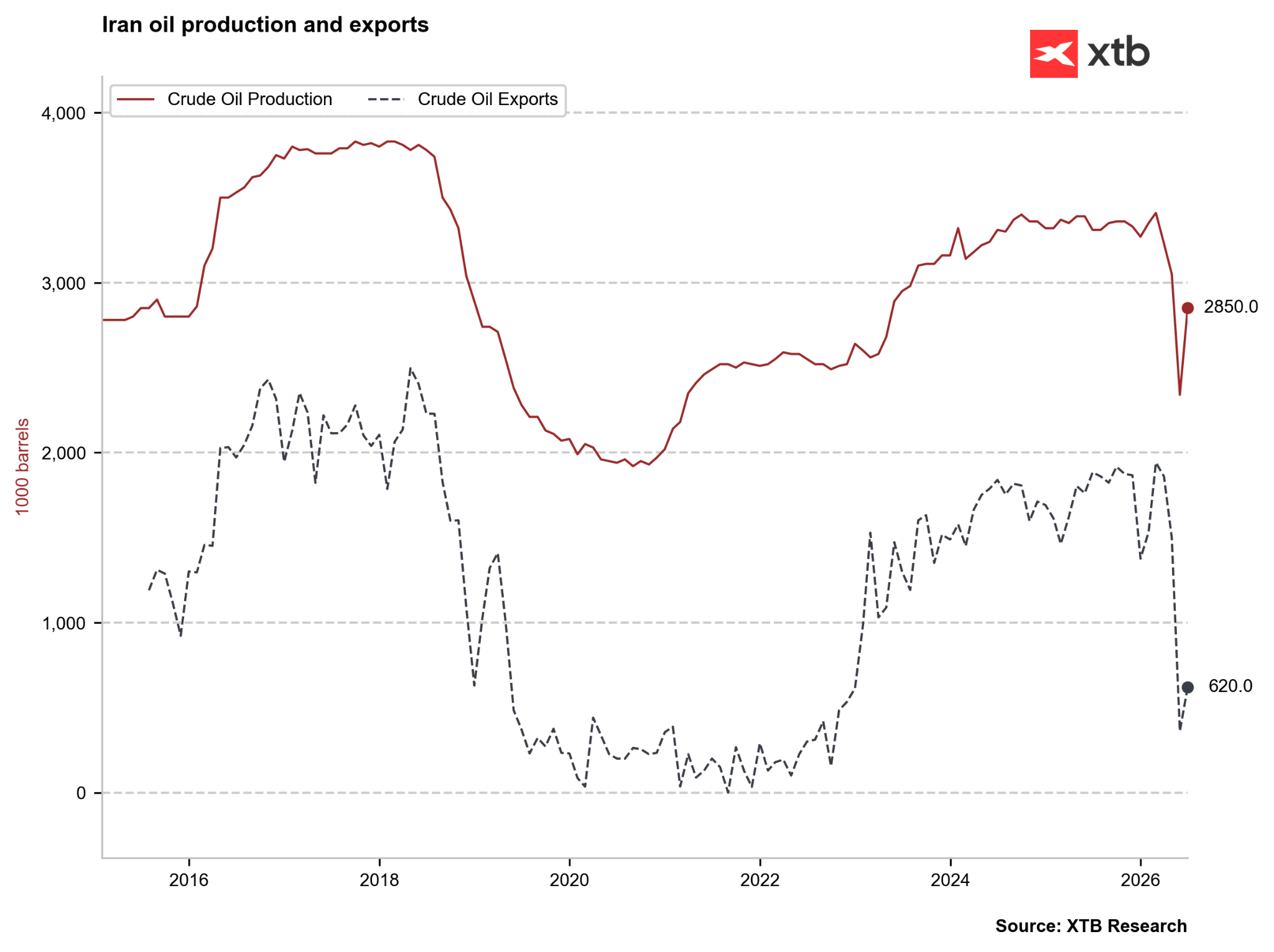
Iran’s production has clearly rebounded, but exports remain approximately 3 times lower than pre-war levels. Source: Bloomberg Finance LP, XTB Oil Price vs. Crack Spread
Crude oil is falling, while the crack spread is showing a small rebound and remains near historical highs. Source: Bloomberg Finance LP, XTB US Crude Oil Inventories
US crude oil inventories are stabilizing. Source: Bloomberg Finance LP, XTB
💨 Natural Gas (TTF + Henry Hub)
Prices for gas contracts in Europe (TTF) continue to fall, declining by another 3.1% to 56.46 EUR/MWh (64.21 USD/MWh) after an earlier drop at the beginning of the week reaching up to 10% due to optimism surrounding de-escalation in the Middle East.
Although gas prices in Europe are falling, an increase in demand in Asia is observed, which may divert supplies from the US to the eastern market, potentially leading to issues with replenishing storage before the winter season.
Currently, storage fill is about 55%, compared to a 5-year average of 71%, with a goal of 90% before November 1.
Natural gas prices in the US are also falling sharply, which may be a symptom of sentiment regarding the potential opening of the Strait of Hormuz. However, it is worth remembering that Qatar will not resume LNG supplies at a normal level until at least mid-September, which is why LNG exports from the US will remain high for many weeks to come.
A slight cooling in the Midwest region has caused US gas consumption forecasts to decrease.
Additionally, strong El Niño suggests that gas consumption during the winter may be lower, indicating that current inventories will be sufficient.
Gas production on Monday was 113.1 bcfd, an increase of 3.7% y/y, while demand was 81.4 bcfd, an increase of 2.7%. LNG exports were 18.1 bcfd.
EIA raised the forecast for average gas production to 111.2 bcfd at the beginning of July.
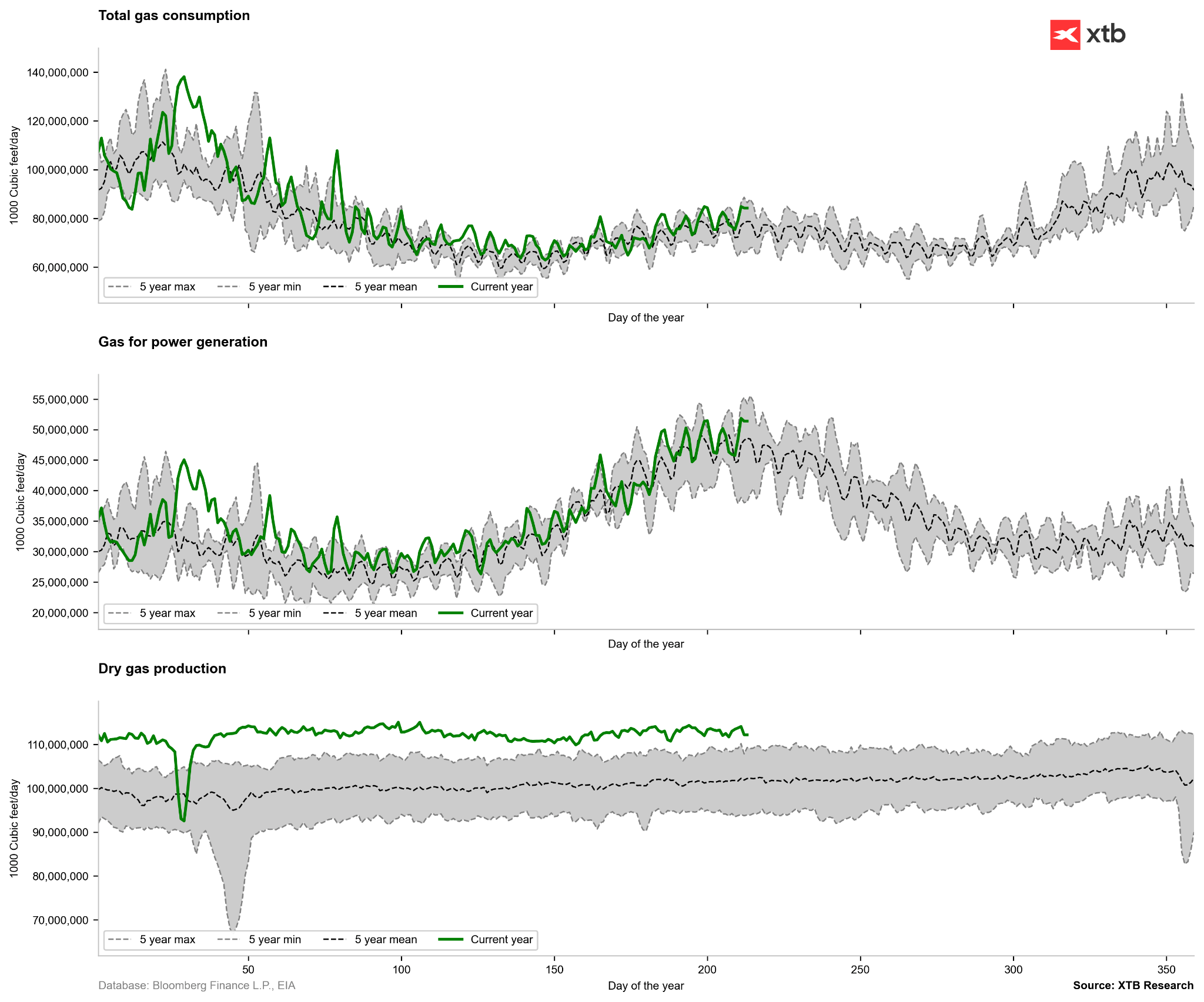
Natural Gas Demand
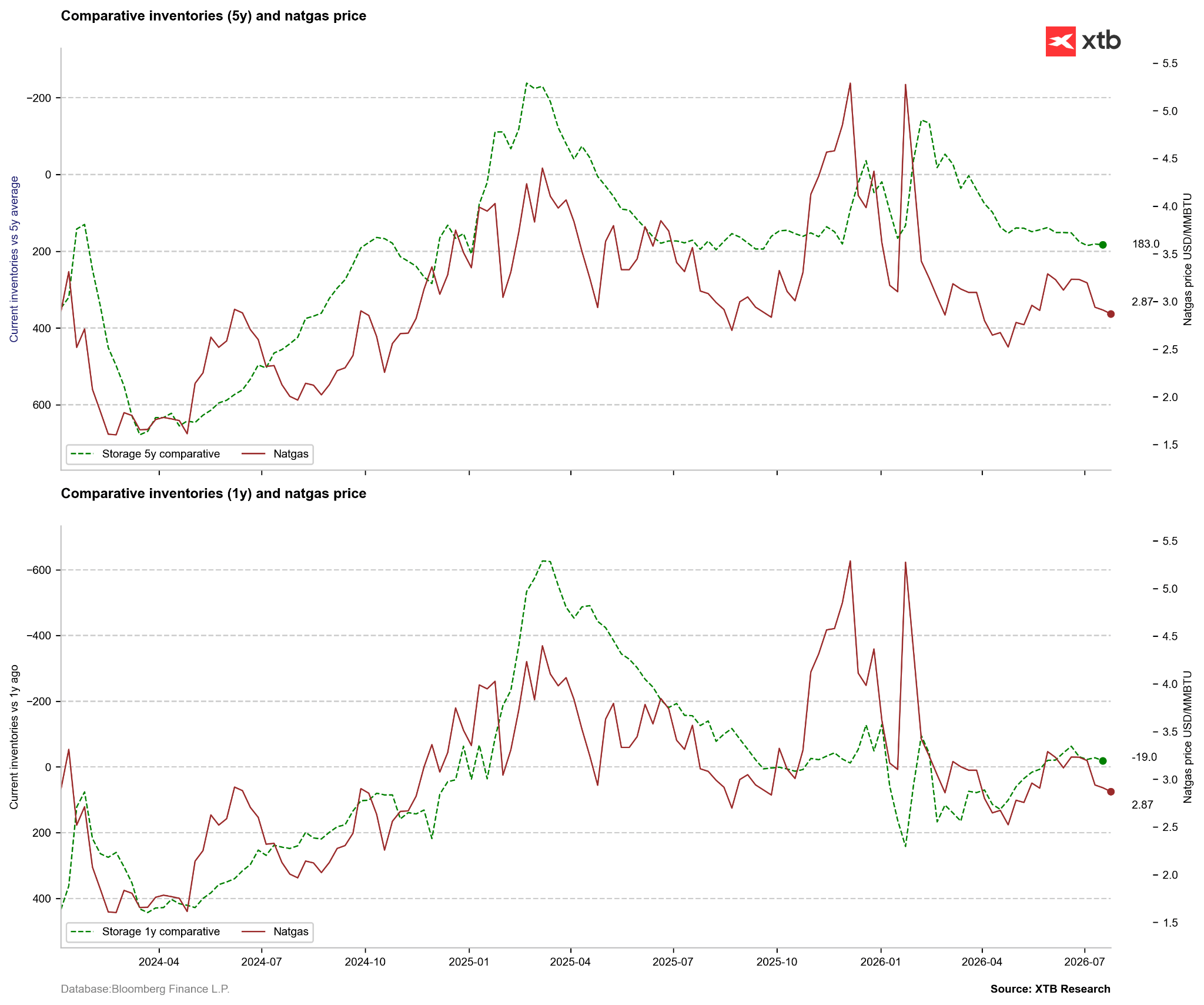
Gas demand remains above the 5-year average during the seasonal peak consumption period. Gas consumption for electricity production should fall in the coming weeks. Source: Bloomberg Finance LP, XTB Comparative Gas Stocks
Comparative stocks have stopped increasing but remain at relatively high levels. Nevertheless, this potentially indicates an undervaluation of gas prices. Source: Bloomberg Finance LP, XTB Natural Gas Price Seasonality
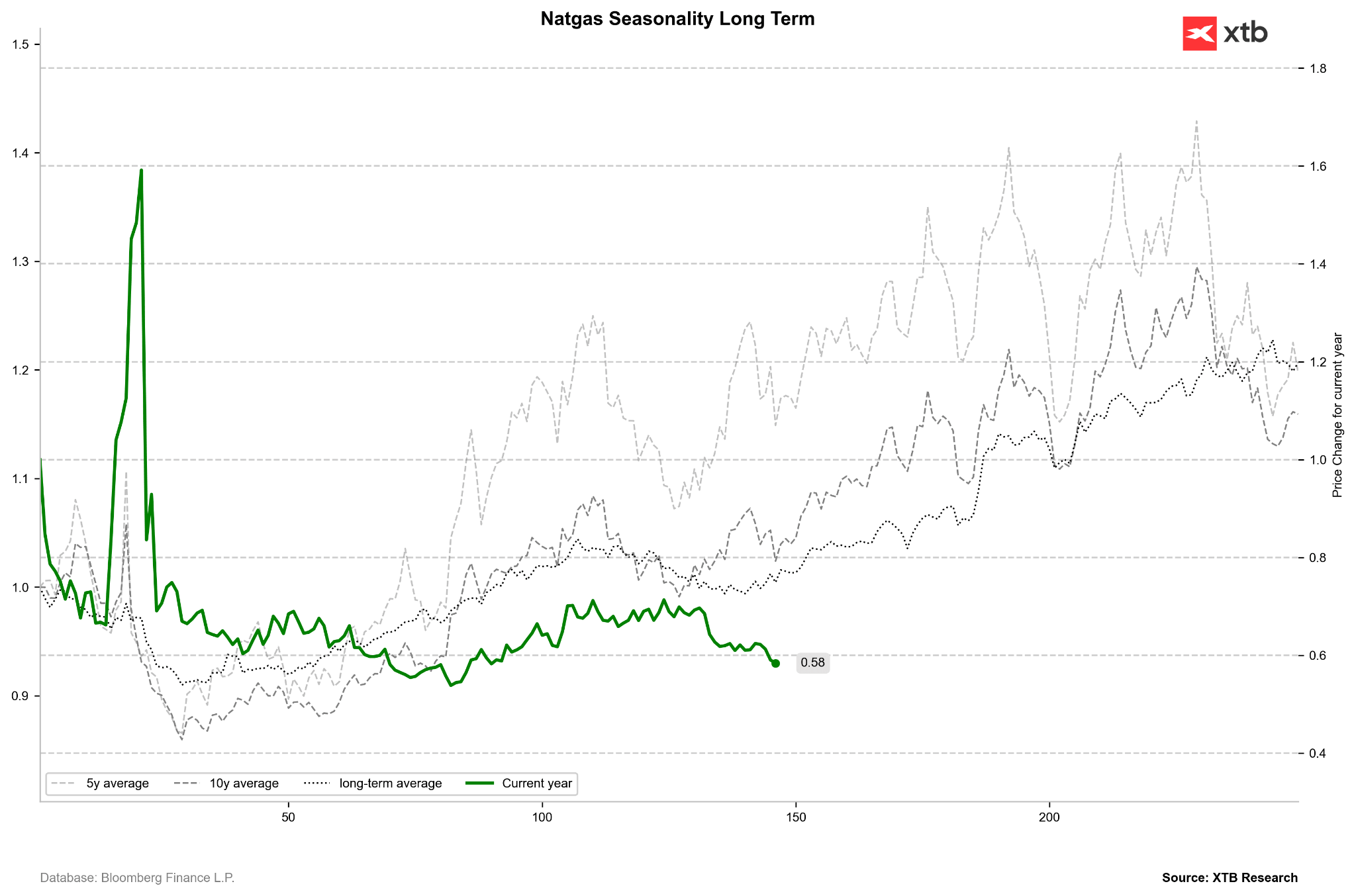
The current price behavior is completely contrary to short-term and long-term seasonality. It is worth remembering that the next two roll-overs will be relatively flat. Source: Bloomberg Finance LP, XTB Temperature Forecasts
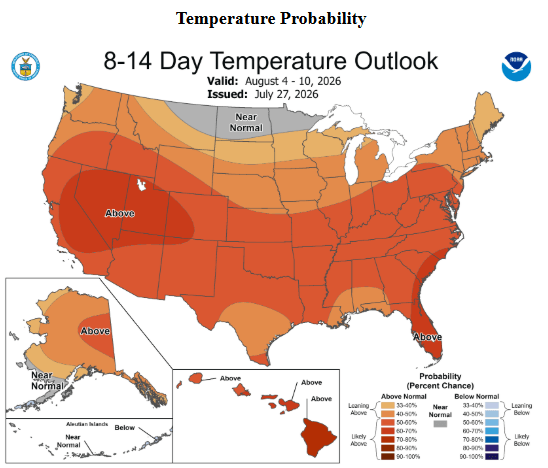
Although temperatures have been slightly lower than previously forecasted recently, a return to higher temperatures is expected at the beginning of August. Source: NOAA Technical Analysis of Gas Prices
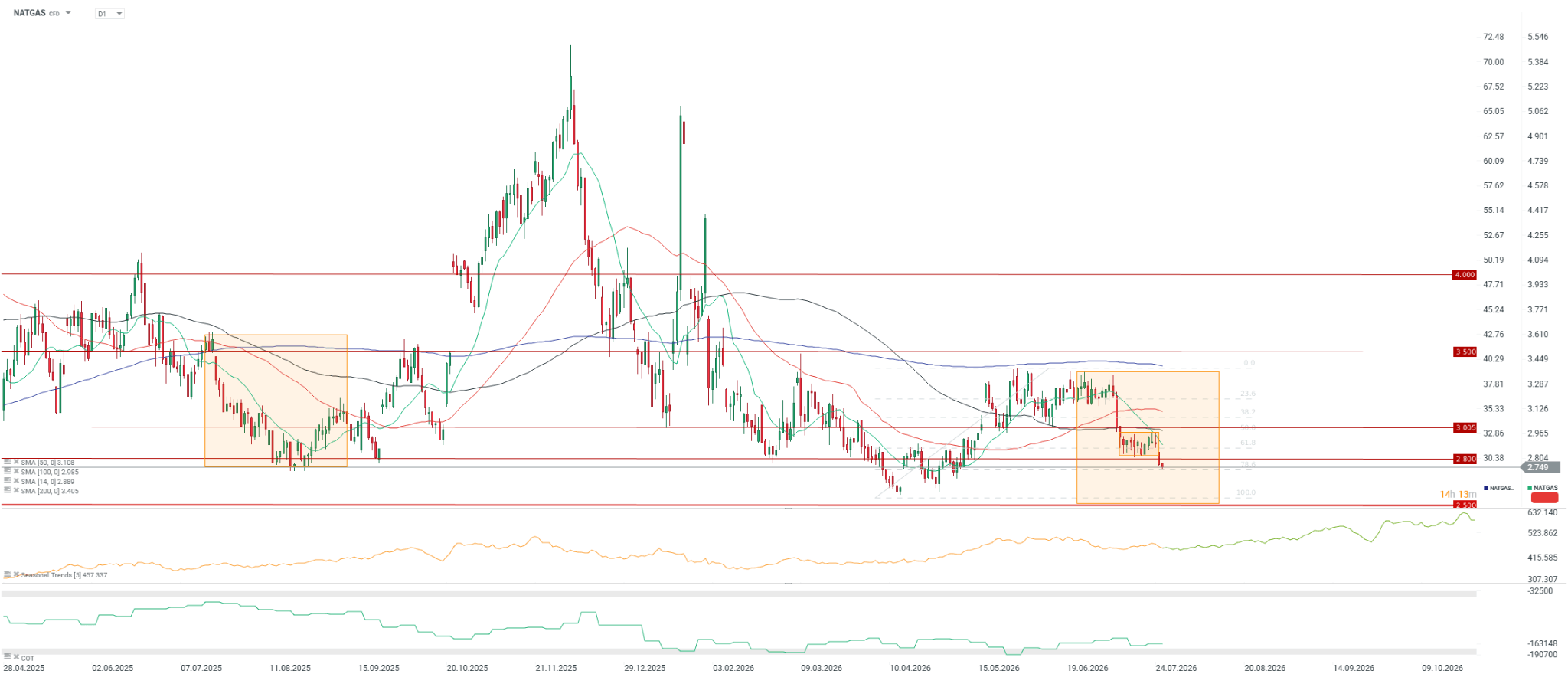
The price finally breaks out of the consolidation downwards and tests the last support at the 78.6 retracement. Last year, the downward wave in the summer period ended only in the second half of August. A similar range would currently indicate 2.5 USD/MMBTU. Source: xStation5
🟡 Gold
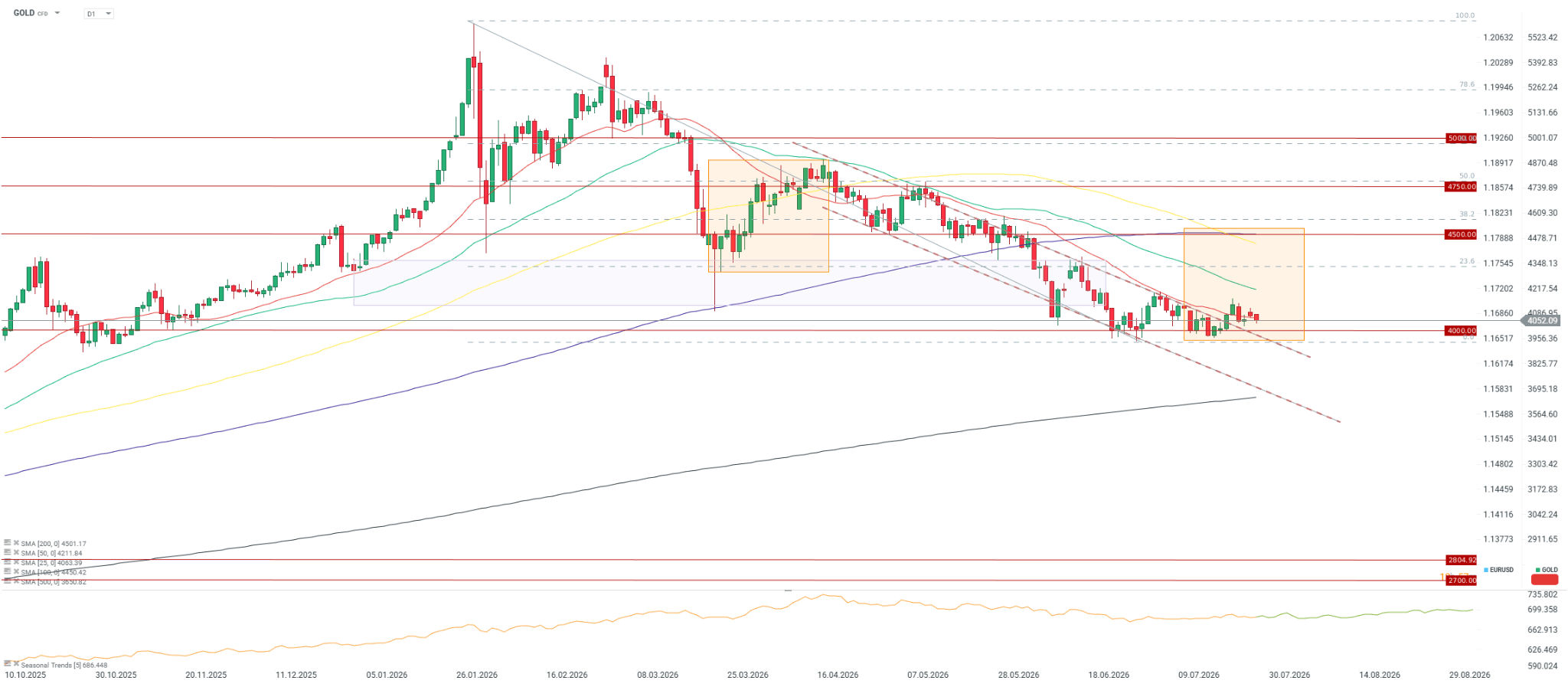
Gold prices fell below $4050 per ounce ahead of the upcoming Federal Reserve meeting.
Markets are pricing in slightly over 33% chance of a 25 basis point Fed rate hike. At the same time, a full rate hike is priced in for September.
A potential rate increase or hawkish rhetoric from the Fed could strengthen bond yields and the dollar’s exchange rate, posing a risk of breaking the support at $4,000 per ounce and capital outflow from ETF funds.
Gold has remained above $4,000 per ounce since the end of June thanks to dip buying and steady demand from central banks.
A temporary pause in the fighting in the Middle East has eased concerns about further inflation growth.
Gold Seasonality
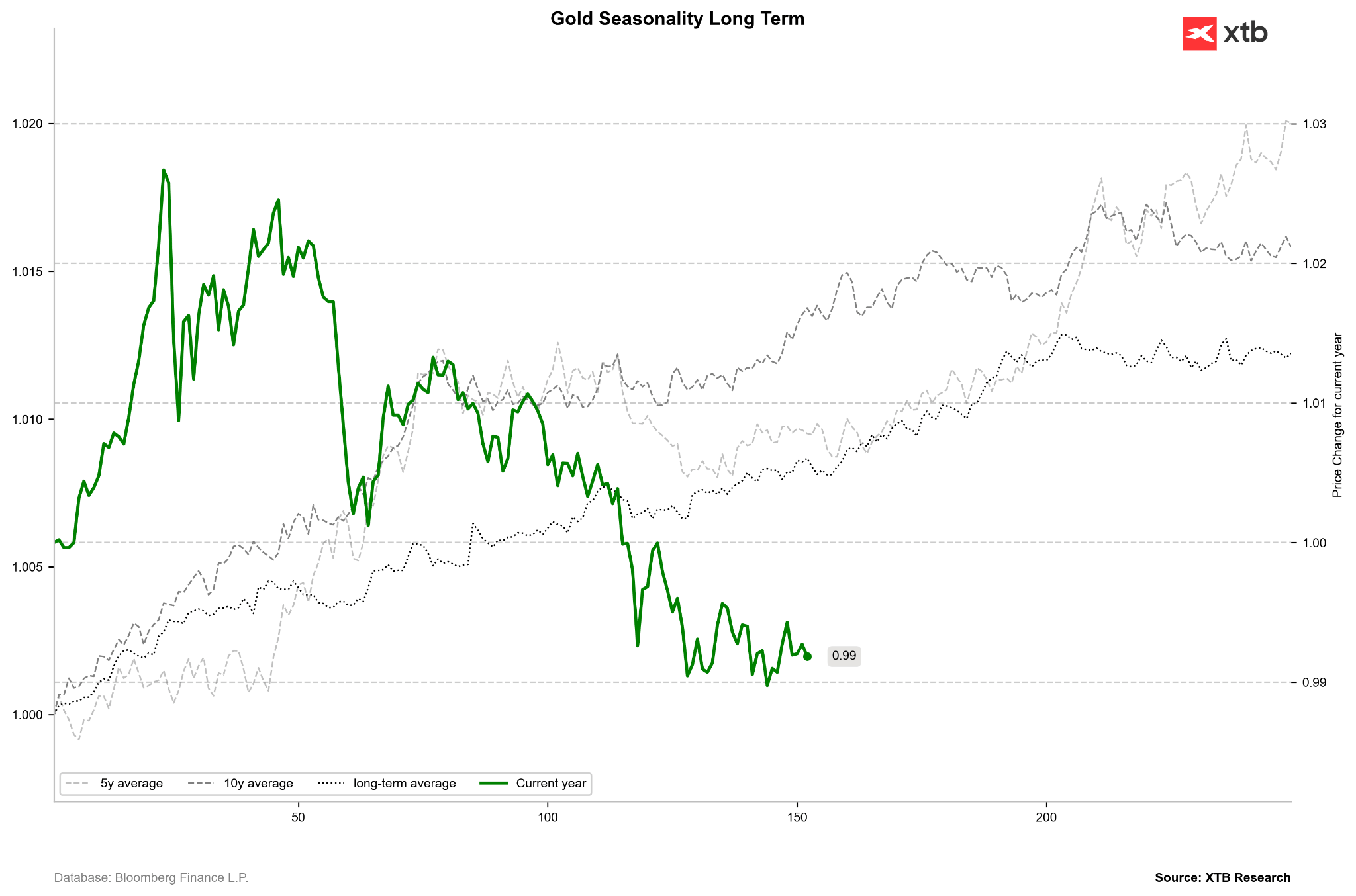
Gold should currently be in the phase of a seasonal rebound start. Nevertheless, we have been observing consolidation for about a month after sharp declines. Source: Bloomberg Finance LP, XTB Fed Interest Rate Expectations
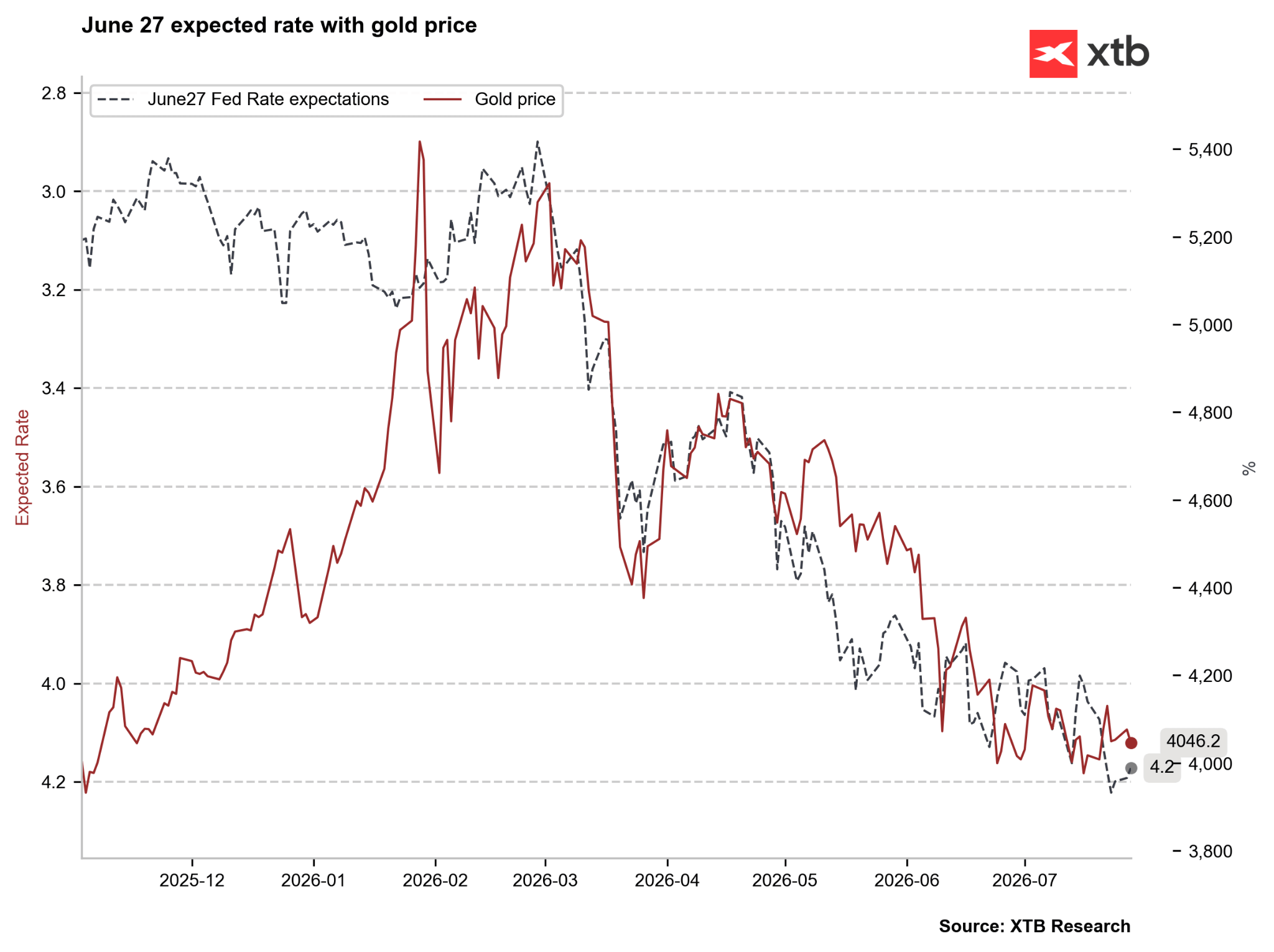
The effective rate is expected to be 4.2% by June next year, which would mean two full rate hikes from the current level. Gold is well priced relative to these expectations. Source: Bloomberg Finance LP, XTB Gold Purchases by ETFs
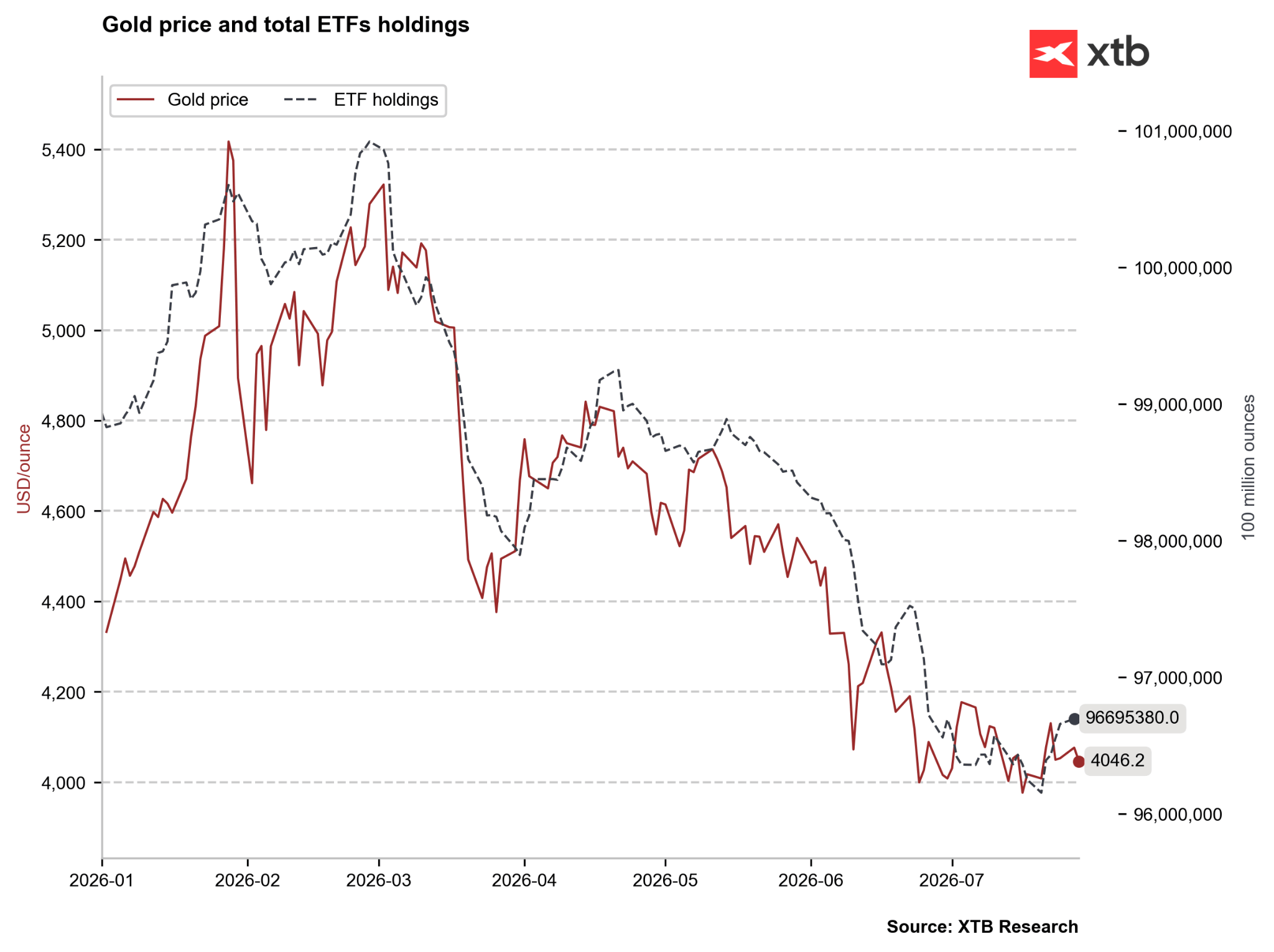
Despite mixed sentiment recently, ETFs are buying gold, and the rebound is already larger than in June. A dovish message from Warsh could push gold back towards $4200 per ounce. Source: Bloomberg Finance LP, XTB Gold Technical Analysis
The price of gold is trying to stay above the 25-period average, following the recent attempt to break out of the descending trend channel. Source: xStation5
🍫 Cocoa
Cocoa futures prices have fallen significantly to levels below $5200 per tonne and below £4000 per tonne, representing a decline of 1/3 compared to the previous year.
Giants like Lindt, Barry Callebaut, and Nestlé have reported a drop in chocolate sales volume (e.g., Lindt down 7.5% in H1) due to high prices of finished products.
Sales in traditional markets continue to look weak, but a clear improvement is observed in Asia.
Corporations are focusing on innovation and social media trends (e.g., Dubai-style chocolate) to regain customers. However, it is worth noting that the amount of cocoa itself in finished products is simultaneously decreasing.
Favorable weather conditions in Côte d’Ivoire, Ghana, and Nigeria are supporting preparations for the main harvests beginning at the turn of August and September.
Cocoa deliveries to ports in Côte d’Ivoire since the start of the season reached 2.11 million tonnes compared to 1.75 million tonnes a year earlier.
The CCC regulator in Côte d’Ivoire has begun a campaign to deliver fertilizers and seedlings to farmers across an area of 1.5 million hectares.
Preliminary expectations for the 26/27 season indicate cocoa production in Côte d’Ivoire at 1.8 million tonnes, which would be a decrease of nearly 20% compared to the current production level.
Transgraph Consulting indicates that the cocoa market surplus in 26/27 will shrink to just 80 thousand tonnes from over 400 thousand tonnes in the current season, which is mainly related to falling production.
Cocoa Stocks on Exchanges
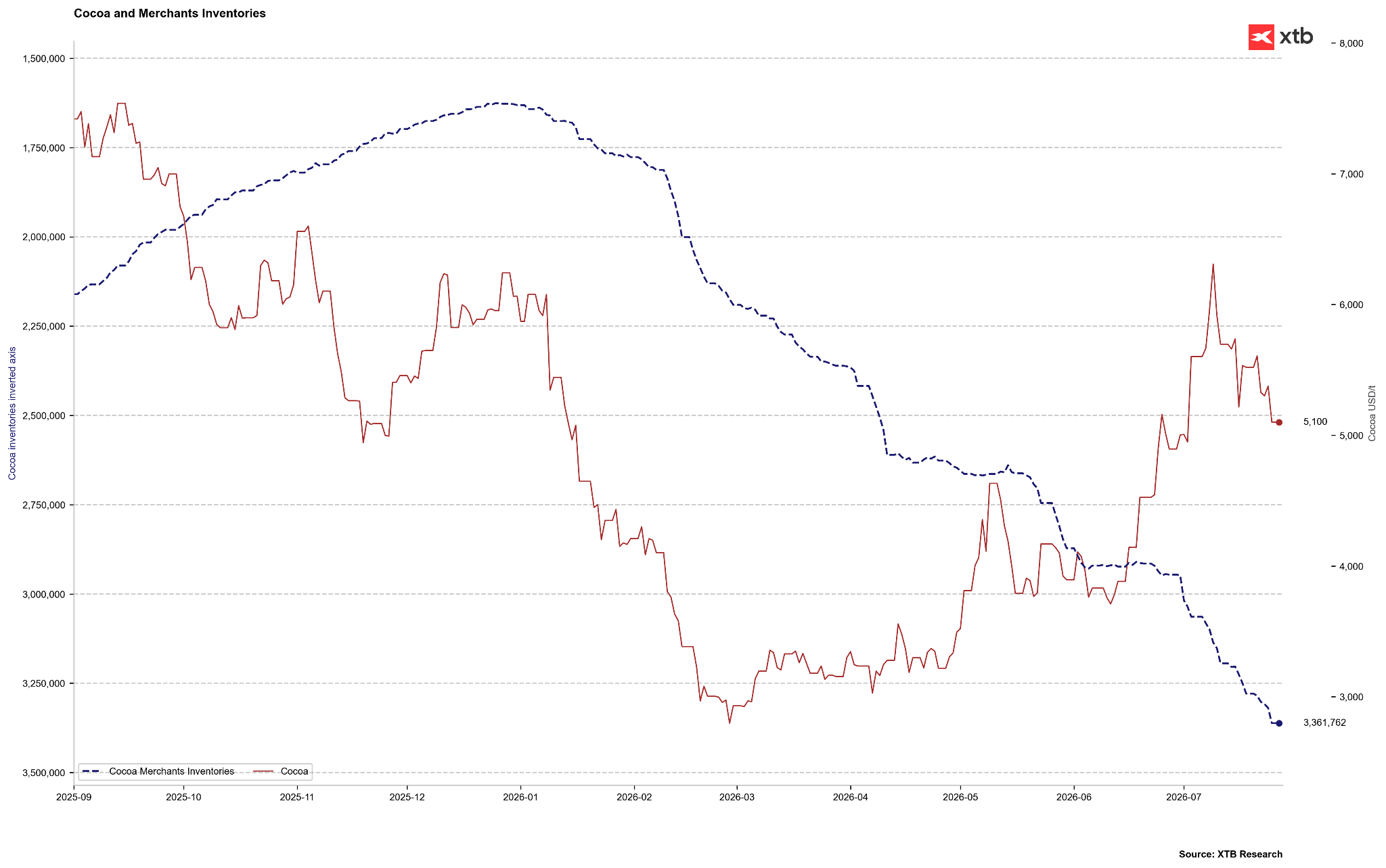
The real picture of the market is currently shown by the strong increase in cocoa stocks on exchanges, despite the fact that seasonally we should already be observing a slight decrease, as we are 2 months before the start of the next harvest season. Source: Bloomberg Finance LP, XTB Speculator Positions in the Cocoa Market
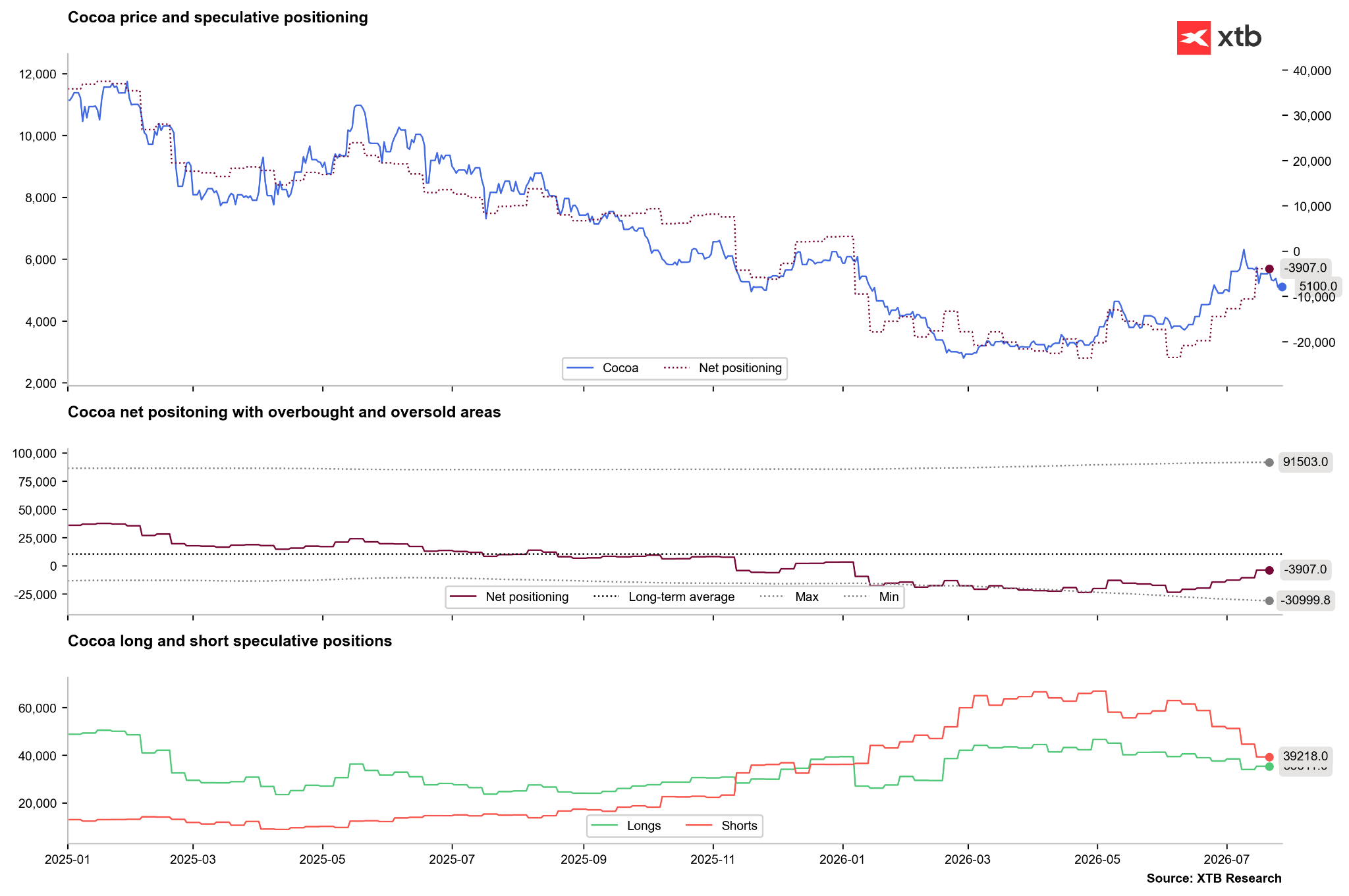
In recent weeks, speculators have reduced a lot of short positions. Source: Bloomberg Finance LP, XTB Cocoa Price Technical Analysis
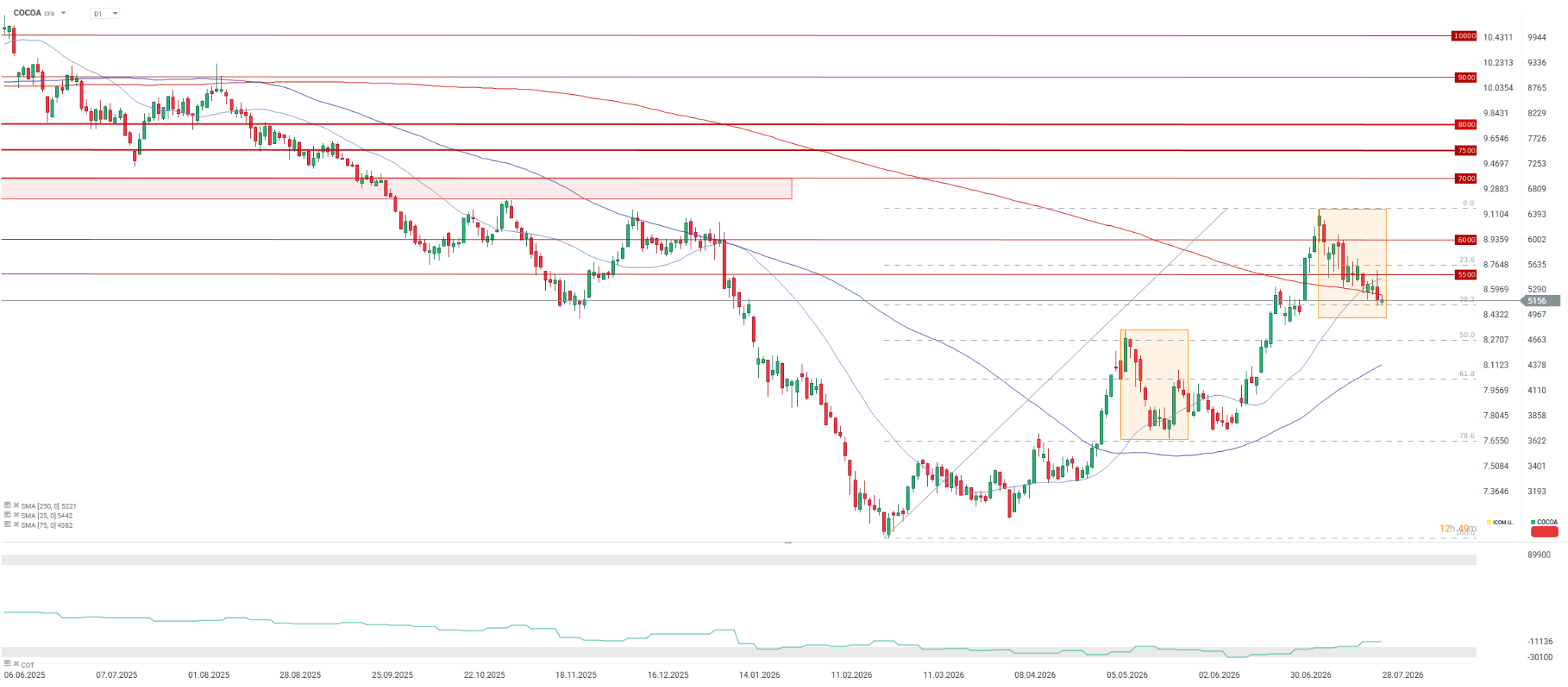
The price of cocoa has experienced a sharp drop to $5150 per tonne and is holding at the support related to the 38.2 retracement of the last upward wave and at the range of the largest correction in the current upward trend. However, the price is below the 25-period average and below the 250-period average. The key support is the area around 4700 at the 50.0 retracement. Source: xStation5
EUR/JPY could find primary resistance around the rising wedge top at 186.90.
The 14-day Relative Strength Index of 57.46 indicates moderate bullish momentum.
The primary support lies at the nine-day EMA of 186.01.
EUR/JPY holds ground after two days of losses, trading around 186.20 during the Asian hours on Tuesday. The currency cross is holding a bullish near-term bias as it trades above both the nine-period and 50-period Exponential Moving Averages (EMAs), keeping the broader uptrend supported.
The 14-day Relative Strength Index (RSI) at 57.46 leans to the bullish side without yet signaling overbought conditions, suggesting buyers still retain control while upside momentum remains moderate. However, the daily chart technical analysis shows that the EUR/JPY cross is remaining within a rising wedge, indicating a strong bearish reversal risk.
The EUR/JPY cross could rise toward the upper boundary of the rising wedge around 186.90. Further advances could support the currency cross to target the all-time high of 187.95, which was recorded on April 17.
On the downside, the initial support lies at the nine-day EMA of 186.01, followed by the lower boundary of the rising wedge around 185.50 and the 50-day EMA at 185.33. A break below this confluence support zone could cause a bearish emergence and put downward pressure on the EUR/JPY cross to navigate the region around the five-month low of 181.87, recorded on March 16, and the seven-month low of 180.81.
To provide the best experiences, we use technologies like cookies to store and/or access device information. Consenting to these technologies will allow us to process data such as browsing behavior or unique IDs on this site. Not consenting or withdrawing consent, may adversely affect certain features and functions.
Functional
Always active
The technical storage or access is strictly necessary for the legitimate purpose of enabling the use of a specific service explicitly requested by the subscriber or user, or for the sole purpose of carrying out the transmission of a communication over an electronic communications network.
Preferences
The technical storage or access is necessary for the legitimate purpose of storing preferences that are not requested by the subscriber or user.
Statistics
The technical storage or access that is used exclusively for statistical purposes.The technical storage or access that is used exclusively for anonymous statistical purposes. Without a subpoena, voluntary compliance on the part of your Internet Service Provider, or additional records from a third party, information stored or retrieved for this purpose alone cannot usually be used to identify you.
Marketing
The technical storage or access is required to create user profiles to send advertising, or to track the user on a website or across several websites for similar marketing purposes.