EUR/USD rebounds from daily lows, challenging 100-day SMA resistance.
Bullish RSI raises reversal risk after reclaiming 1.1500.
Break above 1.1629 exposes 1.1685 and 1.1700 next.
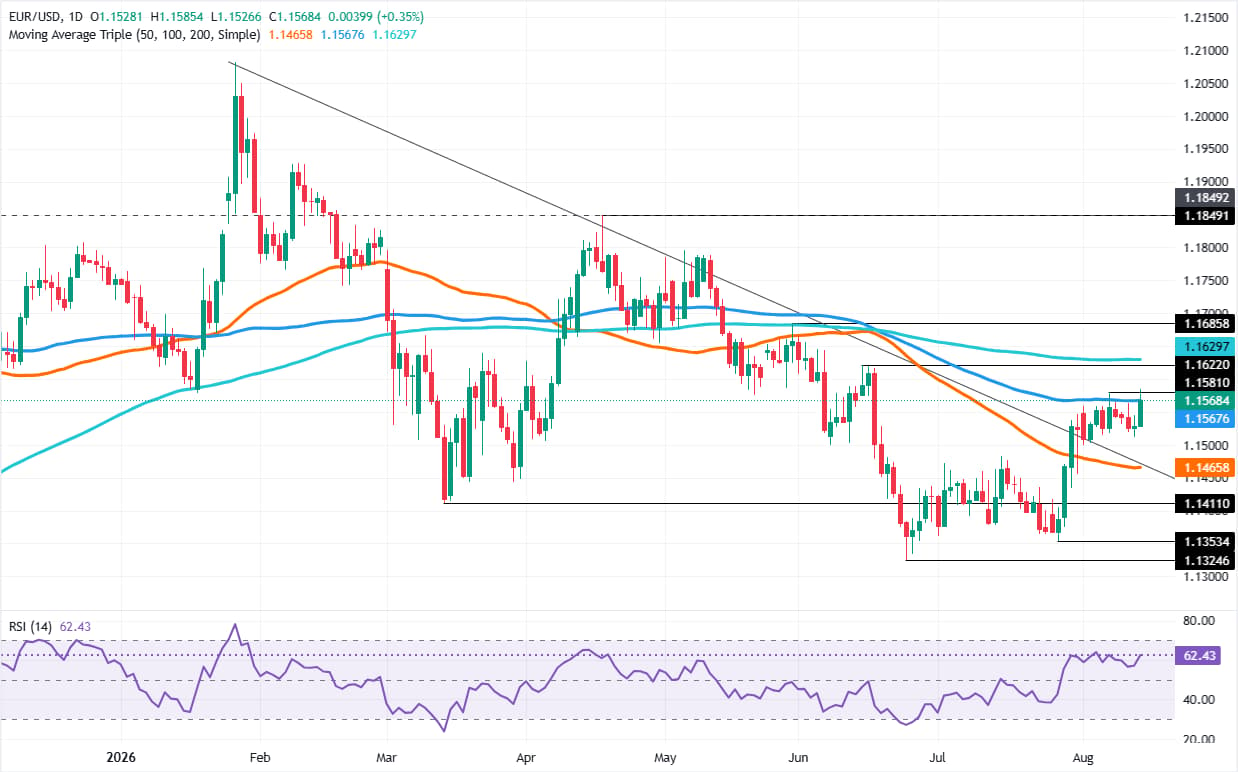
The EUR/USD pair registers gains of over 0.32% on Friday as traders face key resistance at the 100-day Simple Moving Average (SMA) at 1.1567, as bulls eye the 1.1600 psychological figure. At the time of writing, the pair trades at 1.1564 after bouncing off daily lows of 1.1526.
EUR/USD Price Forecast: Technical Outlook
The EUR/USD market structure suggests that the downtrend remains intact. The successive lower highs and lower lows have been respected, but since July 30, when the pair reclaimed the 1.1500 area, the risk of a bullish reversal has increased.
Although the pair topped around 1.1550-60, the Relative Strength Index (RSI) suggests bullish momentum is building. That said, EUR/USD might turn bullish if traders clear key resistance levels.
Upwards, the 200-day SMA at 1.1629 is the next area of interest. Once surpassed, the next cycle high pending is the May 29 high at 1.1685. If those two levels are removed, EUR/USD could be headed toward 1.1700, putting the April 17 high at 1.1849 into play ahead of the 1.1900 area.
On the flip side, if the shared currency drops below 1.1500, a move to the 50-day SMA at 1.1465 is on the cards. The next demand zone would be 1.1400.
USD/MXN rebounds from 16.97 as buyers defend 17.00.
Weak Retail Sales and sentiment deepen US Dollar pressure.
Banxico minutes and Mexico Retail Sales drive next catalysts.
USD/MXN refreshed 24-month lows below 17.00 on Friday, but it has recovered some ground, with buyers stepping in and reclaiming the 17.00 level. Data from the United States (US) weighed on the Greenback, as consumer sentiment and Retail Sales deteriorated. The pair trades at 17.02, after bouncing off daily lows of 16.97.
USD/MXN holds near two-year lows as traders price out Fed hikes
US data proved benign on the inflation front, with consumer and producer prices edging lower. The Nonfarm Payrolls reading on August 7 and jobless claims on Thursday paint a picture of ‘some’ softening, but give Federal Reserve officials no reason to say labor market risks are tilted to the upside.
On Friday, Retail Sales disappointed investors, contracting 0.6% MoM, below forecasts of a 0.1% expansion, and June’s 0.2%. The University of Michigan Consumer Sentiment preliminary reading in August showed some deterioration in sentiment among American households, as the Index dipped from 55.2 to 51, while inflation expectations remained little changed.
The backdrop prompted an aggressive pricing out for a Fed rate hike in 2026. For the September meeting, the odds are 32% for a hike and 68% for keeping interest rates steady.
In Mexico, Economy Secretary Marcelo Ebrard stated that Mexico is asking the US to eliminate or reduce tariffs on the automobile industry. He argued that vehicles made in Japan, South Korea, Germany, or Morocco pay a 15% tariff, while those in Mexico face a 25% tariff.
“So, give me a discount, because I buy more parts of the United States from you than the other countries, I just mentioned”, Ebrard said.
Next week, Mexico’s economic schedule will be busy, with investors eyeing the release of the Bank of Mexico’s (Banxico) last meeting minutes and Retail Sales data. In the US, the docket will feature housing data, the ADP Employment Change 4-week average, jobless claims and Flash PMIs.
USD/MXN Price Forecast: Technical outlook
USD/MXN daily chart
In the daily chart, USD/MXN trades near 17.0294, extending its slide beneath the clustered simple moving averages in the Moving Average Triple around 17.3775. Price action remains capped by the more recent descending resistance trend line, which comes in near 17.4197, while the Relative Strength Index (14) sits around 27 and drifts into oversold territory, hinting that bearish pressure is stretched but still dominant as long as the pair holds below these overhead barriers.
On the downside, the next notable structural floor aligns with the earlier downtrend break level around 15.6176, which acts as a distant but important support reference should the decline deepen. On the topside, a recovery would first need to reclaim the Moving Average Triple resistance near 17.3775, followed by a clearer break above the descending resistance trend line at 17.4197 to ease the bearish bias and open the way for a more sustained corrective rebound.
AUD/USD gains as weak Retail Sales pressure the Greenback.
Bullish RSI supports upside, but 0.7094 caps momentum.
Break above 0.7100 exposes 0.7190 and 0.7200 next.
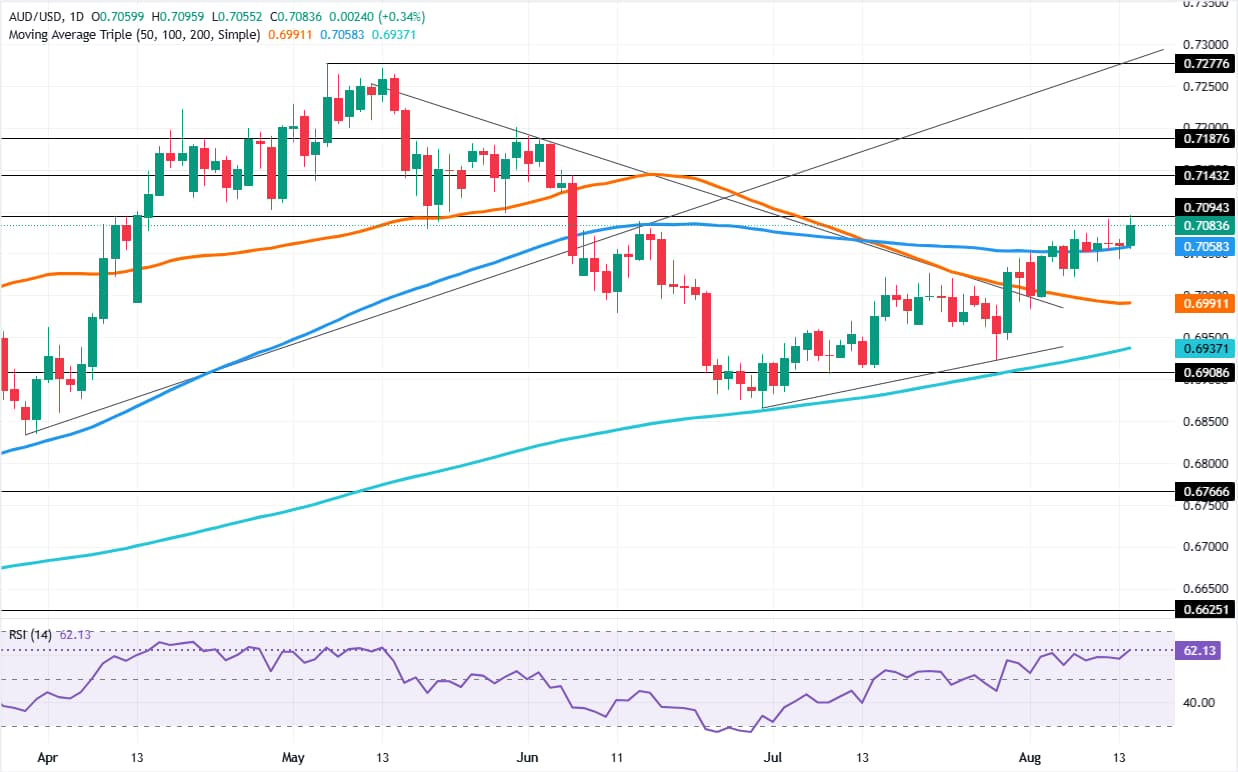
The Australian Dollar advanced on Friday after US Retail Sales disappointed investors, increasing speculation that the Federal Reserve might not raise rates, as the economy showed tentative signs of weakness. The AUD/USD trades at 0.7083, up 0.34%
AUD/USD Price Forecast: Technical outlook
The daily chart shows the AUD/USD is bullish, but buyers remain unable to decisively crack the January 29 high of 0.7094, which could open the door for further upside. Momentum shifted bullish since mid-July, as depicted in the Relative Strength Index (RSI).
From a market structure perspective, the pair has not shifted bullish until buyers regain the June 1 peak at 0.7190. Hence, the first AUD/USD resistance is 0.7100, followed by the latter. On further strength, the next stop is 0.7200.
On the downside, the 100-day Simple Moving Average (SMA) at 0.7058 is the first support. Once cleared, the 50-day SMA emerges as the next demand zone at 0.6991, followed by the 200-day SMA at 0.6937.
USD/CAD trades lower as the Canadian Dollar gains.
The US and Canada are close to reaching a deal before the tariff deadline.
Investors expect the Fed to leave policy rates unchanged again in September.
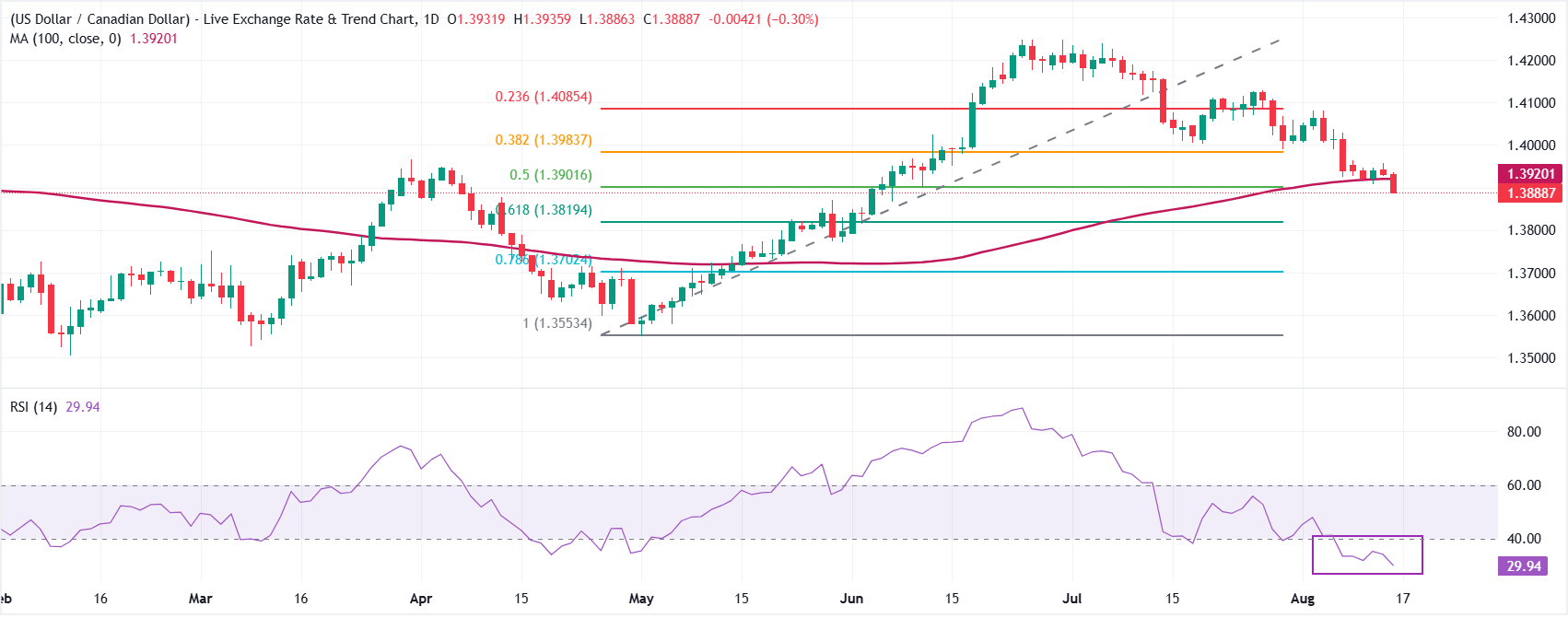
The Canadian Dollar (CAD) outperforms a majority of its currency peers on Friday, with the USD/CAD pair trading 0.32% lower at around 1.3888. The Canadian currency gains on hopes of a United States (US)-Canada interim deal.
A Canadian government source directly familiar with trade negotiations with the United States said on Thursday that talks were progressing well and Washington also wanted an agreement before a new US tariff deadline on August 19, Reuters reports.
Meanwhile, weakness in the US Dollar due to receding fears of a Federal Reserve (Fed) interest rate hike in the September meeting has also weighed on the Loonie pair. At press time, the US Dollar Index (DXY), which gauges the Greenback’s value against six major currencies, trades 0.23% lower to near 99.70.
Fed patience holds as US inflation trend improves but remains above target
Analysts at Wells Fargo observe that “inflation remains elevated, but the trend is improving,” noting that “while inflation remains above target, the recent upturn appears narrow rather than broad-based.” Against this backdrop, they judge that “the Fed remains stuck on hold,” with policymakers reluctant to shift policy until they see clearer evidence that price pressures are durably contained.
Commerzbank’s Bernd Weidensteiner similarly highlights that the inflation data for July “indicated only moderate inflationary pressure; consumer prices excluding food and energy rose by 0.2% from the previous month, while the year-over-year rate fell slightly to 2.5%.” He adds that, although this outcome was broadly in line with expectations, “these figures, combined with the unexpectedly weak jobs data, eased the pressure on the Fed to raise its key interest rates anytime soon.” Together, the banks’ commentary underscores a picture of gradually improving but still above-target US inflation, reinforcing the case for the Fed to remain on hold for now.
USD/CAD Technical Analysis
USD/CAD trades lower at around 1.3888, keeping a bearish near‑term tone as spot holds under the 100‑day simple moving average (SMA) at 1.3920 and the 50.0% Fibonacci retracement at 1.3902. The pair has retreated from recent highs toward the middle of the prior upswing range, while the Relative Strength Index (14) at 29.95 slips into oversold territory, hinting that downside momentum is stretched but not yet reversed.
On the topside, immediate resistance is located at the 50.0% retracement of the latest move at 1.3902, followed by the 100‑day SMA at 1.3920; a sustained break above this band would ease the current bearish pressure and expose the 38.2% level at 1.3984 and then the 23.6% retracement at 1.4085. On the downside, initial support is seen at the 61.8% Fibonacci retracement at 1.3819, ahead of the 78.6% level at 1.3702, while deeper losses would bring the structural swing low region near the 100.0% retracement at 1.3553 into focus.
British Pound picks up above 1.3500 against the US Dollar, after bouncing off lows at 1.3474 .
The US Dollar struggles on Friday as a run of soft inflation data has pushed back hopes of immediate Fed rate hikes.
Later today, the US Retail Sales and Michigan Consumer Sentiment Index data will provide further insight about the US economic outlook
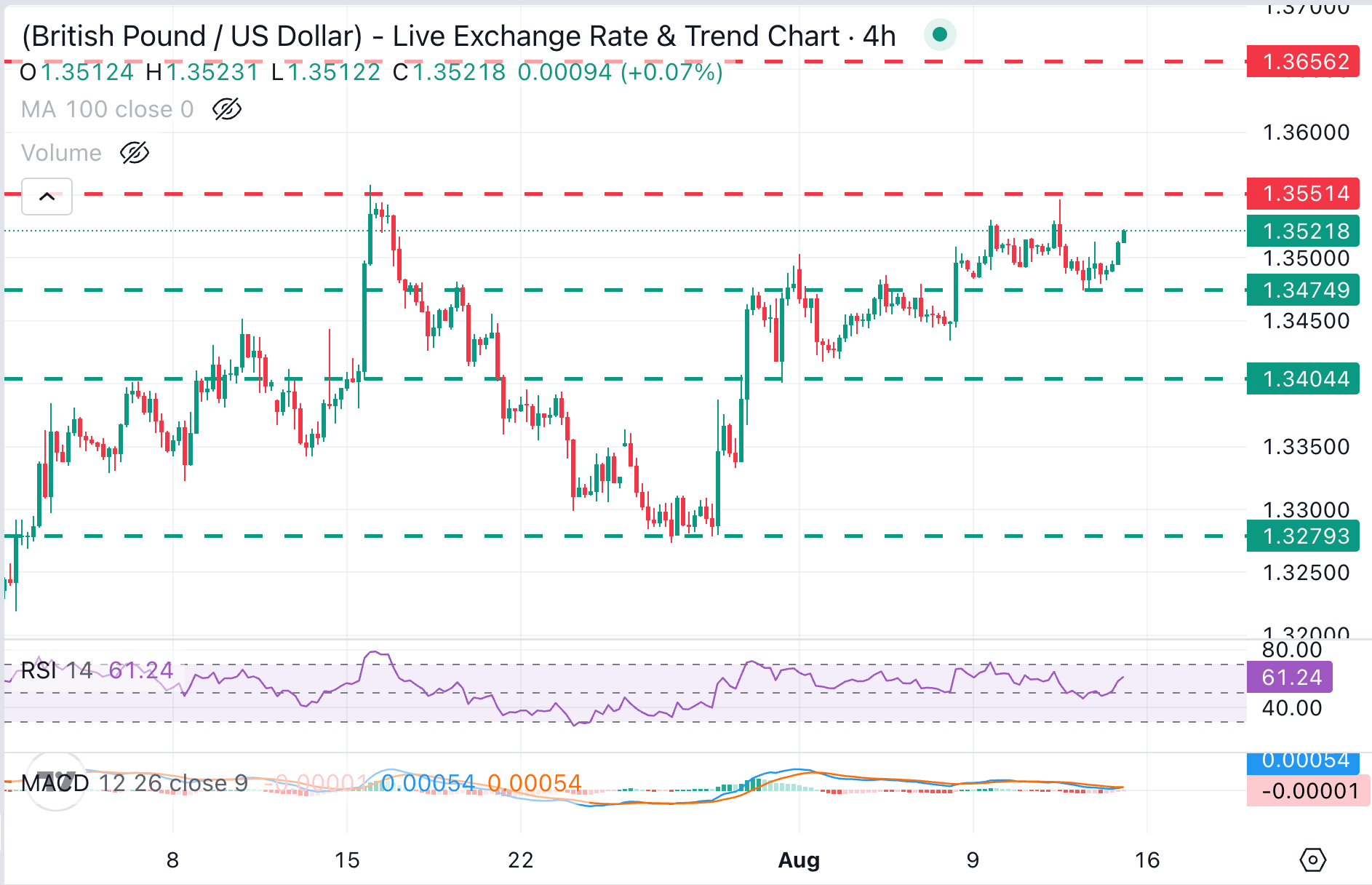
The British Pound (GBP) pares losses against a weaker US Dollar (USD) on Friday, as a run of soft US inflation figures and growing signs of labour market deterioration have cast doubt about the odds for an immediate Federal Reserve (Fed) rate hike. The GBP/USD has returned to the 1.3520 area from Thursday’s lows at 1.3474, inching towards a key resistance around 1.3550.
The focus on Friday is on the US Retail Sales, which are expected to show a 0.1% uptick in July, after a 0.2% gain in June, alongside the University of Michigan survey, which is foreseen to be little changed in August.
FX Strategists at ING state that these are “second-tier releases” that would “likely need to deliver significant surprises to trigger a meaningful dollar reaction,” reinforcing the sense that, absent a major data shock, the Dollar is unlikely to break decisively from its current, relatively stable trading pattern.
Technical Analysis: Key resistance is at the 1.3550 area
GBP/USD trades at 1.3520 at the time of writing, trapped within the weekly trading range, with key resistance area around 1.3550. Momentum indicators show an incipient bullish traction with the 4-hour Relative Strength Index (14) above 60, yet with the Moving Average Convergence Divergence (MACD) indicator flat near the zero line, which suggests that the move is far from impulsive.
Pound bulls would need to confirm above the July 15 and August 12 highs, around 1.3550, to resume their broader bullish trend, aiming for a retest of the early May highs in the mid-range of the 1.3600s.
Downside attempts, on the other hand, have been contained at Thursday’s low of 1.3474, ahead of the previous week’s trading bottom, just above 1.3400. Further down, there is no clear support until the July 27 low, at 1.3273.
Euro rises against the US Dollar to near 1.1550 amid hawkish ECB expectations.
Soft US inflation data has eased fears of a Fed interest rate hike.
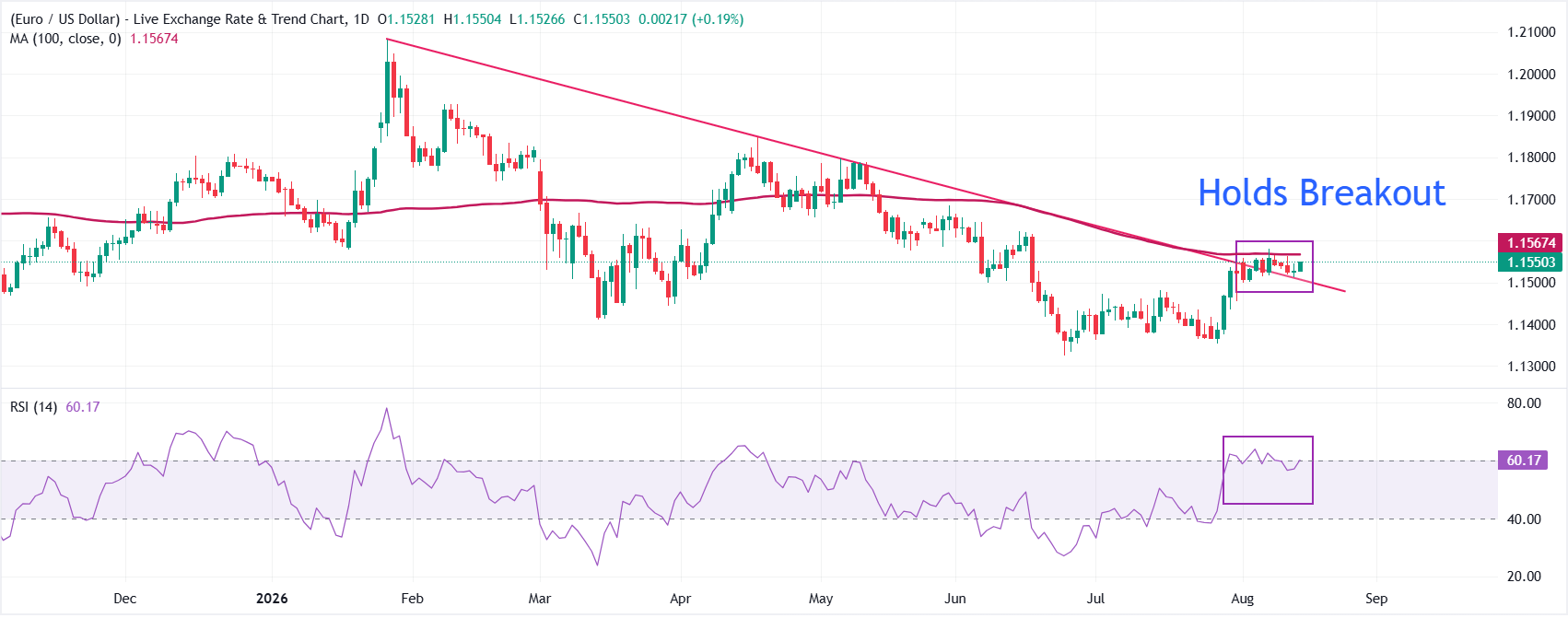
EUR/USD holds the downward-sloping trendline breakout.
The Euro (EUR) trades 0.17% higher at around 1.1550 against the US Dollar (USD) during the European trading session on Friday. The major currency pair gains as the Euro rises due to firm expectations that the European Central Bank (ECB) will raise interest rates in the policy meeting in September.
According to a Reuters poll, 57 of 69 economists said that they see the ECB hiking its deposit rates by 25 basis points (bps) to 2.50% in September.
Market experts also seem confident about the ECB tightening its monetary conditions in September to tame hot inflationary pressures.
ECB seen hiking again as other central banks face tougher choices
Analysts at HSBC highlight a growing divergence in the global policy outlook, noting that “although we expect the European Central Bank (ECB) to now deliver another rate rise in September, for other major central banks it is a much tougher balancing act.” The bank contrasts the ECB’s readiness to tighten further with a more cautious stance elsewhere, underscoring the challenge facing policymakers outside the Eurozone as they weigh inflation risks against the need to keep policy on hold.
Meanwhile, traders pricing out the possibility of an interest rate hike by the Federal Reserve (Fed) in September is dragging the US Dollar.
Fed hike odds slip as softer inflation data drives dovish repricing
Analysts at Deutsche Bank highlight that the softer inflation backdrop has prompted a notable dovish shift in Fed expectations, with “pricing for a September Fed hike fell to just 35% by the close, down from above 50% on the morning of Wednesday’s CPI release.” They add that the “downside PPI surprise led to an immediate reaction in pricing for the next Fed meeting,” noting that “the probability of a September hike had been at 40% right before the release, but was down to 35% by the close.”
EUR/USD Technical Analysis
EUR/USD trades at around 1.1550, holding the downward-sloping trendline at around 1.1540, but is capped by the 100-day simple moving average (SMA), which is at 1.1567.
The Relative Strength Index (14) around 60 hints at firm bullish momentum, but this improving sentiment is yet to overcome the overhead SMA that continues to act as a ceiling.
On the downside, initial support is seen near the former trend-line break point at 1.1510, where the market previously cleared a descending resistance line, now acting as a structural floor. On the topside, the 100-day SMA at 1.1567 forms the first resistance barrier, and a decisive close above this level would be needed to ease the current bearish bias and open the way to a more sustained recovery. Looking up, the major barricade of the pair would be the round-level at 1.1600.
The BOJ could raise interest rates as early as September, but for the yen, what the central bank does next may be even more important — Reuters sources suggest the entire rate-hike cycle could accelerate.
Markets are already reacting: investors are pricing in around an 80% probability of a September rate hike, while the yield on 5-year Japanese government bonds has reached a record high.
The yen remains close to 160 per U.S. dollar despite the earlier intervention, and the BOJ’s September meeting could prove to be a key test for the next move in USD/JPY.
USDJPY is edging lower today, partly due to a weaker U.S. dollar, although the yen also appears to be supported by reports from Reuters. According to three anonymous sources familiar with the Bank of Japan’s thinking, the BoJ could raise interest rates as early as September 2026. The central bank is also reportedly considering accelerating the pace of monetary tightening from its recent rate of around two hikes per year. The sources pointed to the possibility of a move at the September 17–18 meeting, although the BoJ has not commented on the reports. For the yen, this could represent an important shift in the narrative, as the market may need to consider not only another rate hike but also potentially shorter intervals between subsequent moves.
The BoJ’s policy rate currently stands at 1%, its highest level in 31 years, after the central bank left rates unchanged at its July meeting.
Markets are pricing in around an 80% probability of a September rate hike, while the yield on 5-year Japanese government bonds has risen to a record high.
The yen remains close to 160 per U.S. dollar despite the joint Japan-U.S. intervention in the FX market in July.
Why could the BoJ accelerate rate hikes?
The main argument in favor of faster monetary tightening is Japan’s increasingly uncomfortable inflation backdrop. Annual wholesale inflation remained around three-year highs in July, while surveys of inflation expectations among households, businesses and economists show readings approaching or exceeding 2%. The exchange rate is particularly important. A weak yen raises the cost of imported energy, commodities and other goods, potentially adding to inflationary pressure across the economy. In July, the Japanese currency fell to its weakest level in around 40 years, and the subsequent rebound was not enough to produce a lasting reversal. With oil prices also elevated, the weak yen has become increasingly relevant to the BoJ’s efforts to control inflation. A change in stance can also be seen in the central bank’s communication. The summary of opinions from the July meeting showed that some BoJ board members favored faster rate hikes to prevent monetary policy from falling behind inflation. Governor Kazuo Ueda has also indicated that the pace of tightening could be accelerated if financial conditions prove too accommodative.
What would faster rate hikes mean for the yen?
For the yen, the key issue is not necessarily a single September hike, but the potential change in the entire interest-rate path. Japan maintained extremely low borrowing costs for years while U.S. interest rates were considerably higher. This gap increased the attractiveness of strategies involving borrowing or funding positions in yen and investing in higher-yielding assets. If the BoJ does move from roughly two hikes per year toward more frequent tightening, the yield differential between Japanese and foreign assets could begin to narrow more quickly. The bond market suggests investors are already partially pricing in such a scenario: following the Reuters report, the yield on 2-year Japanese government bonds, which is particularly sensitive to BoJ policy expectations, moved higher, while the 5-year yield reached a record high. The prospect of higher Japanese interest rates does not automatically imply sustained yen appreciation. USDJPY also depends on U.S. Treasury yields, Federal Reserve policy, energy prices and global demand for the dollar. Elevated U.S. bond yields continue to provide the dollar with a relative advantage, while higher oil prices are unfavorable for Japan as a major energy importer. This also helps explain why the joint Japan-U.S. intervention in July failed to produce a lasting change in the exchange rate trend. Intervention can sharply alter short-term market dynamics, but on its own it may struggle to overcome interest-rate differentials and other macroeconomic forces. For the yen’s longer-term direction, the key question may therefore be whether a September hike — if it happens — would be an isolated move or the beginning of a faster BoJ tightening cycle.
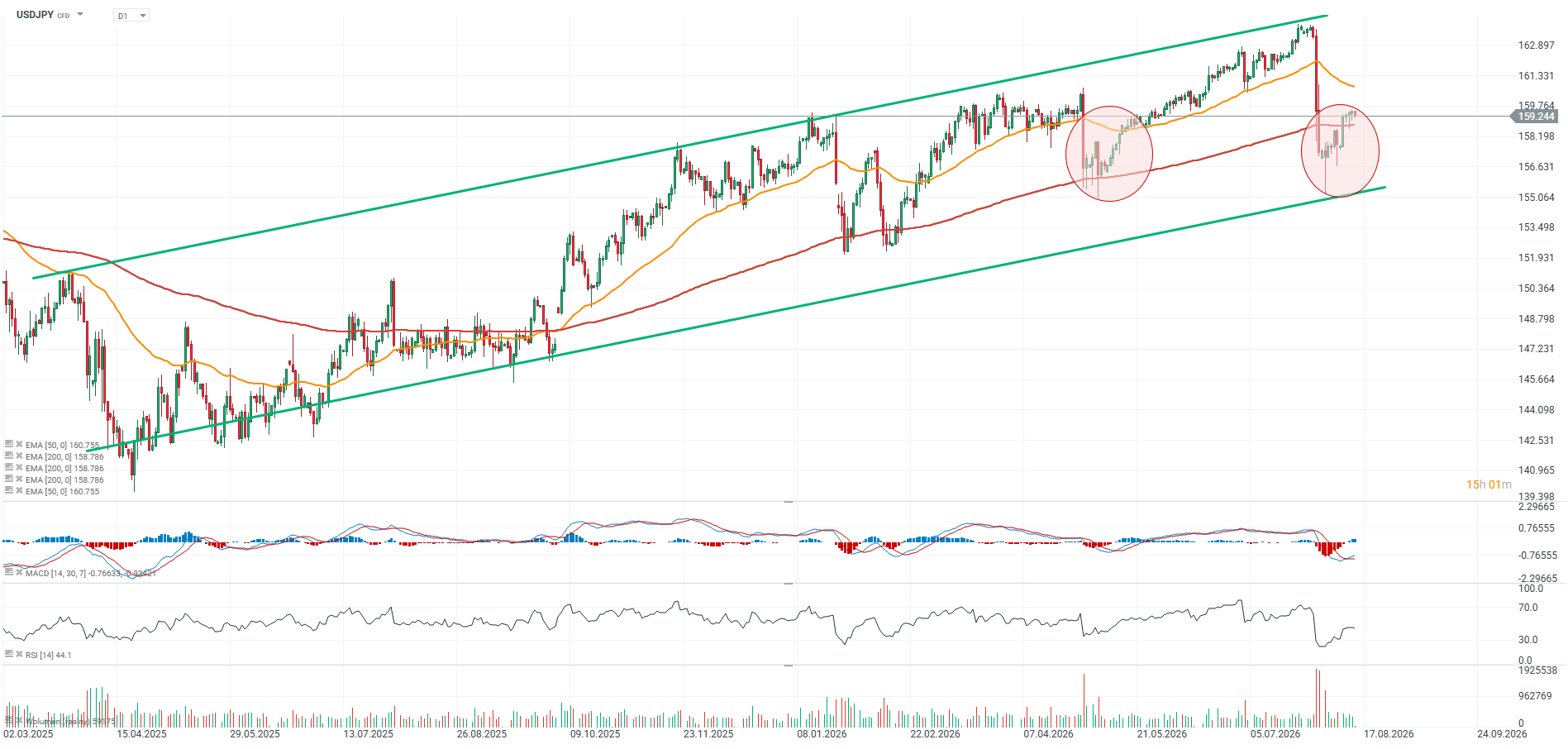
USDJPY chart (D1, H1)
The pair has recovered part of the losses triggered by the intervention, which does not represent a lasting mechanism for shaping free-market forces. USDJPY remains within an upward price channel, and as long as it stays above 155 and the 200-session exponential moving average (EMA200, red line, around 159), the broader uptrend remains the baseline scenario. A renewed decline toward 156 could increase the probability of a trend reversal and cannot be ruled out if the BoJ delivers a meaningful shift in monetary policy.
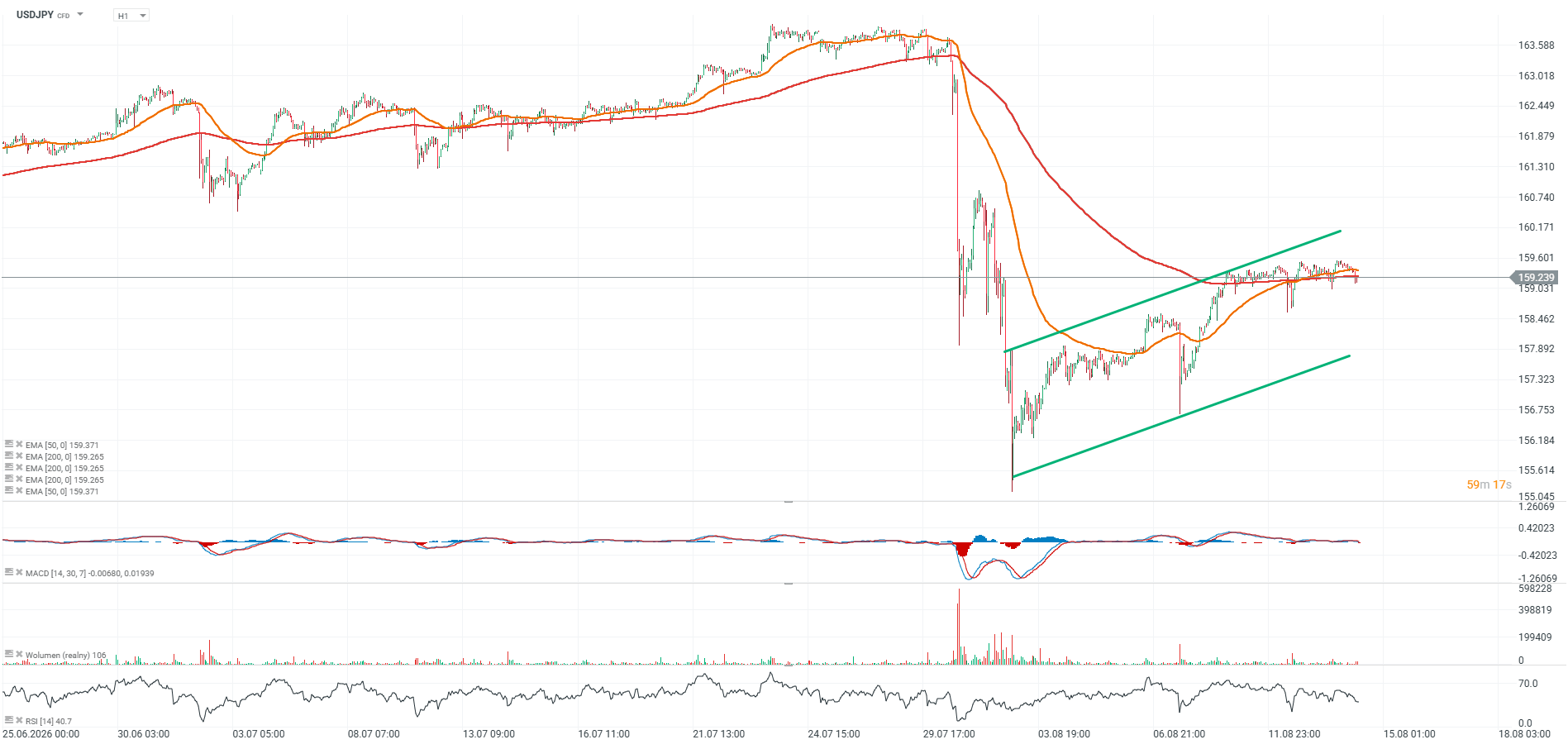
Source: xStation5 On the hourly timeframe, USDJPY remains within a short-term ascending channel. A break below its lower boundary could trigger a 1:1 correction and potentially push the pair toward the 150 area.
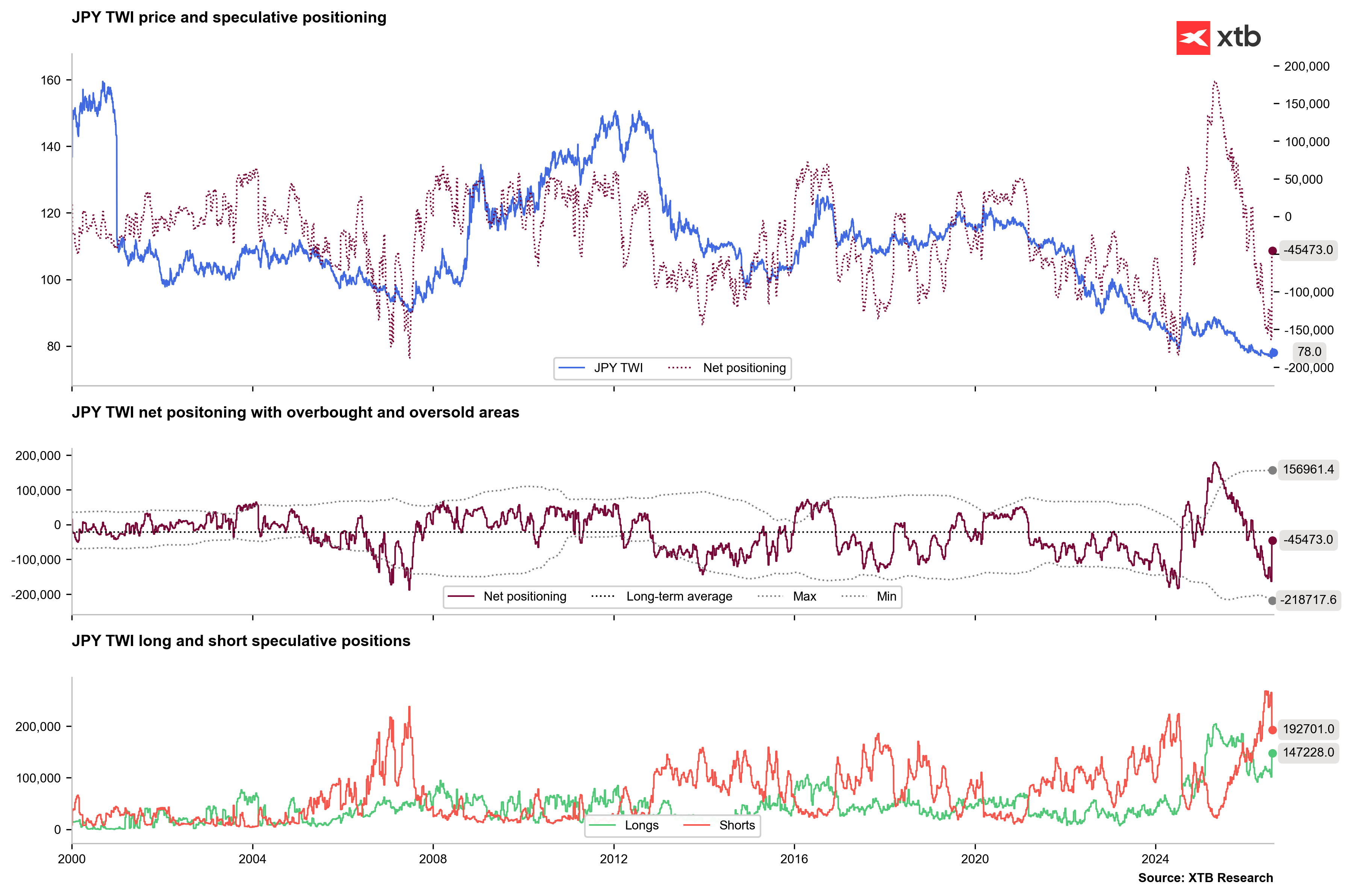
Source: xStation5 The chart of speculative positioning in yen futures shows a clear change following the latest interventions. Data released last Friday, covering positions as of the previous Tuesday, showed a rotation from net short to net long positioning. In the past, shifts of this magnitude have tended to provide additional support for the yen. The key question is what the latest positioning data, covering this Tuesday and due to be released today, will show.
EUR/USD builds on the overnight bounce from an over-one-week low amid a softer USD.
Signs of cooling US inflation further temper Fed hike bets and weigh on the Greenback.
Geopolitical risks should limit losses for the safe-haven buck and cap gains for the major.
The EUR/USD pair attracts some follow-through buyers during the Asian session on Friday and looks to build on the previous day’s modest bounce from the vicinity of the 1.1500 psychological mark, or an over one-week low. Spot prices, however, remain confined in a two-week-old range and currently trade below 1.1550 amid mixed cues.
The US Producer Price Index (PPI) report, released on Thursday, fell short of estimates, which, along with soft US Consumer Price Index (CPI), pointed to a slowdown in overall inflation. This gives the US Federal Reserve (Fed) room to hold interest rates steady, which keeps the US Dollar (USD) depressed below a two-week low, touched on Thursday, and lends some support to the EUR/USD pair.
The shared currency, on the other hand, draws support from growing acceptance that the European Central Bank (ECB) will deliver one final 25-basis-point (bps) rate hike at its September meeting as inflation remains above the 2% target. However, persistent geopolitical uncertainties could limit losses for the safe-haven buck and hold back bulls from placing aggressive bets on the EUR/USD pair.
In the latest developments, NATO fighter jets shot down a drone over Latvian airspace early Friday, while Finland imposed a temporary restriction on aviation and maritime traffic in the eastern Gulf of Finland. Adding to this, Reuters reported that Russia downed 15 drones near its border with Finland and Estonia overnight, marking a fresh escalation in an over six-year-old Russia-Ukraine conflict.
Furthermore, traders continue to price in the war-risk premium on the back of the US-Iran standoff over the Strait of Hormuz. Adding to this, the Iran-backed Houthis in Yemen escalated attacks on vessels in the Red Sea and Bab el-Mandeb Strait, and also claimed a drone strike on a Saudi Aramco refinery, raising the risk of a broader regional conflict. This favors USD bulls and should cap the EUR/USD pair.
EUR/USD 4-hour chart
Technical Analysis
The EUR/USD pair maintains a modest bullish near-term bias above the 200-period Exponential Moving Average (EMA) on the 4-hour chart. That said, a breakout through a two-week-old trading range hurdle near 1.1565 is needed to back further gains. On the downside, immediate support aligns with the lower boundary of the range near 1.1500, with stronger underlying demand seen at the 200-period EMA around 1.1489. The latter reinforces the broader floor for the pair on this timeframe.
To provide the best experiences, we use technologies like cookies to store and/or access device information. Consenting to these technologies will allow us to process data such as browsing behavior or unique IDs on this site. Not consenting or withdrawing consent, may adversely affect certain features and functions.
Functional
Always active
The technical storage or access is strictly necessary for the legitimate purpose of enabling the use of a specific service explicitly requested by the subscriber or user, or for the sole purpose of carrying out the transmission of a communication over an electronic communications network.
Preferences
The technical storage or access is necessary for the legitimate purpose of storing preferences that are not requested by the subscriber or user.
Statistics
The technical storage or access that is used exclusively for statistical purposes.The technical storage or access that is used exclusively for anonymous statistical purposes. Without a subpoena, voluntary compliance on the part of your Internet Service Provider, or additional records from a third party, information stored or retrieved for this purpose alone cannot usually be used to identify you.
Marketing
The technical storage or access is required to create user profiles to send advertising, or to track the user on a website or across several websites for similar marketing purposes.