


Chart of The Day – EUR/USD Deepens Decline. What’s Next For The Pair?
The U.S. dollar has strengthened significantly in recent days, and hawkish revisions to Federal Reserve projections have become the primary catalyst behind the decline in the world’s most important currency pair. Notably, EUR/USD has continued to fall even though the European Central Bank recently delivered a 25-basis-point rate hike.
This suggests that the move is being driven by more than just interest-rate expectations. Investors are increasingly focused on the divergence between the U.S. and eurozone economies. In the United States, key indicators such as ISM surveys, PMI data, and Nonfarm Payrolls continue to point to relatively solid economic growth. By contrast, the eurozone appears stuck in what could be described as “stable stagnation.” Across Europe, risks remain tilted to the downside due to ongoing disruptions in energy markets and persistent weakness in manufacturing, which remains an important contributor to regional growth.
Today German Ifo Business Climate data at 9 AM GMT can move the pair.
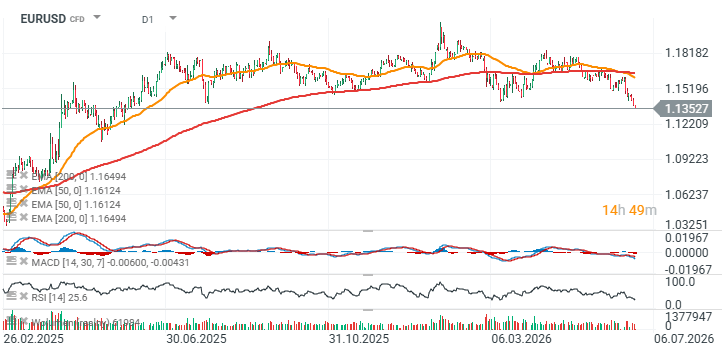
EUR/USD Chart (D1, H1) EUR/USD has fallen toward the 1.135 area, signaling a reversal into a bearish trend. The pair is now trading significantly below the 200-day exponential moving average (EMA200, red line), which is located near 1.16 and reinforced by several important historical price reactions. The pair has now posted nearly five consecutive losing sessions, with the biggest catalyst for the selloff being the Federal Reserve’s shift toward a more hawkish policy outlook.
Source: xStation5
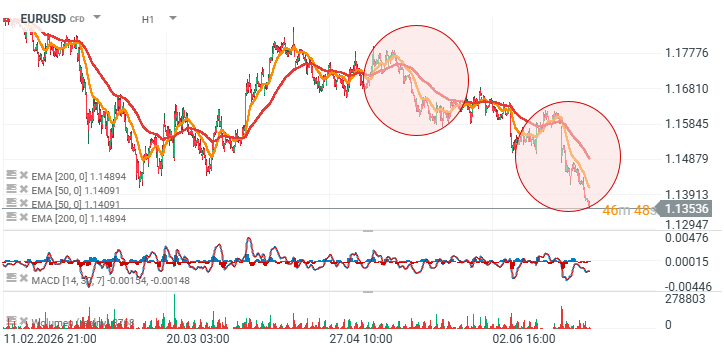
Looking at the hourly timeframe, EUR/USD is currently mirroring the previous correction almost point for point. The key question is whether the strong downside momentum is beginning to fade. If selling pressure starts to ease around current levels, the decline could slow and allow for a rebound toward 1.14, where the 50-period exponential moving average (EMA50, orange line) is currently located.
Source: xStation5

EUR/GBP Price – Testing 10-month lows at 0.8611 in risk-off markets
- EUR/GBP depreciates 0.6% so far this week to test 10-month lows in the 0.8610 area.
- A tech rout in stock markets and frictions in the US-Iran peace deal are weighing on risk appetite on Wednesday.
- Momentum indicators suggest that upside attempts are likely to find sellers.
The Euro (EUR) extends losses for the fourth consecutive day against the British Pound (GBP) on Wednesday. The EUR/GBP pair has lost about 0.6% so far this week and is testing the 0.8610 area at the time of writing, its lowest level in the last 10 months.
The Pound sterling seems to be faring better than the Euro amid the risk-off market mood. Stock markets in Asia and the US have been dragged down by sharp declines in tech shares, as investors take profits after a long AI rally, while frictions between the US and Iran regarding nuclear inspections have cast a shadow over the outcome of the peace deal.
On the macroeconomic front, the Bank of England’s (BoE) official, Alan Taylor, stated on Tuesday that an extended hold is the right response to the increase in price pressures and that the bank should be ready to cut rates if a benign scenario plays out. In the Eurozone, the focus on Wednesday will be on German ZEW Business Climate data, which is expected to show a minor improvement in June.
Technical Analysis: Euro remains under significant bearish pressure
EUR/GBP trades at 0.8615 with a bearish near-term tone, holding a few pips above the lows of March 2026 and August 2025, with momentum indicators in most timeframes highlighting strong negative pressure. The 4-hour Relative Strength Index (14) sits just above oversold levels, while the Moving Average Convergence Divergence (MACD) remains slightly negative.
A confirmation below the mentioned 0.8611 would expose the August 2025 bottom, at 0.8595, and the 161.8% Fibonacci extension of Monday’s sell-off, at the 0.8585 area. On the topside, initial resistance appears at Tuesday’s highs of 0.8634, followed by the June 19 low, at 0.8657. A break above these would open the way toward the June 18 and 21 highs, around 8.8680.
(The technical analysis of this story was written with the help of an AI tool.)
Pound Sterling Price Today
The table below shows the percentage change of British Pound (GBP) against listed major currencies today. British Pound was the strongest against the Swiss Franc.
| USD | EUR | GBP | JPY | CAD | AUD | NZD | CHF | |
|---|---|---|---|---|---|---|---|---|
| USD | 0.14% | 0.08% | 0.06% | 0.09% | 0.08% | 0.24% | 0.22% | |
| EUR | -0.14% | -0.06% | -0.07% | -0.06% | -0.06% | 0.06% | 0.09% | |
| GBP | -0.08% | 0.06% | -0.04% | -0.02% | 0.00% | 0.12% | 0.14% | |
| JPY | -0.06% | 0.07% | 0.04% | 0.02% | 0.00% | 0.13% | 0.15% | |
| CAD | -0.09% | 0.06% | 0.02% | -0.02% | -0.01% | 0.10% | 0.15% | |
| AUD | -0.08% | 0.06% | -0.00% | -0.01% | 0.00% | 0.12% | 0.13% | |
| NZD | -0.24% | -0.06% | -0.12% | -0.13% | -0.10% | -0.12% | 0.02% | |
| CHF | -0.22% | -0.09% | -0.14% | -0.15% | -0.15% | -0.13% | -0.02% |
The heat map shows percentage changes of major currencies against each other. The base currency is picked from the left column, while the quote currency is picked from the top row. For example, if you pick the British Pound from the left column and move along the horizontal line to the US Dollar, the percentage change displayed in the box will represent GBP (base)/USD (quote).
Euro: Test of 1.140 seen before recovery against US Dollar – ING
ING’s Francesco Pesole sees a decent risk that EUR/USD will need to test 1.140 as lingering post-Fed Dollar momentum plays out before any renewed upward pattern. He argues that positive US-Iran headlines and improved Eurozone terms of trade should limit downside, while upcoming confidence data and Purchasing Managers’ Index (PMI) are not expected to be major drivers for EUR/USD.
Euro faces 1.140 test risk
“In line with our USD view above, we see a decent risk that EUR/USD will have to test 1.140 on the back of a long tail of post-Fed USD momentum before re-entering any upward pattern.”
“At the same time, positive headlines from the US-Iran negotiations suggest the depth of the next leg lower should be more limited; the commodity terms of trade for the eurozone have recovered more than half of the initial war-related drop.”
“On the data side, we’ll see eurozone confidence data and PMIs today and tomorrow. Still, the surveys may not yet reflect the interim peace deal and could still signal a less optimistic mood.”
“We don’t expect those to be a key driver of EUR/USD, which remains very heavily dominated by the USD leg
Chart of The Day – What’s Next for EUR/USD
EUR/USD: The dollar takes centre stage — geopolitics, the Fed and the ECB are driving the pair EUR/USD has come under strong selling pressure, testing key support around 1.1440–1.1420 — a level clearly visible on the chart as a broad, horizontal zone of demand, which has repeatedly halted sell-offs over recent months.
Geopolitics: the US–Iran relationship and the Strait of Hormuz
Today, 22 June, technical talks are taking place in Switzerland between the US, Iran, Pakistan and Qatar, and both sides have agreed on a ‘roadmap’ to finalise the agreement within 60 days. However, tensions remain due to the fact that Iran has once again closed the Strait of Hormuz just before the talks began, and Trump is not backing down from his threats to resume attacks — this is fuelling volatility in the energy markets and limiting the euro’s appreciation. Geopolitical de-escalation is, in theory, a tailwind for the euro (capital outflows from safe-haven assets such as the USD), but until the negotiations are concluded, it will be difficult to weaken the dollar on a sustained basis.
Fed: Are we expecting rate hikes?
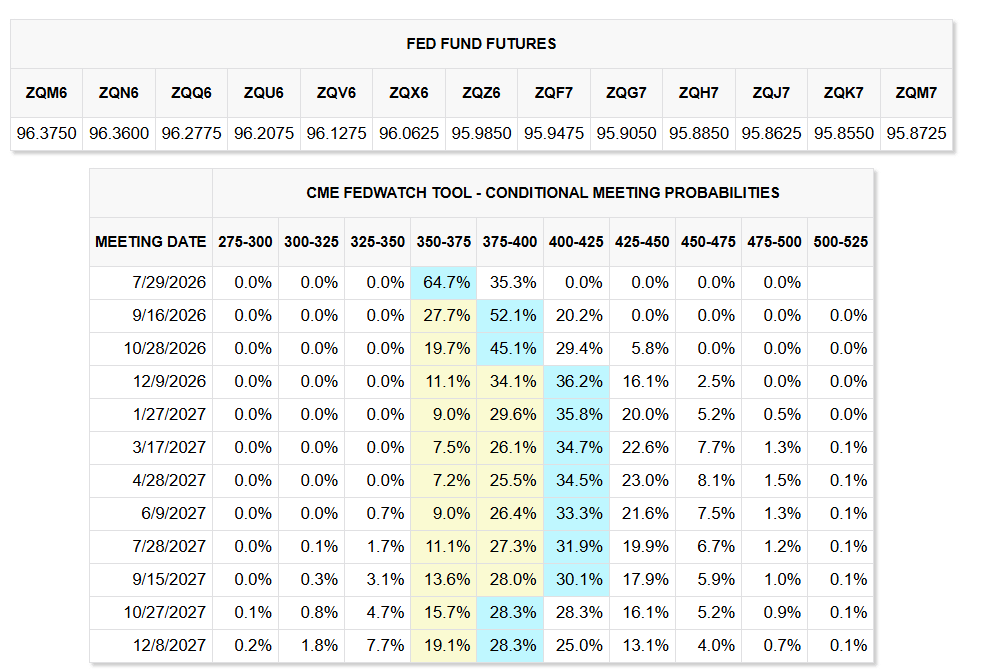
The Fed Fund Futures table and the CME FedWatch Tool clearly show how expectations have evolved. For the upcoming meeting on 29 July 2026 the market is pricing in a 64.7% probability that rates will remain in the 350–375 bps range, whilst the chances of a rise to 375–400 bps stand at 35.3%. At its meeting on 16–17 June 2026 — the first chaired by the new Fed chair, Kevin Warsch — the FOMC unanimously kept rates at 3.50–3.75% , leaving them unchanged for the fourth consecutive time. However, this is not the main news. The key message comes from the new dot-plot projections: 9 out of 18 Fed officials now expect at least one rate hike in 2026, whilst 6 of them anticipate two or more hikes — this is a dramatic shift from March, when none of the committee members had forecast any rises.
The media projection for the interest rate at the end of 2026 now stands at 3.8% — 0.16 percentage points above the current level — which the market interprets as a clear shift towards tightening. Inflationary pressure, fuelled by a surge in oil prices resulting from the US–Iran conflict, has forced the Fed to revise its stance: almost half of the FOMC does not believe that simply maintaining interest rates will be sufficient to bring inflation down to the 2% target.
Derivatives markets are already pricing in ~60% chance of at least one rate rise before the end of the year , with the highest probability at the September or October meeting. This is fundamentally a bullish environment for the dollar — and directly explains the pressure on EUR/USD visible on the chart. The prospect of higher US interest rates, coupled with divergence from the ECB (deposit rate of 2.25%), is widening the yield spread in favour of the USD. The Fed Funds Futures table confirms this picture: from the December 2026 meeting onwards, the probability of rates in the 400–425 bps range is increasing, which means that the market is gradually pricing in a cycle of rate rises — not cuts.
ECB: The rate rise is a backdrop, not a catalyst
On 11 June, the ECB raised the deposit rate by 25 basis points to 2.25% — in line with expectations. The bank also raised its inflation forecast for 2026 to 3.0% from the previous 2.6%. However, this move had already been fully priced in by the market and does not provide direct support for the EUR — as can be seen in the chart, where the pair continues to weaken despite the rate rise. The interest rate differential between the Fed (4.25–4.50 per cent) and the ECB (2.25 per cent) continues to strongly favour the dollar, and the ECB’s rate rise alone does not alter this arithmetic to a sufficient extent.
What can be seen on the EUR/USD D1 chart
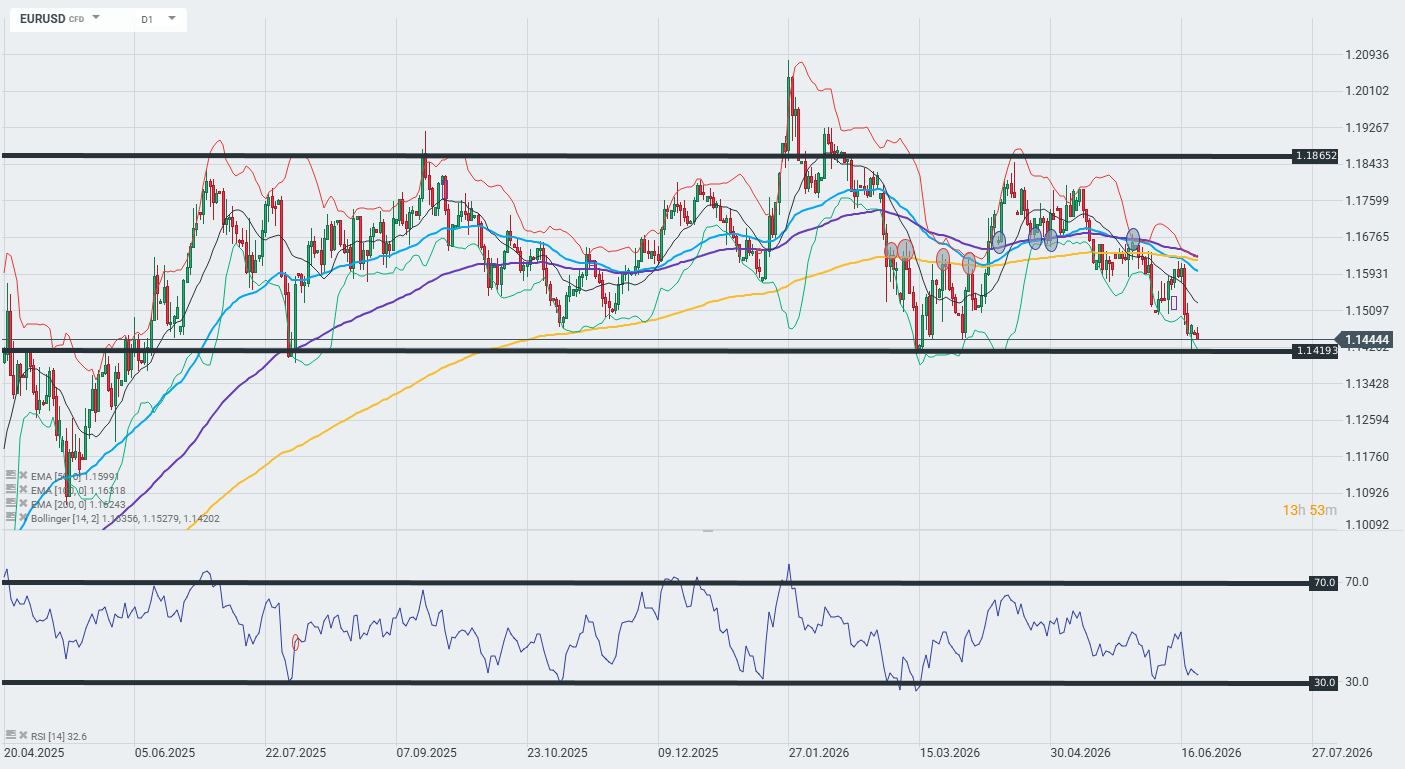
The EUR/USD daily chart shows the pair testing critical support at ~1.1420–1.1444 — a level that has been defended several times by the bulls since spring 2025. The RSI(14) at 32.6 is close to the oversold zone (the 30 threshold), signalling a potential technical rebound. However, the moving average configuration is bearish: the price has broken below the EMA50 (1.1599) and the EMA100 (1.1682) and is approaching the EMA200 (1.1824) from below — all three moving averages above the price are forming dynamic resistance. The Bollinger Bands indicate the lower band at 1.1420, which coincides with the support zone.
Outlook for the coming days:
If the 1.1420 support level holds and US–Iran talks confirm progress, the RSI may rebound and the pair could move back towards 1.15–1.16. A break below 1.1420 would pave the way for a test of 1.13+. As long as the Fed remains ‘hawkish-cautious’ and negotiations on the Middle East front remain volatile, any rebound in the EUR is likely to be short-lived.
Euro edges higher against British Pound amid UK political uncertainty
- EUR/GBP edges higher to near 0.8670 in Monday’s early European session.
- UK PM Starmer was considering his political future after rival Andy Burnham’s decisive election victory in parliament.
- UK Retail Sales climbed 3.2% YOY in May, beating expectations.
The EUR/GBP cross gathers strength to around 0.8670 during the early European trading hours on Monday. The British Pound (GBP) weakens against the Euro (EUR) due to political uncertainty in the United Kingdom (UK). European Central Bank (ECB) President Christine Lagarde is scheduled to speak later in the day. The preliminary readings of Purchasing Managers Index (PMI) from Germany, the Eurozone, and the UK will be highlighted later on Tuesday.
UK Prime Minister Sir Keir Starmer is expected to resign to make way for a new leader. It came as cabinet ally Peter Kyle said the UK leader was considering “political realities” after Andy Burnham’s victory in the Makerfield by-election last week cleared a path for him to challenge for the Labour leadership.
“Markets will be focused on Burnham’s views on fiscal policy and whether there will be any relaxation of the current fiscal rules,” said Commonwealth Bank of Australia strategists, including Kristina Clifton. “A loosening in fiscal rules would likely be poorly received by the UK bond market” and weigh on the pound, they said.
Nonetheless, hotter-than-expected UK Retail Sales data might cap the downside for the GBP. UK Retail sales rose 3.2% year-on-year in May, versus 0.1% prior, the Office for National Statistics (ONS) showed on Friday. This figure beat market expectations of a 1.9% annual increase. On a monthly basis, Retail sales increased 1.2% in May, following a revised 1% decline in April.
Euro strengthens against Canadian Dollar as oil prices decline
- EUR/CAD rises as the commodity-linked Canadian Dollar weakens following a drop in crude prices triggered by successful US-Iran talks.
- Qatar and Pakistan agreed to a 60-day roadmap to secure a final peace agreement, per a joint statement.
- Traders closely await ECB President Lagarde’s highly anticipated speech later on Monday for potential monetary policy clues.
EUR/CAD extends its gains for the second successive day, trading around 1.6260 during the Asian hours on Monday. The currency cross appreciates as the commodity-linked Canadian Dollar (CAD) loses ground amid lower oil prices, given Canada’s status of the largest crude exporter to the United States (US).
West Texas Intermediate (WTI) oil price declines nearly 2%, trading around $75.00 per barrel at the time of writing. Crude oil prices depreciated following the successful conclusion of US-Iran talks in Switzerland, effectively easing global market anxieties regarding a potential supply shortage. A key driver of this market relief was Tehran’s announcement that it had successfully secured critical waivers for its oil and petrochemical exports.
Complementing the diplomatic breakthrough, mediators Qatar and Pakistan released a joint statement from Switzerland confirming that both nations have agreed to a formal, structured roadmap aimed at securing a final peace agreement within the next 60 days.
Providing further details on the negotiations, Iranian Foreign Minister Abbas Araqchi confirmed that the diplomatic progress yielded several major concessions for his country. In addition to the vital export waivers for oil and petrochemicals, the agreed-upon terms include the release of a portion of Iran’s frozen financial assets, alongside the official launch of a comprehensive domestic reconstruction and development plan.
On the macroeconomic front, European Central Bank (ECB) policymaker and Belgian central bank head Pierre Wunsch indicated on Friday that the central bank may implement one more interest rate hike as early as next month. This potential monetary tightening depends on whether the ECB observes further evidence of Eurozone inflation spreading beyond the energy sector into the broader economy. Market participants are now closely watching ECB President Christine Lagarde, who is scheduled to deliver a highly anticipated speech later in the day.
Euro Price Today
The table below shows the percentage change of Euro (EUR) against listed major currencies today. Euro was the strongest against the Canadian Dollar.
| USD | EUR | GBP | JPY | CAD | AUD | NZD | CHF | |
|---|---|---|---|---|---|---|---|---|
| USD | 0.15% | 0.24% | 0.23% | 0.25% | 0.13% | 0.18% | 0.11% | |
| EUR | -0.15% | 0.09% | 0.07% | 0.09% | 0.03% | 0.06% | -0.03% | |
| GBP | -0.24% | -0.09% | -0.02% | -0.00% | -0.07% | -0.03% | -0.11% | |
| JPY | -0.23% | -0.07% | 0.02% | 0.02% | -0.09% | -0.05% | -0.10% | |
| CAD | -0.25% | -0.09% | 0.00% | -0.02% | -0.12% | -0.09% | -0.12% | |
| AUD | -0.13% | -0.03% | 0.07% | 0.09% | 0.12% | 0.06% | -0.02% | |
| NZD | -0.18% | -0.06% | 0.03% | 0.05% | 0.09% | -0.06% | -0.06% | |
| CHF | -0.11% | 0.03% | 0.11% | 0.10% | 0.12% | 0.02% | 0.06% |
The heat map shows percentage changes of major currencies against each other. The base currency is picked from the left column, while the quote currency is picked from the top row. For example, if you pick the Euro from the left column and move along the horizontal line to the US Dollar, the percentage change displayed in the box will represent EUR (base)/USD (quote).
Euro: Consolidation before potential slide against US Dollar – UOB
United Overseas Bank’s (UOB) Quek Ser Leang and Lee Sue Ann highlight that EUR/USD remains under pressure after briefly dipping to 1.1416 before rebounding. They see scope for short-term consolidation between 1.1435 and 1.1495 as oversold conditions unwind, but maintain a bearish bias toward 1.1410, and warn that a break of the 1.1390/1.1410 support zone could open the way to 1.1210.
Oversold Euro pauses within range
“24-HOUR VIEW: When EUR was at 1.1460 in the early Asian session last Friday, we indicated that “conditions are deeply oversold, but there is scope for EUR to drop below the support at 1.1445.” However, we held the view that “the major support at 1.1410 is unlikely to come under threat.” EUR subsequently dropped to a low of 1.1416, rebounding to close at 1.1468 (+0.10%). Downward momentum is slowing, and conditions are unwinding from oversold levels. In other words, instead of continuing to decline, EUR is more likely to consolidate today, probably between 1.1435 and 1.1495”
“1-3 WEEKS VIEW: Last Thursday (18 Jun, spot at 1.1505), we highlighted that while EUR “is expected to remain under pressure, but it may need some time to consolidate before making a move to 1.1445.” After EUR dropped to 1.1450, we highlighted on Friday (19 Jun, spot at 1.1460) that “a breach of 1.1445 will not be surprising, and the next technical target is 1.1410.” EUR subsequently declined to a low of 1.1416 before rebounding. While there is still scope for EUR to decline to 1.1410, oversold short-term conditions could lead to 1-2 days of consolidation first. Overall,