

GBP/USD depreciates as the US Dollar strengthens on increased risk aversion linked to geopolitical tensions.
President Trump said Iran’s ceasefire proposal was “not good enough” ahead of his Hormuz Strait deadline.
BoE policymakers shifted to holding policy rates amid rising energy costs from the Middle East conflict.
GBP/USD pares its recent gains from the previous day, trading around 1.3220 during the Asian hours on Tuesday. The pair depreciates as the US Dollar (USD) gains ground amid increased risk aversion, which could be attributed to the Middle East peace truce uncertainty.
US President Donald Trump said on Monday that the latest proposal for a US ceasefire with Iran is “not good enough” ahead of his deadline for Iran to either reopen the Strait of Hormuz. “It’s not good enough, but it’s a very significant step,” Trump said, adding, “They’re negotiating now, and they’ve made a very significant step. We’ll see what happens.”
Traders keep a close watch on US President Donald Trump’s deadline concerning the Strait of Hormuz. Trump warned that he could target Iranian power plants and bridges unless his demands are met by 8 p.m. Eastern Time.
The Institute for Supply Management (ISM) showed on Monday that the US Services PMI eased to 54.0 in March from 56.1 in February. The figure came in below expectations of 55.0, signaling a slight loss of momentum in the sector.
The Bank of England (BoE) policymakers, including Sarah Breeden and Swati Dhingra, shifted from supporting cuts to holding rates amid rising energy costs linked to the Middle East conflict, while warning CPI inflation could rise to 3%–3.5% in the coming quarters.
EUR/USD edges lower to near 1.1530 while investors remain uncertain over Iran’s final decision to the US proposal.
Iran calls on US President Trump to surrender or his allies will return to the Paleolithic Age.
The US FOMC minutes of the March policy meeting will be released on Wednesday.
The EUR/USD pair ticks marginally lower around 1.1530 during the Asian trading session on Tuesday, but is broadly sideways, wobbling inside Monday’s trading range. The major currency pair consolidates while investors await Iran’s final decision on the ceasefire proposal by the United States (US), which has a deadline of Tuesday, 08:00 PM ET.
As of writing, the US Dollar Index (DXY), which tracks the Greenback’s value against six major currencies, trades slightly higher to near 100.10.
Ahead of US President Donald Trump’s deadline, an advisor to Iran’s Parliament Speaker Mohammad Bagher Ghalibaf has stated that Trump has about 20 hours to either surrender to Iran or his allies will return to the Paleolithic Age, emphasizing that Tehran will not back down. He called Trump’s threats “delusional” and added that they won’t make up for the “disgrace and humiliation” of the US in the region.
On the domestic front, investors await the release of the Federal Open Market Committee (FOMC) minutes of the March policy meeting, which will be released on Wednesday. In the meeting, the Fed left interest rates unchanged in the range of 3.50%-3.75%.
EUR/USD technical analysis
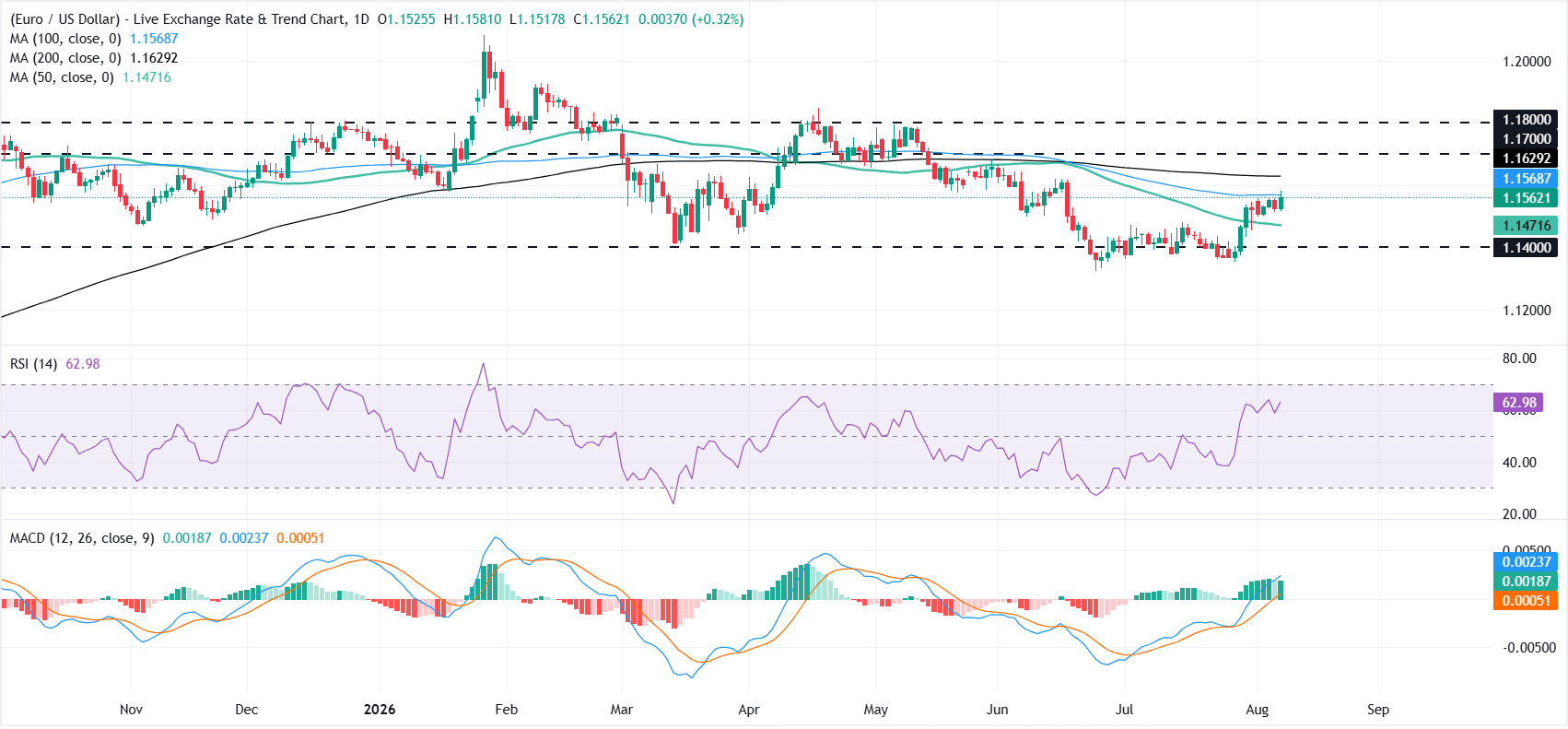
EUR/USD edges down to near 1.1530 in the opening trade on Tuesday. Price sits marginally below the 20-day Exponential Moving Average (EMA) near 1.1560, keeping the short-term tone mildly bearish as the pair struggles to reclaim that dynamic cap.
The 14-day Relative Strength Index (RSI) hovers in the mid-40s, showing negative but not extreme momentum, consistent with a market leaning lower inside a broader consolidation. A downward-sloping resistance trend line from around 1.1660 continues to limit rebounds, while the recent sequence of lower closes under that line confirms sellers retain the near-term advantage.
Initial resistance is now located at the 20-day EMA around 1.1560, with a break above exposing the descending trend-line barrier near 1.1600 and then the March 10 high at 1.1666. On the downside, the rising support trend line coming from the 1.1410 region underpins the market around 1.1470, with a daily close below that level opening the way toward 1.1410 as the next support. As long as the pair trades below 1.1600, rallies are likely to meet selling interest, keeping focus on whether the 1.1470–1.1410 support band can contain the current bearish pressure.
USD/CNH gains ground as the US Dollar advances on increased safe-haven demand linked to Middle East uncertainty.
Trump said Iran’s ceasefire proposal was “not good enough” ahead of his Hormuz Strait deadline.
The PBOC set the USD/CNY midpoint at 6.8854, higher than the 6.8773 estimate.
USD/CNH gains ground after registering modest losses in the previous session, trading around 6.8800 during the Asian hours on Tuesday. The pair appreciates as the US Dollar (USD) holds gains on increased safe-haven demand ahead of further developments on the Iran deadline by US President Donald Trump to open the Strait of Hormuz.
President Trump warned that he could target Iranian power plants and bridges unless his demands are met by 8:00 PM Eastern Time. Trump said on Monday that the latest proposal for a US ceasefire with Iran is “not good enough” ahead of his deadline for Iran to either reopen the Strait of Hormuz. “It’s not good enough, but it’s a very significant step,” Trump said, adding, “They’re negotiating now, and they’ve made a very significant step. We’ll see what happens.”
The Greenback receives support as Iran war surges energy prices, increasing fears of inflation revival and forcing the US Federal Reserve (Fed), to adopt a more hawkish stance. Traders are pricing in a delay of Fed rate cuts and could even raise borrowing costs later this year if inflationary pressures persist. Market participants are now looking ahead to the latest Federal Open Market Committee (FOMC) Meeting Minutes for clearer guidance on the central bank’s policy trajectory.
The People’s Bank of China (PBOC) set Tuesday’s USD/CNY reference rate at 6.8854, above the 6.8773 estimate, allowing the Yuan to trade within a +/-2% band around the midpoint.
Meanwhile, traders’ focus is shifting to Friday’s inflation data, with consumer prices expected to ease slightly, while producer prices are projected to post their first annual increase since 2022.
GBP/USD rises as ceasefire speculation weighs on the US Dollar.
Softer US services data added pressure on the Greenback.
Traders now await US inflation, jobless claims and Fed minutes.
The British Pound (GBP) advances by over 0.40% on Monday as US President Donald Trump said the Tuesday deadline he has set for Iran to make a deal is final, while rumors of a possible de-escalation weighed on the US Dollar (USD). GBP/USD trades around the 1.3240 figure at the time of writing.
Sterling gains as ceasefire rumors lift mood, soften Greenback
Risk appetite improved on Monday after Axios reported that US and Israeli officials, along with regional mediators, are discussing a 45-day ceasefire that could be extended if needed. Investors cheered the news, as depicted by US equities posting gains of 0.15% to 0.52%.
Data from the US showed that business activity deteriorated, according to the Institute for Supply Management (ISM), as the Services PMI in March slipped from 56.1 to 54, below economists’ forecasts of 55. The Prices Paid sub-component of the PMI rose to its highest level since October 2022, coming at 70.7, sparked by the rise of oil and fuel costs, commented Steve Miller, the Chair of the ISM’s Services Business Survey Committee.
Last week, strong US jobs data posted the largest job gains in 15 months and a dip in the Unemployment Rate. Nonfarm Payrolls rose by 178K in March, exceeding estimates of 60K. Meanwhile, the Unemployment Rate fell to 4.3% from 4.4% in February.
Consequently, expectations that the Federal Reserve (Fed) will cut rates are none, according to data from Prime Market Terminal, which reflects that the Fed funds rate will remain in the 3.50%-3.75% range, steady in 2026.
Fed interest rate probabilities
Source: Prime Market Terminal
Traders’ eyes will be on the release of US inflation figures, jobless claims, and the Federal Reserve’s last meeting minutes.
GBP/USD Price Forecast: Technical Outlook
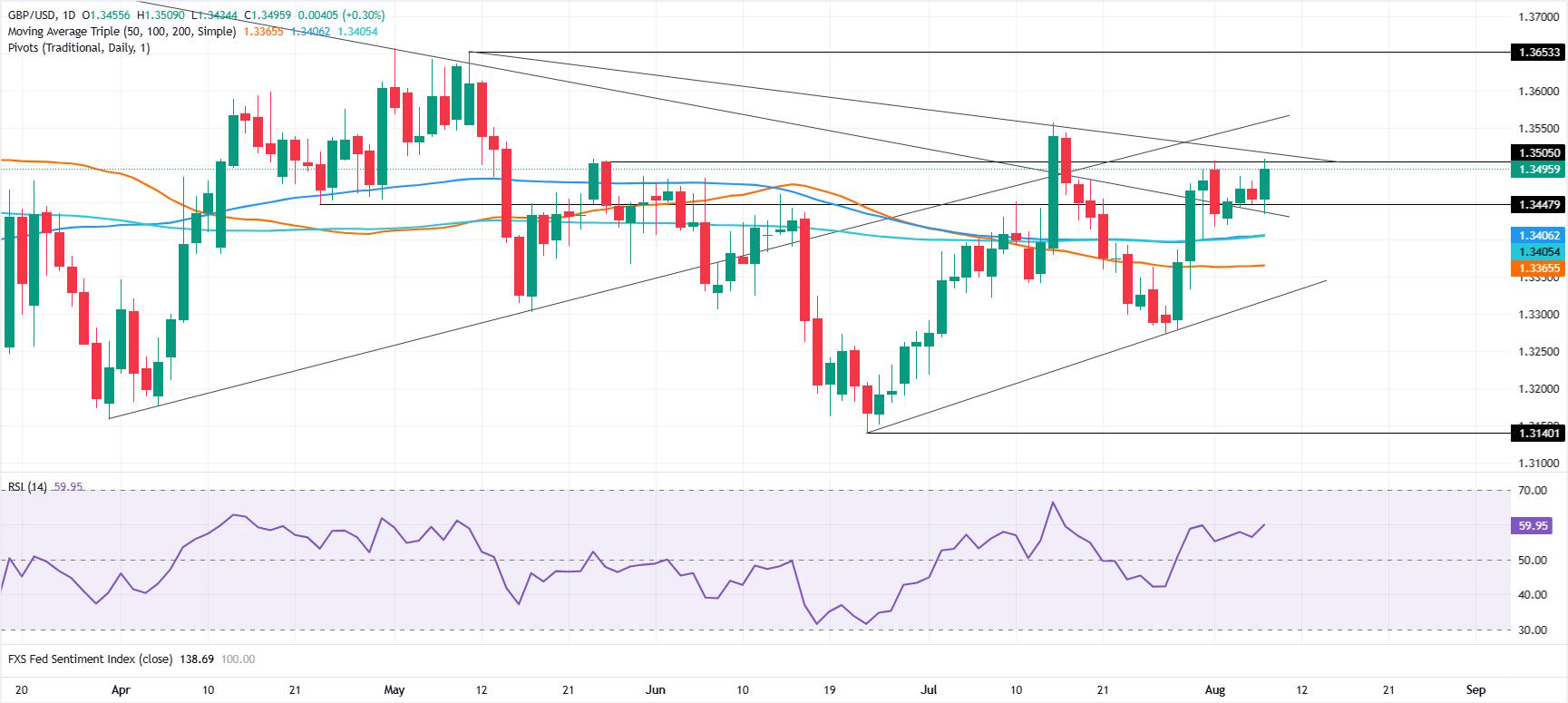
In the daily chart, GBP/USD trades at 1.3239. The near-term bias is mildly bearish as spot holds below the downward-sloping resistance trend line from 1.3869 and trades under the clustered simple moving averages near 1.3500, which now cap the upside. The persistent rejection along that descending line, combined with price pressure below the 50–100–200-day group, signals sellers retaining control, even as the longer-term rising support trend line from 1.3035 still prevents a steeper breakdown.
Initial resistance is now at 1.3320, where recent rebounds have stalled beneath the descending trend line, followed by 1.3435 and the moving-average zone around 1.35. A daily close above that 1.35 area would be needed to dilute the current bearish tone and reopen 1.3600. On the downside, immediate support is seen at 1.3187, with 1.3130 and the rising trend line from 1.3035 below; a clean break under that trend support would confirm a deeper bearish extension toward 1.3050.
(The technical analysis of this story was written with the help of an AI tool.)
Pound Sterling Price Today
The table below shows the percentage change of British Pound (GBP) against listed major currencies today. British Pound was the strongest against the US Dollar.
USD
EUR
GBP
JPY
CAD
AUD
NZD
CHF
USD
-0.23%
-0.28%
0.02%
-0.22%
-0.33%
-0.45%
-0.25%
EUR
0.23%
-0.03%
0.24%
0.00%
-0.13%
-0.25%
-0.05%
GBP
0.28%
0.03%
0.25%
0.00%
-0.09%
-0.22%
0.00%
JPY
-0.02%
-0.24%
-0.25%
-0.23%
-0.36%
-0.49%
-0.28%
CAD
0.22%
-0.00%
-0.01%
0.23%
-0.10%
-0.23%
-0.02%
AUD
0.33%
0.13%
0.09%
0.36%
0.10%
-0.14%
0.09%
NZD
0.45%
0.25%
0.22%
0.49%
0.23%
0.14%
0.23%
CHF
0.25%
0.05%
-0.01%
0.28%
0.02%
-0.09%
-0.23%
The heat map shows percentage changes of major currencies against each other. The base currency is picked from the left column, while the quote currency is picked from the top row. For example, if you pick the British Pound from the left column and move along the horizontal line to the US Dollar, the percentage change displayed in the box will represent GBP (base)/USD (quote).
USD/CAD softens as the US Dollar weakens, allowing the Canadian Dollar to snap a two-day losing streak.
Shifting geopolitical headlines around the US-Iran war keep sentiment fragile, limiting downside in the US Dollar.
Focus also on upcoming US inflation data and Canada employment figures later this week.
The Canadian Dollar (CAD) gains traction against the US Dollar (USD) on Monday as traders react to evolving geopolitical developments in the US-Iran war. At the time of writing, USD/CAD is trading around 1.1315, hovering near four-month highs.
Risk appetite improved earlier in the Asian session following reports of a potential 45-day ceasefire between the US and Iran, which is weighing modestly on the Greenback. However, the US Dollar pared some of its losses as conflicting headlines kept uncertainty elevated and limited expectations of a near-term resolution.
The US Dollar Index (DXY), which tracks the Greenback against a basket of six major currencies, is trading around 99.98 after rebounding from an intraday low near 99.76.
Iran has called for a permanent end to the war in response to the US proposal, according to IRNA, while also rejecting a ceasefire framework conveyed via Pakistan. Meanwhile, a US official cited by Axios said Iran submitted a 10-point response to the proposal, describing it as “maximalist” and noting that it remains unclear whether it would allow progress toward a diplomatic solution.
This suggests the conflict could escalate further, with a deal appearing unlikely ahead of the deadline set by US President Donald Trump, who has warned of potential strikes on power plants and other civilian infrastructure if the Strait of Hormuz is not reopened by Tuesday, 8:00 p.m. Eastern Time.
Beyond immediate geopolitical risks, the broader economic fallout from the war is also coming into focus. Rising Oil prices are adding to inflation pressure while raising concerns about global economic growth, a combination that is complicating the outlook for both the Federal Reserve (Fed) and the Bank of Canada (BoC).
On the data front, the ISM Services Purchasing Managers Index (PMI) for March came in at 54, down from 56.1 in February and below expectations of 55.
Looking ahead this week, market attention will turn to inflation data in the US, including the Consumer Price Index (CPI) for March and the Personal Consumption Expenditures (PCE) Price Index for February. In Canada, the March employment data will also be in focus.
US Dollar Price Today
The table below shows the percentage change of US Dollar (USD) against listed major currencies today. US Dollar was the strongest against the Japanese Yen.
USD
EUR
GBP
JPY
CAD
AUD
NZD
CHF
USD
-0.22%
-0.26%
0.02%
-0.23%
-0.31%
-0.43%
-0.24%
EUR
0.22%
-0.02%
0.22%
-0.01%
-0.11%
-0.23%
-0.04%
GBP
0.26%
0.02%
0.23%
-0.01%
-0.09%
-0.25%
-0.01%
JPY
-0.02%
-0.22%
-0.23%
-0.23%
-0.34%
-0.47%
-0.28%
CAD
0.23%
0.01%
0.01%
0.23%
-0.08%
-0.21%
-0.02%
AUD
0.31%
0.11%
0.09%
0.34%
0.08%
-0.14%
0.07%
NZD
0.43%
0.23%
0.25%
0.47%
0.21%
0.14%
0.22%
CHF
0.24%
0.04%
0.00%
0.28%
0.02%
-0.07%
-0.22%
The heat map shows percentage changes of major currencies against each other. The base currency is picked from the left column, while the quote currency is picked from the top row. For example, if you pick the US Dollar from the left column and move along the horizontal line to the Japanese Yen, the percentage change displayed in the box will represent USD (base)/JPY (quote).
The offshore yuan strengthened to around 6.87 per dollar on Monday, extending gains from the previous week in thin holiday trading, even as geopolitical risks remained elevated. Tensions in the Middle East continue to cloud market sentiment, with US allies such as Pakistan, Egypt, and Turkey reportedly working to broker a roughly 45-day ceasefire aimed at averting potential US strikes on Iran’s energy infrastructure and possible retaliation from Tehran.
The latest developments follow President Donald Trump’s decision to extend his deadline to Tuesday for Tehran to reopen the Strait of Hormuz. However, Iran has rejected Washington’s ultimatum, stating it will only fully reopen the waterway once war-related damages are compensated. Domestically, investors are turning their focus to upcoming inflation data due later this week. Consumer inflation is expected to ease slightly, while producer prices are projected to post its first annual increase since September 2022.
EUR/USD rises to near 1.1560 as Iran’s confirmation of receiving the US ceasefire proposal has improved the market mood.
The USD Index slides below 100.00 as its safe-haven demand diminishes.
Iran clarifies that it won’t reopen Hormuz in exchange of temporary ceasefire.
The EUR/USD pair trades 0.4% higher to near 1.1560 during the European trading session on Monday. The major currency pair strengthens as market sentiment turns favorable toward riskier assets, such as the Euro (EUR), following confirmation from Iran that it has received the United States’ (US) ceasefire proposal through Pakistan.
An improvement in investors’ risk appetite has diminished the safe-haven demand of the US Dollar (USD). During the press time, the US Dollar Index (DXY), which tracks the Greenback’s value against six major currencies, is down almost 0.4% to near 99.80. The USD Index was steady above 100.00 in the Asian trade.
US Dollar Price Today
The table below shows the percentage change of US Dollar (USD) against listed major currencies today. US Dollar was the weakest against the New Zealand Dollar.
USD
EUR
GBP
JPY
CAD
AUD
NZD
CHF
USD
-0.34%
-0.38%
-0.16%
-0.19%
-0.48%
-0.53%
-0.31%
EUR
0.34%
-0.02%
0.15%
0.16%
-0.16%
-0.18%
0.00%
GBP
0.38%
0.02%
0.17%
0.15%
-0.12%
-0.18%
0.05%
JPY
0.16%
-0.15%
-0.17%
-0.01%
-0.32%
-0.38%
-0.16%
CAD
0.19%
-0.16%
-0.15%
0.00%
-0.28%
-0.35%
-0.12%
AUD
0.48%
0.16%
0.12%
0.32%
0.28%
-0.07%
0.17%
NZD
0.53%
0.18%
0.18%
0.38%
0.35%
0.07%
0.24%
CHF
0.31%
-0.01%
-0.05%
0.16%
0.12%
-0.17%
-0.24%
The heat map shows percentage changes of major currencies against each other. The base currency is picked from the left column, while the quote currency is picked from the top row. For example, if you pick the US Dollar from the left column and move along the horizontal line to the Japanese Yen, the percentage change displayed in the box will represent USD (base)/JPY (quote).
Though Iran has acknowledged the receipt of the ceasefire proposal, it has clarified that there will be no acceptance of the proposal under pressure or deadlines. Tehran has also stated that it will not reopen the Strait of Hormuz, a passage to 20% of global oil supply, in exchange for a ‘temporary ceasefire’.
On the macro front, investors await the US ISM Services PMI data for March, which will be published at 14:00 GMT. The Services PMI is expected to arrive at 55.0, lower than the previous reading of 56.1.
This week, major highlights will be the US Federal Open Market Committee (FOMC) minutes of the March policy meeting and the Consumer Price Index (CPI) data for March, which will be released on Wednesday and Friday, respectively.
EUR/USD technical analysis
EUR/USD trades higher at around 1.1560 at the press time. The pair sits just below the 20-day Exponential Moving Average (EMA) near 1.1570, keeping a mild bearish bias in place while price remains capped beneath this dynamic barrier. A symmetrical triangle formation on the bottom level suggests that the broader trend has turned sideways, and a bullish reversal could be around the corner.
The 14-day Relative Strength Index (RSI) range shift move into the 40.00-60.00 zone from territory below 40.00 signifies cooling upside momentum, with bullish bias remaining in place.
Initial resistance emerges at the 20-day EMA around 1.1570, followed by the descending trend-line region near 1.1600, where repeated failures have formed a tight cap on the upside. A close above that zone would weaken the bearish stance and open the way toward 1.1660. On the downside, immediate support is located at the rising trend line from 1.1408, now intersecting around 1.1500, with a break there exposing the late-1.14 area as the next bearish target. A sustained move below 1.1450 would confirm a deeper downside extension within the prevailing daily downtrend towards the March low at 1.1411.
NZD/USD rebounds after retesting a four-month trough during the Asian session on Monday.
Reports of a push for a US-Iran ceasefire weigh on the USD and lend some support to spot prices.
Geopolitical risks remain in play, warranting caution before positioning for any further recovery.
The NZD/USD pair attracts some buyers near the 0.5680 region, or over a four-month trough retested during the Asian session on Monday, and for now, seems to have snapped a two-day losing streak. Spot prices currently trade just above the 0.5700 mark, up nearly 0.25% for the day, though the upside potential seems limited.
Bloomberg, citing Axios, reported that the US, Iran, and regional mediators are discussing terms for a possible 45-day ceasefire that could lead to an end of fighting. The headlines offer a temporary respite to the fragile global risk sentiment and undermine the US Dollar’s (USD) global reserve currency status, which turns out to be a key factor lending some support to the NZD/USD pair. Investors, however, remain on edge amid persistent geopolitical uncertainties.
US President Donald Trump threatened to destroy Iran’s civilian infrastructure, including power plants and bridges, if Tehran does not meet his deadline to reopen the Strait of Hormuz by Tuesday. Iran, on the other hand, outlined a new condition and said that the transit through the strategic waterway could resume if part of the revenue is allocated to compensate Iran for war-related damages. Moreover, chances of a deal over the next 48 hours remain low.
Meanwhile, investors remain worried that the war-driven surge in energy prices would rekindle inflationary pressures and force major central banks, including the US Federal Reserve (Fed), to adopt a more hawkish stance. In fact, traders are now pricing in a greater probability that the Fed will raise borrowing costs in 2026, which could act as a tailwind for the USD. This might cap the upside for the NZD/USD pair and warrants some caution for bullish traders.
Traders now look forward to the release of the US ISM Services PMI for some impetus later during the North American session amid thin liquidity on the back of the Easter Monday Holiday in many global financial markets. Nevertheless, the fundamental backdrop makes it prudent to wait for some follow-through buying before confirming that the NZD/USD pair has formed a near-term bottom and positioning for any further appreciating move.
To provide the best experiences, we use technologies like cookies to store and/or access device information. Consenting to these technologies will allow us to process data such as browsing behavior or unique IDs on this site. Not consenting or withdrawing consent, may adversely affect certain features and functions.
Functional
Always active
The technical storage or access is strictly necessary for the legitimate purpose of enabling the use of a specific service explicitly requested by the subscriber or user, or for the sole purpose of carrying out the transmission of a communication over an electronic communications network.
Preferences
The technical storage or access is necessary for the legitimate purpose of storing preferences that are not requested by the subscriber or user.
Statistics
The technical storage or access that is used exclusively for statistical purposes.The technical storage or access that is used exclusively for anonymous statistical purposes. Without a subpoena, voluntary compliance on the part of your Internet Service Provider, or additional records from a third party, information stored or retrieved for this purpose alone cannot usually be used to identify you.
Marketing
The technical storage or access is required to create user profiles to send advertising, or to track the user on a website or across several websites for similar marketing purposes.